
 0
 EN
 English
 عربى
 Español
 русский
If you need any help, please feel free to contact us
Home / Author / Cai Shurong — After-Sales Project Coordinator / Temperature and Pressure Compensated Swirl Flowmeters for Accurate Steam and Gas Measurement
Temperature and Pressure Compensated Swirl Flowmeters for Accurate Steam and Gas Measurement
Introduction
Industrial facilities increasingly require flow measurement systems that do more than display the volume of a moving fluid. In steam, compressed air, nitrogen, natural gas, and other gases, the measured operating volume can change significantly as temperature and pressure fluctuate. A reading that appears stable in actual cubic meters per hour may not represent a stable mass flow or standardized volume flow. For process control, energy management, production accounting, and billing, this difference can lead to significant errors.
The SA80T-TP Series Temperature/Pressure Compensation Swirl Flowmeter is designed for these demanding measurement conditions. It combines the operating principle of a swirl flowmeter with integrated temperature and pressure measurement. The converter uses these process inputs to calculate fluid density in real time and provide compensated flow values, including mass flow and standard volume flow, in addition to operating volumetric flow.
This design is especially valuable in steam and gas networks. Saturated steam, superheated steam, compressed air, nitrogen, natural gas, and process gases can all experience changes in density as operating conditions vary. By continuously considering temperature and pressure, the SA80T-TP supports more reliable measurement than a conventional flowmeter that assumes constant process conditions.
The product is manufactured and supported by Jiangsu Vner Electronic Technology Co., Ltd., an industrial flow measurement specialist based in Yangzhou, China. The company develops electromagnetic, Coriolis, vortex, swirl, turbine, thermal mass, ultrasonic, and metal tube rotameter solutions for liquid, gas, and slurry applications. Its engineering resources, calibration capabilities, manufacturing infrastructure, and project experience support the development of flow instruments for demanding industrial environments.
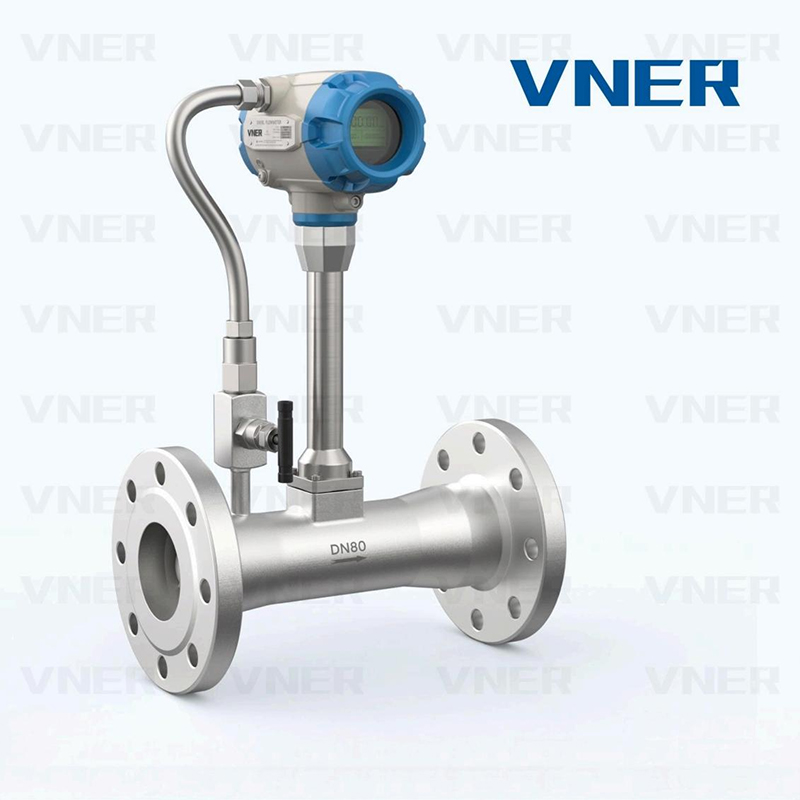
SA80T-TP Series Temperature/Pressure Compensation Swirl Flowmeter-副本
What Is a Temperature and Pressure Compensated Swirl Flowmeter?
A swirl flowmeter measures flow by introducing a controlled rotational motion into the process fluid. A specially shaped swirl generator causes the fluid to rotate as it passes through the meter body. Downstream of the generator, the rotating flow forms a stable swirling pattern. The sensor detects the characteristic frequency or movement associated with this swirl, and the converter translates the signal into flow rate.
Under stable process conditions, the relationship between swirl frequency and volumetric flow is predictable. This allows the instrument to provide operating volumetric flow without requiring a separate moving mechanical element. The absence of an impeller or turbine rotor can reduce mechanical wear and help the meter operate reliably in clean gases, steam, and other suitable process media.
The SA80T-TP extends this measurement concept by adding process temperature and pressure inputs. These measurements are used to determine the current density of the medium according to configured fluid parameters and standard thermodynamic correlations. The converter can then calculate a compensated value that is more meaningful for the application.
For example, a compressed air line may operate at different pressures during production shifts. If the flowmeter reports only actual volume, the displayed value may change because the air density changes, even when the mass supplied to the production equipment is similar. A compensated output expressed in standard cubic meters per hour can provide a more consistent basis for energy analysis and production comparison.
Steam applications present a similar challenge. Steam density depends strongly on pressure and temperature. A measured operating volume does not directly indicate the actual quantity of steam delivered. With temperature and pressure compensation, the meter can calculate mass flow, such as kilograms per hour or tonnes per hour, which is more appropriate for boiler monitoring, steam allocation, and thermal energy management.
Core Measurement Advantages
Real-Time Density Compensation
The central advantage of the SA80T-TP is its ability to respond to process changes. A standard flowmeter may be configured for a nominal pressure and temperature, but that fixed assumption can create errors when the process moves away from the design point. The TP version continuously receives temperature and pressure information and updates the density calculation during operation.
This makes the instrument suitable for systems where load conditions vary, production demand changes, or pressure control is not perfectly constant. The converter can use the measured conditions to produce a compensated mass or standard volume flow rather than relying solely on the raw operating volume.
Mass Flow Output for Steam and Gas
Mass flow is often the most useful engineering value for steam and gas systems. It is directly related to material balance, energy consumption, boiler output, gas usage, and product allocation. By calculating mass flow from measured volume, temperature, pressure, and configured medium parameters, the SA80T-TP can support more effective process monitoring.
In a boiler house, for instance, tonnes per hour of steam can be compared with fuel consumption and production demand. In a natural gas system, mass-based data can support fuel accounting and process balancing. In compressed air networks, compensated flow can help users identify abnormal consumption, leakage, and demand peaks.
Standard Volume Flow Output
Many gas measurement systems use standardized volume units, such as normal cubic meters per hour. These units allow gas consumption to be compared under a defined reference condition instead of under constantly changing operating conditions.
The SA80T-TP can provide standard volume flow output when the application is configured with the required reference conditions and medium parameters. This function is useful for plant-wide gas allocation, compressed air energy management, nitrogen distribution, and utility billing. It also simplifies comparisons between different production lines operating at different pressures.
Operating Volumetric Flow Output
Although compensated values are essential for many applications, operating volumetric flow remains useful. It represents the volume of fluid moving through the pipeline under actual process conditions. The availability of operating volume, mass flow, and standard volume flow gives users a broader view of process behavior.
Operators can use operating volume for equipment loading and line capacity analysis, mass flow for material balance, and standard volume for utility consumption comparisons. Providing several flow representations from one instrument can reduce the need for separate calculation systems or independent measuring devices.
Suitable for Changing Process Conditions
Industrial flow systems rarely operate at one fixed point throughout the year. Steam demand changes with production schedules, gas pressure may vary between day and night, and compressed air systems can experience sudden demand from pneumatic equipment. A measurement instrument that remains dependent on one assumed density may become less reliable as conditions change.
The temperature and pressure compensation function helps the meter follow these variations. It does not eliminate the need for correct installation, appropriate sizing, accurate sensor configuration, or suitable thermodynamic parameters. However, it provides a more robust measurement foundation than an uncompensated volumetric reading when density changes are an important part of the application.
How the SA80T-TP Works in Industrial Systems
Swirl Generation and Signal Detection
The measurement process begins when the fluid enters the meter body and passes through the swirl generator. The generator creates a controlled rotational flow field. The resulting swirl has a characteristic behavior related to the fluid velocity and flow rate.
The sensor detects the flow-related signal without requiring a continuously rotating mechanical shaft. The converter processes the sensor signal and determines the basic operating flow. This arrangement can be advantageous in applications where users prefer a solid-state sensing method with limited mechanical movement inside the measuring tube.
Correct flow profile development is important for swirl measurement. Pipeline layout, upstream and downstream straight lengths, valves, reducers, elbows, and disturbances should be considered during selection and installation. Engineering-based sizing and application review help ensure that the meter operates within a suitable velocity and Reynolds number range.
Temperature Measurement
The integrated temperature measurement provides a real-time indication of the process temperature near the flow measurement point. Temperature is particularly important in steam and gas applications because it directly affects density and, in some cases, the physical state of the medium.
For saturated steam, temperature and pressure are closely related under equilibrium conditions. Comparing the measured values can also help identify unusual operating conditions, such as wet steam, superheating, or sensor installation issues. For superheated steam, both temperature and pressure are needed to calculate density more accurately across the operating range.
Pressure Measurement
Pressure measurement completes the compensation process. Gas density changes substantially as absolute pressure changes. The converter therefore needs an appropriate pressure input and properly configured pressure basis for meaningful compensation.
Pressure measurement should be taken at a representative location and installed with attention to vibration, pulsation, condensation, and temperature exposure. The pressure connection and sensor arrangement must be selected for the medium and operating conditions. In high-temperature steam service, suitable installation practices are especially important to protect the pressure sensing system and maintain stable readings.
Converter Calculation
The converter combines the basic flow signal with the temperature and pressure inputs. It then applies configured medium properties and standard thermodynamic relationships to calculate the required output. Depending on the application, the result may be displayed or transmitted as operating volume, mass flow, or standard volume flow.
The quality of the final result depends on the accuracy and stability of all measurement inputs. It also depends on correct configuration of the medium, reference conditions, pressure units, temperature units, and output scaling. For this reason, product selection should be treated as an engineering task rather than a simple instrument purchase.
| Measurement function | Primary purpose | Typical application value |
|---|---|---|
| Operating volumetric flow | Shows actual volume under process conditions | Pipeline loading, local process monitoring, capacity review |
| Temperature measurement | Provides a density calculation input | Steam condition monitoring and gas compensation |
| Pressure measurement | Provides a second density calculation input | Compressed gas, natural gas, and steam measurement |
| Mass flow | Expresses the quantity of medium by mass | Steam balance, fuel accounting, dosing, and production control |
| Standard volume flow | Converts gas volume to a reference condition | Gas allocation, compressed air analysis, and utility billing |
Advantages Compared with Conventional Flow Measurement Methods
Compared with Uncompensated Vortex or Swirl Meters
A conventional vortex or swirl flowmeter can provide dependable operating volume when process density remains relatively stable. However, the reading may not accurately represent mass flow when temperature and pressure fluctuate. Users must then add external pressure and temperature instruments, a separate flow computer, or manual correction calculations.
The SA80T-TP integrates these measurement functions into one compensated flowmeter. This can reduce the number of separate devices, simplify system architecture, and provide a more direct relationship between the measured flow and the value needed by the process. It also reduces the risk of mismatched sampling points or inconsistent data from separate instruments.
Compared with Mechanical Turbine Flowmeters
Turbine flowmeters use a rotating rotor whose speed is related to fluid velocity. They can be effective in clean liquids and gases, but the rotor and bearings are mechanical components that may be affected by wear, contamination, lubrication conditions, or changes in fluid properties.
A swirl flowmeter does not depend on a continuously rotating turbine rotor. This can reduce mechanical maintenance concerns in suitable steam and gas applications. The device is also better aligned with applications where the user wants compensated gas or steam flow without introducing a fragile moving assembly into the pipeline.
Each technology has its own application range, and a turbine meter may remain appropriate for certain clean liquid services or specialized gas duties. The advantage of the SA80T-TP is its combination of swirl measurement, integrated compensation, and suitability for variable-density steam and gas service.
Compared with Differential Pressure Flowmeters
Differential pressure flowmeters are widely used and can measure many process fluids. However, they normally require a primary element, pressure sensing system, impulse lines, and a flow calculation method. In steam and gas applications, density compensation is often necessary, and impulse lines may require heat tracing, condensate management, or regular inspection.
The SA80T-TP provides a more integrated instrument arrangement. It does not remove all installation requirements, but it can reduce the complexity associated with separate primary elements and external compensation hardware. Lower permanent pressure loss may also be possible compared with some restrictive primary devices, depending on the selected meter size and process design.
Compared with Thermal Mass Flowmeters
Thermal mass flowmeters measure the effect of a flowing gas on a heated sensor. They can provide direct mass-based gas measurement and are often useful for clean, relatively stable gas applications. Their performance can be influenced by gas composition, humidity, contamination, sensor coating, and changes in the mixture from the calibration condition.
The SA80T-TP calculates compensated flow using measured operating conditions and configured process parameters. For steam, compressed air, and known industrial gases, this approach can offer a practical balance between measurement capability and application flexibility. For mixed or changing gas compositions, accurate medium configuration remains essential regardless of the selected technology.
Compared with Coriolis Mass Flowmeters
Coriolis meters directly measure mass flow and can also provide density information. They are highly capable instruments, particularly for liquids, slurries, and demanding mass-based measurement applications. However, they may involve higher purchase cost, greater weight, larger installation requirements, or more complex sizing for large steam and gas pipelines.
The SA80T-TP offers a different value proposition. It uses a flow measurement principle suited to steam and gas lines and adds temperature and pressure compensation to calculate mass or standard volume flow. For utility networks, boiler headers, compressed air systems, and process gas pipelines, this approach may provide a more economical and practical alternative when direct Coriolis measurement is not required.
Application Areas
Power Generation and Boiler Systems
Boiler and power generation facilities need reliable information about steam production, distribution, and consumption. The SA80T-TP can monitor saturated or superheated steam at boiler outlets, branch lines, turbine-related systems, and plant utility headers.
Mass flow data can be compared with fuel input, boiler efficiency, steam pressure, and production demand. This supports combustion optimization, thermal efficiency analysis, and identification of abnormal steam losses. In distributed steam networks, compensated measurement also provides a fairer basis for allocating steam consumption among production areas.
The meter may also be considered for cooling water circulation and heat exchanger services when the selected model and installation conditions are appropriate. Liquid applications require separate evaluation of conductivity, flow range, pressure loss, materials, and the suitability of the swirl measurement principle.
Chemical and Petrochemical Plants
Chemical plants use compressed air, nitrogen, natural gas, process vapor, and other gases throughout production. These media often move through networks with changing pressure and demand. Compensated measurement can improve the visibility of actual consumption and support process balance calculations.
In reactors, accurate gas input is important for stoichiometric control. Hydrogen, oxygen, nitrogen, and other process gases may need to be supplied at controlled rates. A compensated output can help operators distinguish a real change in material delivery from a change caused only by pressure or temperature variation.
In petrochemical utilities, gas meters may be used for furnace fuel monitoring, process gas distribution, flare-related analysis, and compressed air management. The final selection must consider gas composition, hazardous-area requirements, line size, pressure, temperature, and the required communication or control system interface.
Oil and Gas Operations
Steam injection for enhanced oil recovery requires dependable monitoring of steam quantity and condition. The difference between operating volume and mass flow can be significant in high-temperature, high-pressure steam service. Temperature and pressure compensation helps produce a more useful representation of the steam delivered to the injection system.
Fuel gas measurement for process heaters and furnaces is another important application. Standardized gas flow can support fuel consumption comparisons and operational cost analysis. In all oil and gas applications, users should review material compatibility, pressure rating, environmental conditions, area classification, and maintenance access before ordering.
Pharmaceutical Manufacturing
Pharmaceutical facilities use clean steam for sterilization and steam-in-place operations. They may also monitor purified water and water for injection utilities. For clean steam, the meter selection must consider hygienic design expectations, materials, surface requirements, drainage, installation orientation, and validation procedures.
The compensated version is most valuable where steam mass flow or energy usage must be tracked under varying conditions. For purified water and water for injection, the measurement principle and product configuration must be reviewed carefully to ensure that all wetted materials and hygienic requirements are suitable for the application.
Food and Beverage Processing
Food and beverage plants consume steam, carbon dioxide, compressed air, chilled water, hot water, and cleaning solutions. Carbon dioxide dosing in beverage lines can benefit from standardized gas measurement, while steam monitoring can support cooking, sterilization, and thermal process control.
Cleaning-in-place and sterilization-in-place systems may also require accurate utility measurement. The SA80T-TP can be considered for temperature- and pressure-variable steam or gas services, while liquid services should be assessed according to the specific medium, cleanliness requirements, and process conditions.
Pulp and Paper Manufacturing
Pulp and paper plants use large quantities of steam for drying and process heating. They also handle black liquor, white liquor, process water, compressed air, and various chemical solutions. Steam measurement at dryer sections and utility headers can help improve energy balance and identify inefficient operation.
Liquor measurement requires special attention to solids content, viscosity, temperature, corrosiveness, and potential coating or plugging. The product family includes several flow technologies, allowing the manufacturer to recommend a more suitable instrument when a swirl meter is not the best choice for a particular liquid duty.
Textile and Dyeing Facilities
Textile plants use process water, dye liquors, steam, compressed air, and thermal media. Flow conditions may be stable in some systems and pulsating in others. Accurate flow regulation helps control color consistency, heating performance, washing cycles, and overall material consumption.
The SA80T-TP is most relevant to steam, compressed gas, and other suitable services where density changes affect measurement. For dye liquors and process liquids, the selection should be based on conductivity, solids, viscosity, temperature, and chemical compatibility.
Steel and Metallurgy
Steel plants require cooling water for continuous casting, rolling, furnaces, and auxiliary equipment. They also use argon, nitrogen, oxygen, natural gas, and other gases in furnaces and metallurgical processes. Gas compensation is valuable where pressure and temperature vary across the distribution system.
Industrial environments in metallurgy can involve vibration, dust, heat, electrical noise, and demanding maintenance conditions. A suitable instrument must therefore be selected with attention to enclosure protection, sensor installation, cable routing, grounding, process connections, and access for inspection.
Engineering Selection and Installation
Process Data Collection
Accurate selection begins with complete process information. Users should provide the medium name, composition, minimum and maximum flow, normal flow, operating pressure, design pressure, operating temperature, design temperature, line size, pipe material, and required output units.
For gases, the molecular composition or specific gas type is important. For steam, the user should identify whether the service is saturated or superheated and provide the expected pressure and temperature range. For compressed air, humidity and reference conditions may affect the required calculation basis.
Meter Sizing
Oversizing can reduce measurement sensitivity at normal flow, while undersizing can create excessive velocity, pressure loss, noise, or range limitations. The selected size should cover the normal operating point while remaining within the recommended minimum and maximum flow range.
Engineering sizing should also consider start-up flow, shutdown conditions, intermittent operation, pressure fluctuations, and future production expansion. A meter that is selected only for the current maximum flow may not perform well when the plant spends most of its time at a much lower rate.
Pipeline Layout
Swirl flowmeters require a developed and reasonably stable flow profile. Elbows, tees, valves, reducers, pumps, compressors, and other disturbances should be evaluated. Upstream and downstream straight-run requirements depend on the meter design and installation arrangement.
The pipeline should be supported so that vibration and mechanical stress are not transferred to the meter body. Flanges, gaskets, bolts, and reducers should be correctly matched. The internal pipe diameter should be considered during sizing because abrupt steps or misalignment can disturb the measurement signal.
Steam Installation
Steam lines require careful management of condensate. Poor drainage can produce wet steam, two-phase flow, water hammer, and unstable readings. Drip legs, separators, traps, insulation, and correct pipeline slope may be necessary depending on the system design.
The temperature and pressure sensors must be installed in locations that represent the actual steam condition. Excessive heat exposure to the converter should be avoided. Where a remote installation is required, the mounting arrangement and cable design should be selected for the ambient temperature and maintenance environment.
Gas Installation
Gas lines should be protected from liquid carryover, condensation, dust, and excessive pulsation. Filters, separators, or upstream conditioning may be necessary depending on the medium. Changes in gas composition should be reviewed because density calculations depend on configured process properties.
For compressed air networks, installation near a receiver, compressor discharge, or a rapidly cycling valve may require additional consideration. Flow pulsation can affect signal quality and should be evaluated during system design.
Electrical and Communication Planning
The converter should be connected according to the selected power supply, signal output, grounding arrangement, and control system requirements. Users may require analog outputs, pulse or frequency signals, alarm functions, or digital communication depending on the plant automation architecture.
Shielding, grounding, cable separation, and protection against electromagnetic interference are important in large industrial facilities. The wiring design should also consider hazardous-area requirements where applicable. Final electrical details should be confirmed against the product documentation and project specifications.
Manufacturing Strengths and Quality Approach
Specialized Flow Measurement Experience
Jiangsu Vner Electronic Technology Co., Ltd. has focused on industrial flow measurement since 2011. Its product range includes electromagnetic, Coriolis, vortex, swirl, turbine, thermal mass, ultrasonic, and metal tube rotameter instruments.
This broad technology portfolio is valuable because industrial applications do not all require the same measurement principle. A manufacturer that understands multiple technologies can compare alternatives and recommend a solution based on the medium, flow range, pressure, temperature, conductivity, viscosity, installation conditions, and accuracy requirements.
Modern Manufacturing Facilities
The company operates modern facilities covering approximately 23,000 square meters across three plants. This manufacturing base supports production organization, assembly, testing, inventory management, and engineering activities for different flowmeter families.
A multi-plant structure can also support specialization of manufacturing operations. Product assembly, electronics work, calibration, inspection, and preparation for delivery can be organized according to process requirements. Effective production control is particularly important for compensated flowmeters because the final product combines mechanical flow measurement, electronic signal processing, temperature input, pressure input, and software-based calculation.
Technical Team and Engineering Resources
With more than 150 technical personnel, the company has resources for product development, application engineering, production support, calibration, and project service. The technical team can help users address questions about flow range, meter sizing, installation conditions, process compensation, and technology selection.
Engineering support is especially important for steam and gas applications. A meter cannot achieve reliable compensated output if the medium parameters, reference conditions, pressure basis, or installation environment are incorrectly specified. Application review before production helps reduce the risk of selecting an unsuitable configuration.
Calibration and Quality Control
In-house calibration supports consistent product verification before shipment. Calibration and inspection procedures can confirm the relationship between the sensor signal and the expected flow response. They also provide a basis for traceability and product documentation.
Quality control should cover incoming materials, mechanical dimensions, sensor assembly, electronic modules, enclosure integrity, signal processing, display performance, output functions, and final inspection. For the SA80T-TP, temperature and pressure input verification is also important because the compensation result depends on these measurement channels.
Automated and Repeatable Production
Increasing automation in manufacturing can improve repeatability and reduce variation in assembly processes. Automated or controlled production steps help maintain consistent product quality, particularly when multiple units must be delivered for a large industrial project.
Repeatability is important to EPC contractors and plant operators. Instruments installed across different process areas should have consistent configuration, documentation, output behavior, and service procedures. Manufacturing discipline helps support this consistency beyond the performance of an individual meter.
Project and Export Experience
The company has delivered more than 2,000 engineering projects in over 30 countries. This project experience exposes the manufacturer to different process industries, climate conditions, standards, documentation requirements, and customer expectations.
Experience with EPC contractors, end users, and OEM partners also supports flexible project cooperation. The manufacturer can participate in product selection, technical clarification, drawing and document preparation, production scheduling, inspection coordination, and after-sales communication according to project needs.
Operational Benefits for Plant Owners
Improved Energy Accounting
Steam and compressed gas are often among the largest utility costs in an industrial plant. Uncompensated readings can make it difficult to compare consumption between departments or determine whether an efficiency project has delivered real savings.
Mass flow and standard volume flow provide a stronger basis for energy accounting. Operators can compare production output with steam consumption, compressed air use, or fuel gas demand. Abnormal changes may indicate leakage, insulation failure, equipment degradation, or incorrect operating conditions.
Better Closed-Loop Control
Flow controllers depend on reliable process feedback. If density changes but the flow signal does not account for those changes, a control loop may deliver too much or too little material. Temperature and pressure compensation reduces this source of deviation in suitable steam and gas control applications.
Examples include steam valve control, burner fuel regulation, gas mixing, reactor feed control, and compressed air distribution. The compensated signal can help the control system respond to the actual quantity of material being delivered rather than only to its changing operating volume.
Simplified System Architecture
Integrating flow, temperature, and pressure measurement into one instrument can simplify the overall system. It may reduce the number of separate devices, cable runs, mounting locations, and calculation modules required for a basic compensated measurement point.
A simplified architecture can also make commissioning and maintenance more manageable. Operators can review several related measurement values at one location and reduce the possibility of errors caused by different instruments using different sampling times or reference conditions.
Reduced Maintenance Burden
The swirl measurement principle does not rely on a continuously rotating mechanical rotor. In suitable applications, this can reduce maintenance associated with bearings, shafts, and mechanical wear. The instrument still requires periodic inspection and verification, but the maintenance approach can be simpler than that of some mechanical flow technologies.
Maintenance requirements depend on the medium, installation quality, vibration, contamination, thermal cycling, and process severity. Regular review of sensor outputs, pressure connections, wiring, grounding, and process conditions remains important for long-term reliability.
Recommended Commissioning Procedure
Before commissioning, confirm that the meter size, body material, pressure rating, process connections, temperature range, and pressure range match the installation. Verify that the pipeline is clean and free from construction debris, welding slag, or sealing material that could interfere with the flow path or sensors.
Check the flow direction and ensure that the meter has been installed according to the required orientation. Confirm that upstream and downstream piping provides an appropriate flow profile and that the pipeline is adequately supported.
Verify the temperature and pressure sensor connections. Confirm the pressure unit, temperature unit, reference conditions, medium parameters, and output scaling in the converter. For standard volume flow, make sure the selected reference temperature and pressure are consistent with the plant's measurement policy.
After energizing the instrument, allow the system to stabilize where necessary. Compare the local display with the control system signal and confirm that analog, pulse, alarm, and communication outputs operate as expected. Where possible, compare the reading with a reference instrument or a known process balance.
Record the initial configuration, calibration information, process conditions, and commissioning results. Maintaining this information supports future troubleshooting and helps identify whether a later change is caused by the instrument, the process, or the installation.
Limitations and Application Considerations
No flowmeter is suitable for every application. The SA80T-TP is intended to provide compensated measurement within the limits of its sensors, configured process parameters, installation conditions, and applicable flow range. It should not be treated as a universal replacement for every liquid, gas, steam, or slurry instrument.
Two-phase flow, severe pulsation, heavy contamination, unstable gas composition, condensation, and poorly developed flow profiles can affect performance. Users should provide complete process data so the manufacturer can assess whether the swirl principle and compensated calculation are suitable.
Density calculation accuracy depends on the quality of the temperature and pressure measurements and on the correctness of the configured medium properties. If the gas composition changes substantially, the calculation model may need to be reviewed. For steam, the distinction between saturated and superheated conditions is important.
For safety-critical, custody-transfer, or regulatory applications, users should confirm the applicable accuracy, certification, testing, and documentation requirements before purchase. Project specifications may require additional inspection, calibration documentation, material certificates, communication protocols, or hazardous-area approvals.
Why Choose an Engineering-Oriented Manufacturer?
Buying a flowmeter is not only a matter of selecting a nominal diameter and output signal. The instrument must be matched to the physical behavior of the medium, the operating range, the pipeline configuration, the automation system, and the maintenance capabilities of the plant.
An engineering-oriented manufacturer can assist before the order is placed, during production, at commissioning, and throughout the service life of the product. This approach is particularly useful for compensated steam and gas measurement because several parameters must work together to produce a meaningful result.
The manufacturer’s multi-technology portfolio allows it to compare swirl, vortex, Coriolis, electromagnetic, turbine, thermal mass, ultrasonic, and rotameter solutions. Its project experience in oil and gas, petrochemical, power, polysilicon, water and wastewater, and other industrial sectors provides practical knowledge for different process environments.
In-house calibration, controlled manufacturing, technical personnel, traceability, and application-based sizing contribute to a more dependable supply process. These strengths can be valuable for standard instrument orders as well as OEM programs, packaged systems, and large EPC projects.
Frequently Asked Questions
What does the TP designation mean?
TP refers to temperature and pressure compensation. The instrument includes temperature and pressure measurement inputs and uses them with the flow signal to calculate compensated mass flow or standard volume flow.
Can the SA80T-TP measure both steam and gas?
It is designed for suitable steam and gas applications, including saturated or superheated steam, compressed air, nitrogen, natural gas, and other configured process gases. Final suitability depends on pressure, temperature, composition, flow range, installation, and material requirements.
What is the difference between operating volume and standard volume?
Operating volume is the volume measured under actual process conditions. Standard volume is gas volume converted to a defined reference temperature and pressure. Standardized values are useful for comparing gas consumption when operating conditions change.
Why is mass flow important for steam?
Steam density varies with pressure and temperature. Mass flow expresses the actual quantity of steam being delivered and is therefore useful for boiler efficiency, energy balance, steam allocation, process control, and cost analysis.
Does compensation eliminate the need for correct installation?
No. Compensation improves the calculation of density-related flow values, but the meter still requires correct sizing, suitable straight-run conditions, proper sensor installation, stable electrical connections, and accurate process configuration.
Is the product suitable for changing gas pressure?
Yes, variable gas pressure is one of the situations where temperature and pressure compensation provides significant value. The pressure sensor must be correctly installed and configured, and the gas composition should remain within the assumptions used by the calculation.
Can the meter provide only mass flow?
The instrument can provide mass flow as required, but operating volumetric flow and standard volume flow may also be available depending on the selected configuration and application requirements.
How should a meter be selected for a steam line?
Provide the steam type, minimum, normal, and maximum flow, operating and design pressure, operating and design temperature, line size, connection requirements, output signals, and installation information. These details allow the manufacturer to evaluate sizing and compensation requirements.
Can the same technology be used for liquid applications?
Swirl flowmeters may be suitable for certain liquids, but the application must be reviewed according to conductivity, viscosity, solids content, temperature, pressure, and flow range. The manufacturer also offers other technologies that may be more appropriate for specific liquid services.
What manufacturing support is available?
Support can include application review, flowmeter sizing, technical clarification, configuration assistance, calibration, quality documentation, project coordination, and after-sales communication. The exact scope should be confirmed according to the project requirements.
What information should be included in an inquiry?
An inquiry should include the medium, composition, flow range, pressure, temperature, line size, pipe material, process connection, required accuracy, output signal, power supply, installation environment, and any certification or documentation requirements.
Conclusion
The SA80T-TP Series Temperature/Pressure Compensation Swirl Flowmeter addresses a common weakness in industrial steam and gas measurement: the difference between actual operating volume and the quantity that the process really needs to control or account for.
By combining swirl flow measurement with integrated temperature and pressure inputs, the instrument can calculate density-related values in real time and provide mass flow, standard volume flow, and operating volumetric flow. This supports more accurate energy management, process control, utility allocation, gas monitoring, and production analysis.
Compared with uncompensated flowmeters, it offers a more complete measurement solution for changing process conditions. Compared with mechanical turbine meters, it avoids dependence on a continuously rotating rotor. Compared with more complex external compensation arrangements, it integrates key measurement functions into one instrument. Compared with larger or more expensive direct mass technologies, it can provide a practical alternative for many steam and gas networks.
Its performance depends on appropriate engineering selection and installation. Correct medium configuration, suitable meter sizing, reliable temperature and pressure measurement, stable flow conditions, and proper commissioning are essential. Supported by specialized flow measurement experience, multiple manufacturing facilities, in-house calibration, technical resources, and international project experience, the manufacturer is positioned to provide more than a standalone instrument.
For industrial users seeking dependable measurement of saturated steam, superheated steam, compressed air, nitrogen, natural gas, and other suitable gases, a temperature and pressure compensated swirl flowmeter can provide an effective balance of functionality, integration, maintainability, and application value.
References
1. International Organization for Standardization. Measurement of Fluid Flow in Closed Conduits: General Principles and Requirements.
2. International Organization for Standardization. Measurement of Fluid Flow by Means of Pressure Differential Devices.
3. International Organization for Standardization. Measurement of Gas Flow in Closed Conduits.
4. International Association for the Properties of Water and Steam. Industrial Formulations and Thermodynamic Properties of Water and Steam.
5. American Society of Mechanical Engineers. Performance Test Codes for Measurement of Industrial Fluid Flow.
6. International Society of Automation. Industrial Process Measurement and Control Practices.
7. Manufacturer technical documentation for temperature and pressure compensated swirl flow measurement systems.
8. Industrial energy management guidance for steam, compressed air, and process gas networks.
Product: SA80T-TP Series Temperature/Pressure Compensation Swirl Flowmeter-副本



Products
Contact Information
-

+86 18652789521
+86-0514-83633600 / 83633900 -

+86-0514-83633600 / 83633900
-

s@vner.com.cn
katherine@vner.com.cn -

No. 11 Xingye Road, Chenji Town Industrial Park, Yizheng, Yangzhou, China
