
 0
 EN
 English
 عربى
 Español
 русский
If you need any help, please feel free to contact us
Home / Author / Ren Xiaotong — Technical Sales Engineer for Gas Flow Meters / How U-Shaped Coriolis Mass Flowmeters Improve Industrial Measurement
How U-Shaped Coriolis Mass Flowmeters Improve Industrial Measurement
Accurate flow measurement is central to modern process control, energy management, product quality, and commercial transfer. In many industrial systems, measuring only volumetric flow is no longer sufficient. Changes in temperature, pressure, density, viscosity, and composition can cause the actual mass transferred through a pipeline to differ significantly from the apparent volume. A mass flowmeter can address this problem by measuring the quantity of material directly in mass units while also providing valuable information about density and process temperature.
The KSMF-U Series Coriolis Mass Flowmeter is designed for demanding liquid, gas, and liquefied-gas applications where measurement stability, high accuracy, wide turndown, and strong process adaptability are required. Its U-shaped dual-tube construction uses the Coriolis effect and controlled mechanical vibration to measure mass flow directly. The same measuring system can also determine fluid density and process temperature, while the transmitter can calculate volume and standard volume where required.
With nominal sizes from DN20 to DN300 and a series flow capacity reaching up to 2,040,000 kg/h, the KSMF-U platform extends Coriolis measurement into applications that traditionally relied on large mechanical meters, turbine meters, differential-pressure devices, or combinations of flow, pressure, and temperature instruments. It is suited to process plants, transfer skids, loading systems, chemical dosing units, high-pressure gas services, and large industrial pipelines.
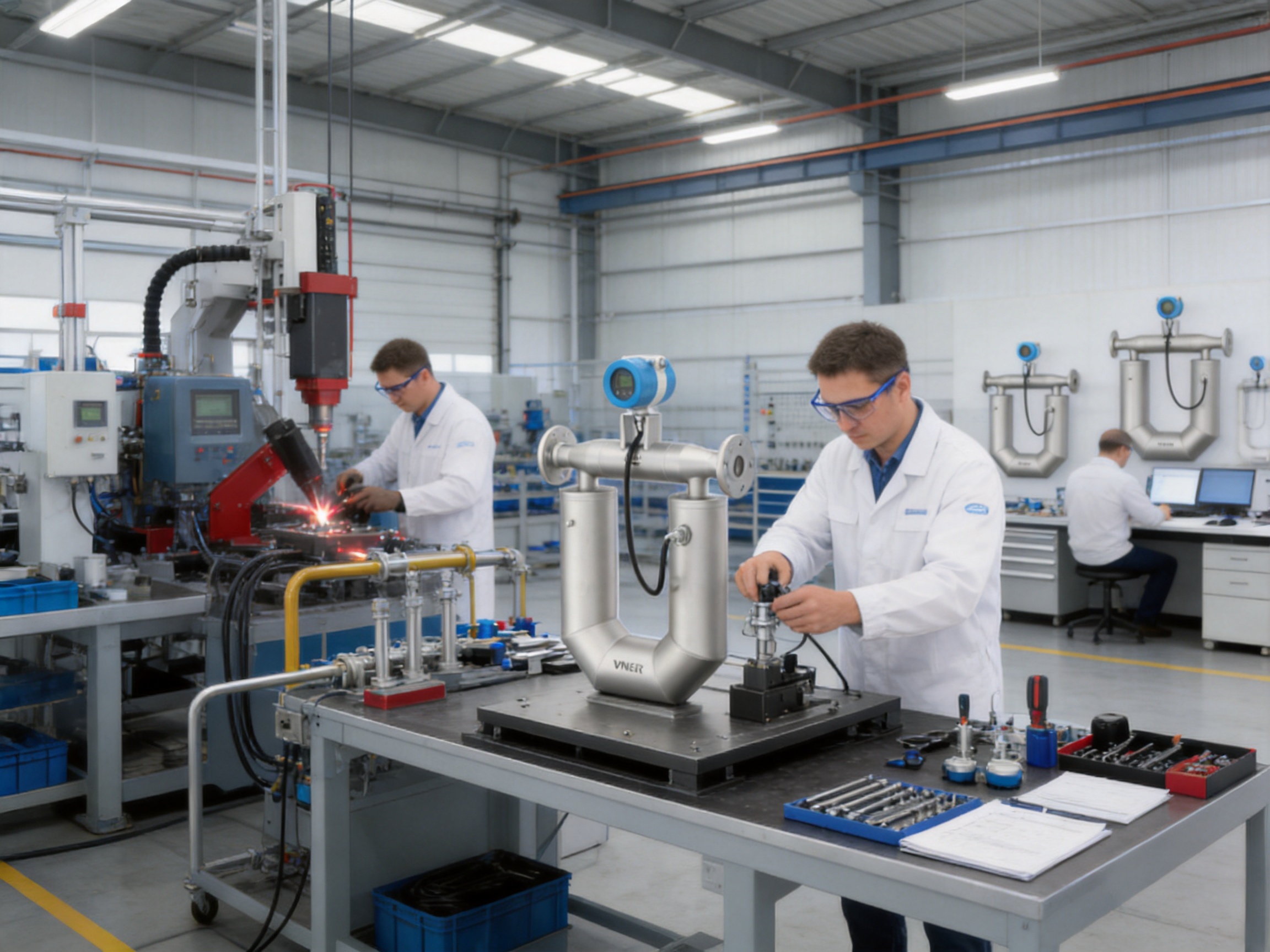
Its value is not limited to the sensor itself. Reliable industrial measurement depends on engineering selection, manufacturing consistency, calibration, material control, electronics, quality assurance, and technical support. The manufacturer behind the product operates modern facilities in Yangzhou, China, with three plants, approximately 23,000 square metres of manufacturing space, and a technical team of more than 150 people. Since 2011, the company has concentrated on industrial flow measurement and has supplied solutions for oil and gas, petrochemical, polysilicon, power, water, wastewater, and other process industries.
This article explains the operating principle, construction, performance, application benefits, manufacturing strengths, selection considerations, installation requirements, and practical advantages of the KSMF-U Series.
1. The Role of Mass Measurement in Industrial Processes
Many industrial materials are purchased, sold, blended, dosed, or consumed according to mass. Crude oil, refined products, chemical additives, liquefied gases, polymers, pulp chemicals, and alternative fuels can all vary in density as operating conditions change. A volumetric meter may report the correct volume under its measuring conditions, but the corresponding mass may change when temperature or pressure changes.
Mass flow measurement reduces this source of uncertainty. The meter responds to the inertia of the moving fluid rather than relying only on a calibrated relationship between volume and velocity. This makes the measurement more useful for batch control, formulation, inventory reconciliation, loading and unloading, process balancing, and commercial metering.
Density measurement provides an additional process variable. Density can be used to calculate volume from mass, identify changes in product composition, monitor concentration, detect product interfaces, or verify that a material meets a process specification. When the transmitter also measures temperature, the instrument becomes a compact source of several important process values.
For many installations, the combination of mass flow, density, and temperature from one meter can reduce the number of separate instruments, simplify piping, and decrease the amount of compensation required in the control system. This can be particularly valuable where space is limited or where a process skid must be assembled quickly.
2. Operating Principle of the U-Shaped Coriolis Meter
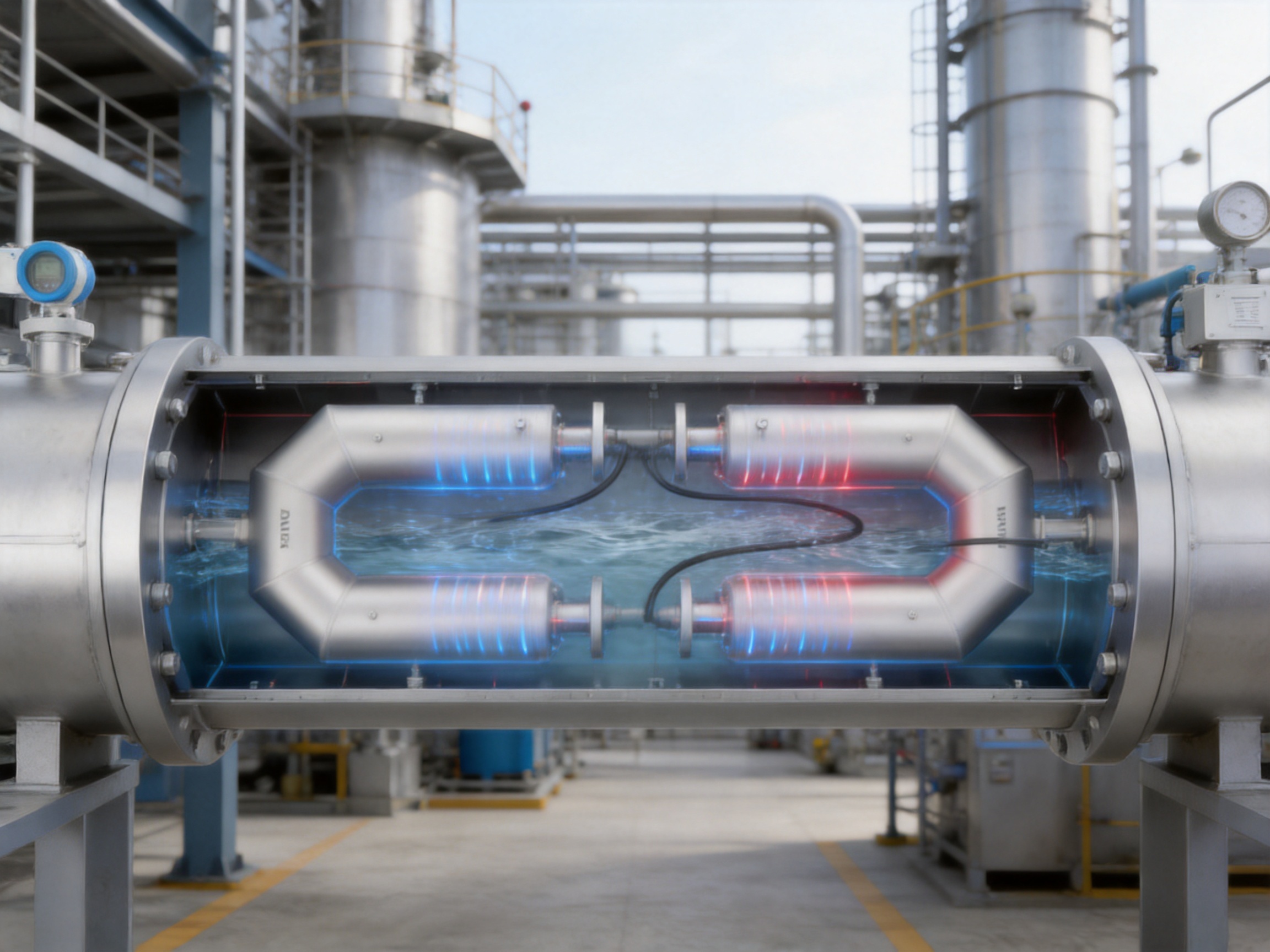
The KSMF-U Series uses two parallel measuring tubes arranged in a U-shaped configuration. An excitation system causes the tubes to vibrate in a controlled mechanical mode. When the process fluid is stationary inside the tubes, the vibration is symmetrical. As fluid begins to move, the interaction between the tube vibration and the moving mass creates a Coriolis force.
This force produces a small phase difference between the motion of the upstream and downstream portions of the tubes. Sensors positioned on the measuring structure detect the movement and phase shift. The phase shift is proportional to the mass flow rate. Because the primary measurement is based on the moving mass, the result is not dependent on a fixed fluid density in the same way as a volumetric instrument.
The vibration frequency and response of the tubes also provide information about the density of the material inside them. A temperature sensor monitors the process temperature and supports compensation for thermal effects. The transmitter processes the sensor signals, applies the relevant calibration data, and provides mass flow, density, temperature, calculated volume, and other configured values.
The dual-tube design provides a balanced measuring structure. The tubes operate together, helping the sensor maintain stable mechanical behaviour over a broad flow range. The U-shaped geometry also provides a long effective measuring path within a relatively compact meter body. This contributes to sensitivity while retaining a robust structure suitable for industrial service.
Unlike many velocity-based technologies, a Coriolis meter does not require the flow to be fully developed before measurement. Swirl, moderate disturbances, and changes in the upstream layout generally have much less influence on the reading. For this reason, the KSMF-U can often be installed where long upstream and downstream straight runs are impractical.
3. Main Performance Characteristics
| Item | KSMF-U Series Capability |
| Measuring principle | U-shaped dual-tube Coriolis measurement using phase shift |
| Primary variables | Mass flow, density, and process temperature |
| Calculated variables | Volume flow and standard volume, subject to configured conditions |
| Nominal diameter | DN20 to DN300, approximately 3/4 inch to 12 inches |
| Series flow capacity | Up to 2,040,000 kg/h, depending on model and application |
| Mass or volume accuracy | Available accuracy classes from approximately ±0.10% to ±0.50% of rate, depending on model and application |
| Repeatability | Typically 0.05% to 0.10% of rate |
| Density range | Approximately 0.3 to 3.0 g/cm³ |
| Process temperature | Low, normal, and high-temperature versions from approximately -200°C to +300°C |
| Pressure options | Standard pressure configurations and high-pressure versions up to approximately 25 to 40 MPa, model-dependent |
| Wetted materials | 316L stainless steel as standard, with Hastelloy and titanium options |
| Outputs | 4–20 mA and pulse output |
| Communication | Modbus RS-485 and HART |
| Protection | IP67; explosion-proof Ex d versions available |
The performance values must always be confirmed against the selected meter size, process medium, temperature, pressure, viscosity, installation orientation, and calibration requirements. Coriolis meters are highly capable instruments, but correct sizing remains essential. A meter that is too large may operate close to the lower end of its useful range, while a meter that is too small may create unnecessary pressure loss or fail to accommodate peak flow.
4. Advantages Compared with Conventional Flow Technologies
4.1 Direct Mass Flow Measurement
A major advantage is the direct measurement of mass flow. Conventional volumetric instruments normally require density compensation if the process is reported in mass units. That compensation may depend on an assumed density, a laboratory value, or a separate density and temperature measurement. Any error in those inputs affects the final mass calculation.
The KSMF-U measures mass flow through the Coriolis effect and can independently measure density. This simplifies the measurement chain and reduces dependence on external compensation instruments. It is especially useful for products whose density changes with temperature, pressure, composition, or blending ratio.
4.2 Lower Dependence on Flow Profile
Vortex, turbine, ultrasonic, and differential-pressure meters can be sensitive to the velocity profile entering the meter. Elbows, valves, reducers, pumps, and other fittings may introduce swirl or asymmetry. In many installations, straight-pipe sections, flow conditioners, or careful placement are needed to maintain accuracy.
The KSMF-U is substantially less dependent on flow profile. It does not normally require upstream or downstream straight pipe runs for the same reason as velocity-based technologies. This can reduce piping length, skid size, engineering complexity, and retrofit difficulty. The installation still needs to comply with the product manual and the process must be arranged to prevent unwanted gas accumulation or liquid separation, but the layout constraints are generally less severe.
4.3 Wide Application Range
The series is available for liquids, gases, and liquefied gases. It can be applied to clean liquids, high-viscosity products, suspensions, gas-liquid mixtures within appropriate limits, and medium- or high-pressure gases. This versatility allows one measurement platform to be used across different units within a plant.
By comparison, a turbine meter may require a relatively clean, low-viscosity liquid and may be affected by wear or changes in viscosity. A vortex meter may need a minimum flow velocity and can be influenced by low-density gases or severe pulsation. A differential-pressure meter introduces permanent pressure loss and usually requires pressure and temperature compensation for mass measurement. The KSMF-U avoids many of these limitations, although the process must still be evaluated for entrained gas, vibration, pressure loss, and material compatibility.
4.4 Measurement of Multiple Variables
One Coriolis meter can provide mass flow, density, and temperature. These values can support process control, product verification, batch management, and diagnostics. The transmitter can also calculate volume and standard volume according to configured reference conditions.
For a blending system, mass flow from several KSMF-U meters can be used to control the recipe. For a loading station, mass flow and totalized mass can control the delivered quantity. For a chemical process, density can indicate concentration or composition changes. For an energy system, temperature and density can support fuel-quality monitoring and inventory calculations.
4.5 Strong Performance at Low and Variable Flow
Coriolis technology generally provides useful measurement over a wide turndown range because its basic signal is generated by mass movement through the vibrating tubes. The KSMF-U series can offer turndown up to approximately 1:50, depending on the model and application. Best stability is typically achieved within a more conservative operating range, such as 1:20, but the instrument remains suitable for processes with changing demand.
This is important in batch systems and production plants that operate at different rates during startup, normal operation, cleaning, changeover, and shutdown. A single meter can often cover a wider operating envelope than a conventional device selected only for the nominal rate.
5. Mechanical Design and Materials
The measuring tubes and wetted components are central to the accuracy and service life of a Coriolis meter. The KSMF-U uses 316L stainless steel as the standard wetted material, providing a useful combination of strength, corrosion resistance, weldability, and broad chemical compatibility. Hastelloy and titanium options are available for more aggressive or demanding media.
The external meter body uses stainless steel materials, including 304 and 316L options. The enclosure is designed for industrial environments and has IP67 protection. This helps protect the electronics and internal components from dust and temporary water exposure when the instrument is installed and maintained correctly.
Process connections can be selected in flanged, threaded, Tri-Clamp, and fitting-type configurations. DIN, ANSI/ASME, and JIS connection standards support international project requirements. These options make the meter suitable for permanent process pipelines, sanitary or semi-sanitary skids where applicable, modular equipment, and retrofit projects.
High-temperature and low-temperature designs extend the usable range of the platform. Low-temperature configurations can support cryogenic or near-cryogenic services within the specified design envelope, while high-temperature versions are available for process streams reaching approximately 300°C. The selected sensor, insulation arrangement, electronics location, gasket, and connection materials must all be considered as part of the complete installation.
High-pressure versions are available for demanding gas and liquefied-gas applications. Pressure ratings can reach approximately 25 to 40 MPa on suitable models. These ratings are model-dependent and must not be treated as universal for every size or connection. The process pressure, design temperature, pressure cycling, and local safety requirements should be reviewed before ordering.
6. Electronics, Signals, and System Integration
The KSMF-U transmitter is intended to integrate into industrial control and monitoring systems. A 4–20 mA output can be assigned to mass flow, density, temperature, volume flow, or another configured variable. Pulse output can be used for totalizing, batch control, loading operations, or transfer systems.
Modbus RS-485 communication supports digital integration with PLC, DCS, SCADA, remote terminal, and pipeline control systems. HART communication can provide configuration, diagnostics, and process data through compatible control infrastructure. These communication options help users access more information than is available from a single analog signal.
Power supply options include 24–26 V DC, 220 V AC, and wide-range configurations covering approximately 22 to 245 V, depending on the selected transmitter. This flexibility is useful for equipment packages that operate from different control voltages or for international projects with varying electrical standards.
Explosion-proof Ex d versions are available for hazardous areas where the equipment must meet the applicable classified-area requirements. Certification may include ATEX, PCEC, CE, SIL, and other approvals depending on the model, configuration, and region. Project engineers should verify the exact certificate, gas group, temperature class, installation method, and associated electrical requirements rather than relying only on the general product family description.
7. Manufacturing and Quality Strengths
The performance of a precision flowmeter depends on more than the theoretical measuring principle. Tube geometry, welding quality, sensor alignment, excitation stability, electronic processing, temperature compensation, calibration, and enclosure sealing all affect the finished instrument. Consistency across these stages is therefore a major supplier advantage.
The manufacturer operates three plants with approximately 23,000 square metres of modern facilities. This manufacturing base provides room for component preparation, assembly, testing, calibration, storage, engineering, and quality-control activities. A larger integrated production environment can support better coordination between design, manufacturing, inspection, and after-sales service.
The company has a technical team of more than 150 people and has focused on industrial flow measurement since 2011. Its product portfolio includes electromagnetic, Coriolis, vortex, swirl, turbine, thermal mass, ultrasonic, and metal-tube rotameter technologies. This broad technical scope is valuable because customers can receive technology selection support based on the actual medium and process rather than being directed toward one instrument type for every application.
In-house calibration is another important strength. Calibration allows the manufacturer to verify meter performance under controlled conditions, record relevant data, and support traceability. For customers, this can simplify documentation and provide greater confidence that the supplied instrument corresponds to its stated performance. Calibration procedures should be matched to the required accuracy, fluid type, flow range, and project standard.
Certified quality processes support repeatable production and inspection. For a Coriolis meter, repeatability is especially important because the product depends on accurately matched mechanical elements and stable electronics. Production control should include material identification, dimensional verification, tube assembly, welding inspection, sensor installation, enclosure testing, electrical verification, and final performance testing.
The company also describes an increasingly automated manufacturing approach. Automation can improve consistency in repetitive production tasks, reduce variation between units, support process traceability, and increase output capacity. Automation does not replace engineering judgement or final inspection, but it can create a more stable manufacturing baseline when combined with qualified procedures and trained personnel.
More than 2,000 engineering projects in over 30 countries have provided practical experience across different industries, climates, process media, and regulatory environments. This type of field exposure helps improve application guidance, model selection, installation recommendations, and troubleshooting procedures.
8. Application in Oil and Gas Systems
Oil and gas facilities require dependable measurement for production allocation, custody-related transfer, loading, unloading, blending, injection, and inventory management. Fluids may include crude oil, condensate, refined products, injection water, LPG, and other liquefied hydrocarbons.
For liquid hydrocarbon pipelines, the KSMF-U can provide mass flow and density in a single instrument. This is useful where product temperature changes during transportation or where different grades are transferred through the same infrastructure. Density data can assist with product identification, volume conversion, and material balance.
Loading and unloading systems often benefit from direct mass measurement. A pulse output can be connected to a batch controller, while the 4–20 mA output or digital communication can provide live flow information to the control system. At the end of a transfer, totalized mass can be used for reconciliation and documentation.
For LPG and other liquefied gases, the availability of high-pressure designs is important. The meter must be selected for the actual pressure, temperature, phase condition, and expected flow. The process should be arranged to maintain the appropriate liquid or gas condition through the measuring tube and to minimise flashing or unstable two-phase flow.
9. Application in Chemical and Petrochemical Plants
Chemical plants often handle fluids with changing viscosity, density, temperature, and composition. Additives, solvents, acids, alkalis, polymer feedstocks, process gases, and intermediate products may all require precise dosing or transfer measurement.
Mass-based dosing is often more reliable than volume-based dosing when the material density changes. The KSMF-U can measure the quantity delivered to a reactor, blending vessel, filling system, or continuous process line. Its density output can provide an additional check on the material and may help detect an incorrect product, dilution problem, or composition change.
High-viscosity liquids can be challenging for some flow technologies because viscosity affects pressure loss, rotor movement, or calibration stability. Coriolis meters are less dependent on viscosity-related velocity effects, although high viscosity can still increase pressure loss and influence the selected meter size. Proper engineering should consider the minimum and maximum operating temperatures because heating a product may significantly reduce viscosity.
Gas-liquid mixtures require particular attention. A Coriolis meter can tolerate certain process conditions involving dispersed gas or suspended material, but unstable slug flow, large gas pockets, or severe phase separation can reduce measurement stability. The system designer should evaluate the phase behaviour and use separators, back-pressure control, or other process measures where needed.
10. Application in Pulp, Paper, and Water-Related Processes
Pulp and paper plants use chemical liquors, bleaching agents, sizing materials, coatings, and other additives. Accurate chemical consumption measurement helps maintain product quality and reduces waste. Because many chemicals are supplied and consumed by mass, a Coriolis meter is a natural choice for dosing and transfer.
The KSMF-U can support continuous measurement in chemical preparation units, bleaching stages, coating systems, and additive lines. The direct mass signal can be used by a dosing control loop, while totalized mass can support consumption accounting. Density measurement may help verify concentration where the relationship between density and composition has been established for the specific material.
In water and wastewater applications, the product may be selected for chemical dosing, sludge-related service, treatment chemicals, or industrial utility systems. The correct meter depends on solids concentration, viscosity, corrosiveness, gas entrainment, cleaning requirements, and the required accuracy. Materials such as Hastelloy or titanium may be considered for aggressive fluids.
11. Application in New Energy and Fuel Blending
Alternative fuels and energy carriers often require precise blending. Biofuels, fuel additives, thermal oils, liquefied gases, and other products can have different densities and temperatures. A recipe based only on volume may become inaccurate if the components change condition during transfer.
Mass flow measurement supports repeatable blending ratios. Multiple meters can measure individual components, and a control system can use their signals to regulate valves or pumps. Density and temperature values provide additional information for quality control and inventory management.
For transfer skids, the KSMF-U can provide a compact combination of flow measurement and process monitoring. Its pulse output supports totalization and batch termination, while communication through Modbus or HART can transmit operating data to a supervisory system.
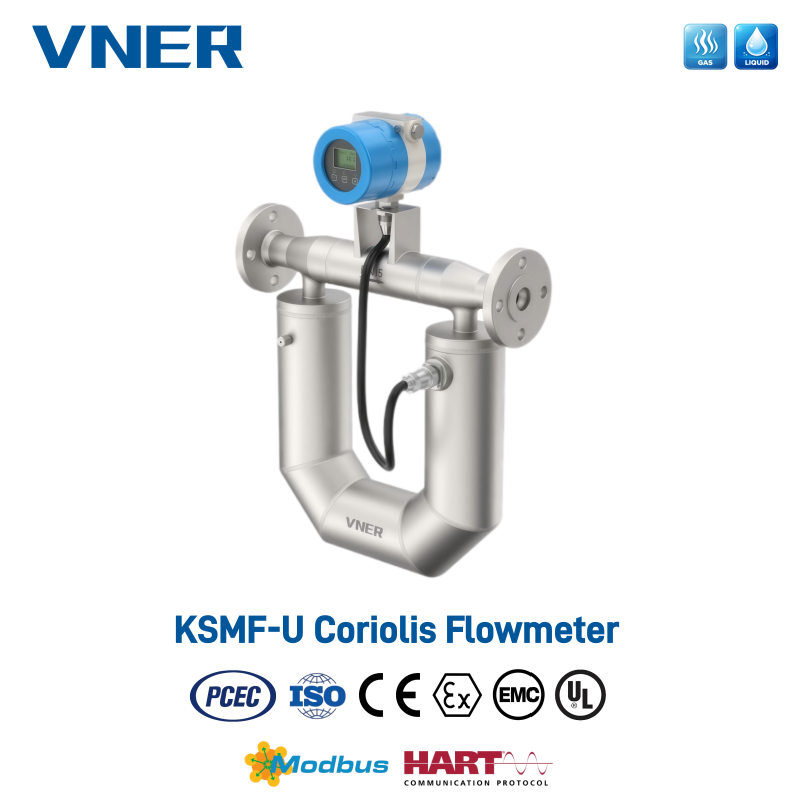
KSMF U-Series Coriolis Mass Flowmeter
12. Installation and Sizing Considerations
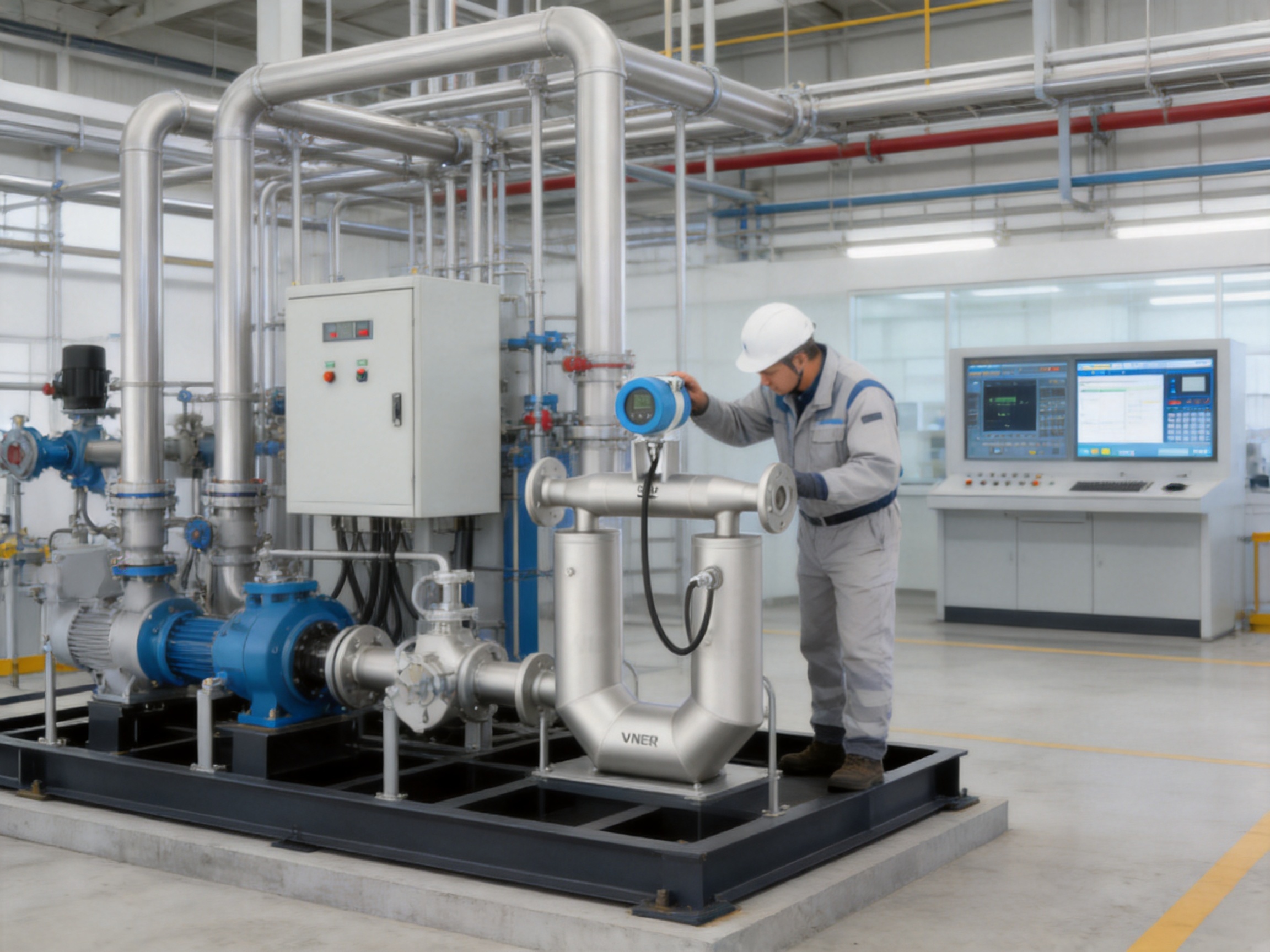
Although the KSMF-U does not normally require long straight pipe runs, correct installation remains essential. The meter should be mounted in a location where the tubes remain filled with liquid when measuring liquids. Avoiding high points that collect gas and low points that collect solids can improve stability. For gas service, the installation should prevent liquid accumulation and allow the process to remain in the intended phase.
The meter should be protected from excessive external vibration. Pumps, compressors, reciprocating equipment, and nearby vibrating structures can transmit mechanical energy to the sensor. Where necessary, the installation should use appropriate supports, flexible connections, vibration isolation, or a different mounting location.
For liquid applications, maintaining sufficient back pressure can help prevent flashing and unwanted gas release. Valves and control elements should be positioned according to the process design so that pressure remains appropriate across the measuring tube. If the process contains entrained gas, a separator or gas-management arrangement may be necessary.
Meter sizing should consider minimum, normal, maximum, and emergency flow rates. The selected model should operate within its recommended range without creating excessive pressure loss. High-viscosity media, low-temperature operation, and dense fluids may require special attention because they can increase the required pumping pressure.
Material compatibility must be checked against the complete fluid composition, including cleaning chemicals, additives, chlorides, solvents, and trace contaminants. Temperature and pressure ratings must be reviewed together. A high-pressure meter may not retain the same pressure rating at the highest temperature, and connection ratings may differ from sensor-body ratings.
Electrical installation should follow the selected protection concept and local regulations. In hazardous areas, the Ex d configuration, cable glands, grounding, conduit, and inspection requirements must be compatible with the area classification. Signal cables should be routed to reduce the possibility of electromagnetic interference, and the meter should be properly grounded according to the installation manual.
13. Commissioning and Routine Operation
Before commissioning, verify the flow direction, process connections, gasket condition, grounding, power supply, output wiring, communication settings, and transmitter configuration. Confirm that the selected units for mass flow, density, temperature, totalization, and standard volume match the project requirements.
The pipeline should be flushed or cleaned when appropriate before the meter is placed into normal operation. Foreign particles, welding debris, or excessive solids can obstruct the flow path or affect the performance of valves and pumps. The process should be introduced gradually to avoid water hammer, thermal shock, or sudden pressure changes.
Zero verification may be required when the measuring tubes are completely filled and the process is stationary. Zero stability depends on the meter being properly installed, free from flow, and protected from vibration and temperature changes during the procedure. A correct zero contributes to better low-flow performance.
During operation, the user should monitor diagnostic information, signal stability, density behaviour, temperature, pressure, and process conditions. Unexpected density changes may indicate a product transition, gas entrainment, contamination, or a process problem. An unstable flow signal may result from two-phase flow, vibration, cavitation, inadequate back pressure, or an incorrect installation.
Routine maintenance is generally limited compared with mechanical meters because there are no rotating internal parts in the measuring principle. Nevertheless, electrical connections, enclosure seals, grounding, process connections, supports, and calibration status should be checked according to the operating environment and quality system.
14. Why the Product Is Suitable for Retrofit Projects
Brownfield projects often have limited space, existing pipework, short straight runs, and difficult access. Replacing an older flowmeter with another velocity-based meter may require pipe modifications, flow conditioners, or additional compensation instruments. The KSMF-U can simplify the retrofit because it is less dependent on upstream and downstream flow conditioning.
The availability of different connection standards and sizes helps match existing pipelines. Flanged, threaded, Tri-Clamp, and fitting-type versions support different equipment arrangements. The range from DN20 to DN300 covers small process lines as well as large transfer pipelines.
Multiple power and communication options also support integration with existing control systems. A plant may use 4–20 mA for basic process control, pulse output for totalization, and Modbus or HART for configuration and diagnostics. This allows the meter to be introduced without completely replacing the site’s automation architecture.
For replacement projects, engineering teams should compare the existing meter’s face-to-face dimensions, connection rating, process temperature, flow range, and hazardous-area certification with the proposed KSMF-U configuration. A technical review before ordering can prevent mechanical or electrical changes during installation.
15. Comparison with Specific Meter Technologies
| Technology | Typical Strength | Relative KSMF-U Advantage | Important Consideration |
| Electromagnetic | Excellent for conductive liquids and low pressure loss | Measures mass and density directly and can also handle gases or non-conductive products | Electromagnetic meters require sufficient conductivity and a full conductive liquid pipe |
| Turbine | Good accuracy for clean, stable liquids | Less dependent on viscosity, contains no rotating measuring rotor, and provides density information | Coriolis selection must still consider pressure loss and two-phase flow |
| Vortex | Useful for steam, gases, and clean liquids | Provides direct mass flow without the same dependence on velocity profile and minimum vortex velocity | Vortex meters can be simpler for some utility services and should not be replaced automatically |
| Thermal mass | Effective for many low-pressure gas applications | Offers liquid, gas, and liquefied-gas capability with density measurement | Thermal meters are often economical for clean, low-pressure gases |
| Ultrasonic | Suitable for large pipes and low-pressure-loss measurement | Provides direct mass measurement and is less affected by some flow-profile conditions | Ultrasonic performance depends on fluid properties, installation, and acoustic conditions |
| Differential pressure | Established technology with broad industrial familiarity | Reduces the need for separate pressure, temperature, and density compensation | Differential-pressure meters may create permanent pressure loss |
The correct comparison is always application-specific. Coriolis technology is not automatically the best choice for every service. For very large water lines, electromagnetic or ultrasonic meters may be more economical. For simple clean gas monitoring, a thermal or vortex meter may be sufficient. The advantage of the KSMF-U is its combination of direct mass measurement, density capability, wide media coverage, compact installation requirements, and industrial durability.
16. Engineering Support and Product Selection
Choosing a Coriolis meter should begin with a complete process data sheet. Important information includes medium name and composition, minimum and maximum flow, normal flow, operating pressure, design pressure, operating temperature, design temperature, density, viscosity, solids concentration, gas content, connection standard, area classification, and required output signals.
The manufacturer’s broad product portfolio allows its technical team to compare Coriolis measurement with electromagnetic, vortex, swirl, turbine, thermal mass, ultrasonic, and rotameter options. This is useful for EPC contractors and end users who need a practical selection rather than a product chosen only from a catalogue category.
Engineering-driven sizing can help balance accuracy, pressure loss, turndown, and cost. For example, a large line may not need a meter selected solely by pipe diameter if a reducer arrangement is technically acceptable. Conversely, reducing the line too much may create excessive pressure loss or affect the process. The correct decision depends on pump capacity, control requirements, fluid viscosity, and operating range.
Project documentation may include datasheets, dimensional drawings, wiring diagrams, material certificates, calibration reports, inspection records, certificates, manuals, and test documentation. Availability of this information supports procurement, construction, commissioning, and future maintenance.
17. Practical Benefits for Plant Owners
Plant owners can benefit from the KSMF-U in several ways. Direct mass measurement improves the reliability of product accounting. Density measurement supports material verification and volume conversion. A wide turndown range helps one meter handle changing process rates. Reduced straight-run requirements can lower installation costs. Multiple communication options simplify control-system integration.
Operational value can also come from improved process visibility. When mass flow, density, and temperature are available together, engineers can identify changes that might otherwise remain hidden. A density shift may indicate a change in composition. A temperature increase may explain a viscosity reduction. A discrepancy between mass and calculated volume may indicate a process or inventory issue.
For batch systems, pulse output and totalization support accurate cut-off and transfer control. For continuous processes, the 4–20 mA signal can be assigned to the variable most important to the control loop. For plant-wide monitoring, Modbus or HART provides access to additional values and diagnostic information.
Long-term reliability also depends on application suitability and manufacturing consistency. The combination of stainless-steel construction, optional corrosion-resistant materials, IP67 protection, explosion-proof versions, in-house calibration, and certified quality processes gives the product a strong foundation for industrial service.
18. Frequently Asked Questions
What does the KSMF-U Series measure?
The primary measurement is mass flow. The instrument also measures fluid density and process temperature. Depending on configuration, it can calculate volume flow, standard volume, concentration-related values, and totalized quantities.
Can it measure both liquids and gases?
Yes. The series is designed for liquids, gases, and liquefied gases. The selected model must match the medium’s density, pressure, temperature, flow rate, and phase behaviour. Gas applications should be checked carefully because low-density gas service may require a suitable sensor size and specific operating conditions.
Are straight pipe runs required?
The KSMF-U normally does not require upstream or downstream straight pipe runs in the same way as many velocity-based meters. It is largely independent of flow profile. However, good piping practice is still necessary to prevent gas accumulation, liquid separation, vibration, cavitation, and unstable process conditions.
What is the largest available meter size?
Nominal sizes extend to approximately DN300, or about 12 inches. The series flow capacity can reach approximately 2,040,000 kg/h, depending on the selected model and operating conditions.
What materials are available for corrosive fluids?
316L stainless steel is the standard wetted material. Hastelloy and titanium options are available for aggressive or demanding media. Material selection must be based on the complete chemical composition, concentration, temperature, pressure, and cleaning procedure.
Can the meter be used for high-pressure LPG service?
High-pressure variants are available for liquefied-gas applications, with pressure options reaching approximately 25 to 40 MPa on suitable models. The exact pressure rating depends on meter size, sensor design, connection, temperature, and certification. The application must be reviewed before selection.
How does the meter handle high-viscosity liquids?
Coriolis measurement is less affected by viscosity-related changes than many velocity-based technologies. The KSMF-U can be used for high-viscosity liquids within its application limits. High viscosity can still increase pressure loss, so the engineer should review the minimum operating temperature, pump capacity, meter size, and expected flow range.
Can it measure fluids containing gas or solids?
The series can handle some gas-liquid mixtures, suspensions, and process fluids with solids within appropriate limits. Stable, dispersed mixtures are generally easier to measure than large gas slugs, severe flashing, or rapidly separating phases. The process should be evaluated to determine whether separators, back-pressure control, or other conditioning is required.
What outputs are available?
Standard output options include 4–20 mA and pulse output. Modbus RS-485 and HART communication are available for digital integration, configuration, diagnostics, and access to multiple process variables.
Is explosion-proof construction available?
Ex d explosion-proof versions are available. Certification and installation requirements depend on the selected model and project region. The area classification, gas group, temperature class, cable entry, grounding, and local regulations must be confirmed for each installation.
What power supplies can be used?
Depending on the transmitter configuration, options include 24–26 V DC, 220 V AC, and wide-range supplies covering approximately 22 to 245 V.
How should the meter be sized?
Sizing should consider minimum, normal, and maximum flow, fluid density, viscosity, pressure, temperature, gas content, solids, allowable pressure loss, and required accuracy. Selecting a meter solely according to line diameter may result in an unsuitable operating range.
What manufacturing advantages support product reliability?
The manufacturer operates three plants with approximately 23,000 square metres of facilities, maintains a technical team of more than 150 people, performs in-house calibration, uses certified quality processes, and is increasing manufacturing automation. These capabilities support production consistency, inspection, traceability, and technical support.
Is the product suitable for commercial metering?
The KSMF-U can be used for commercial or transactional metering where the selected model has the required approvals, accuracy, calibration, and legal metrology documentation. Project-specific certification should always be verified before purchase.
19. Conclusion
The KSMF-U U-shaped Coriolis Mass Flowmeter combines direct mass measurement with density and temperature measurement in a robust industrial platform. Its dual-tube construction provides high sensitivity and stable operation over a wide flow range, while its low dependence on flow profile reduces installation constraints. The product range covers DN20 to DN300 and flow capacities up to approximately 2,040,000 kg/h, allowing the technology to serve both process lines and large transfer systems.
Its advantages are particularly clear where fluid density changes, mass-based dosing is required, space is limited, or several process variables must be obtained from one instrument. Oil and gas transfer, LPG loading, chemical dosing, petrochemical processing, pulp and paper chemicals, utility systems, and alternative-fuel blending are representative applications.
The product is supported by a manufacturing organisation with modern facilities, multiple plants, in-house calibration, certified quality processes, engineering experience, and an increasingly automated production approach. This combination of measuring technology, material options, electronics, calibration, and technical support makes the KSMF-U a strong option for demanding industrial flow measurement.
As with every precision instrument, successful performance depends on correct sizing, compatible materials, suitable installation, appropriate process conditions, and verification against project standards. When these factors are addressed during selection and commissioning, the KSMF-U can provide stable, repeatable, and useful measurement data throughout the operating life of the process.
References
1. Coriolis Flow Measurement Principles, industrial instrumentation training literature.
2. General Industrial Flow Measurement Practice, process automation engineering references.
3. Coriolis Mass Flowmeter Installation and Commissioning Guidelines, manufacturer technical documentation.
4. Industrial Process Measurement and Control, engineering handbook for flow, density, temperature, and pressure measurement.
5. Hazardous-Area Electrical Equipment and Explosion Protection, applicable international and regional certification guidance.
6. Process Instrumentation Materials and Corrosion Compatibility, industrial materials-selection references.
7. Quality Control and Calibration Practices for Industrial Flowmeters, instrumentation manufacturing guidance.
For technical selection, users should provide the medium, flow range, pressure, temperature, density, viscosity, gas or solids content, connection standard, hazardous-area classification, output requirements, and applicable certification requirements. These details allow the appropriate KSMF-U model, material, pressure class, temperature version, transmitter, and calibration configuration to be selected.
Product: KSMF U-Series Coriolis Mass Flowmeter



Products
Contact Information
-

+86 18652789521
+86-0514-83633600 / 83633900 -

+86-0514-83633600 / 83633900
-

s@vner.com.cn
katherine@vner.com.cn -

No. 11 Xingye Road, Chenji Town Industrial Park, Yizheng, Yangzhou, China
