
 0
 EN
 English
 عربى
 Español
 русский
If you need any help, please feel free to contact us
Home / Author / Ren Xiaotong — Technical Sales Engineer for Gas Flow Meters / Temperature and Pressure Compensated Swirl Flowmeters for Steam and Gas Measurement
Temperature and Pressure Compensated Swirl Flowmeters for Steam and Gas Measurement
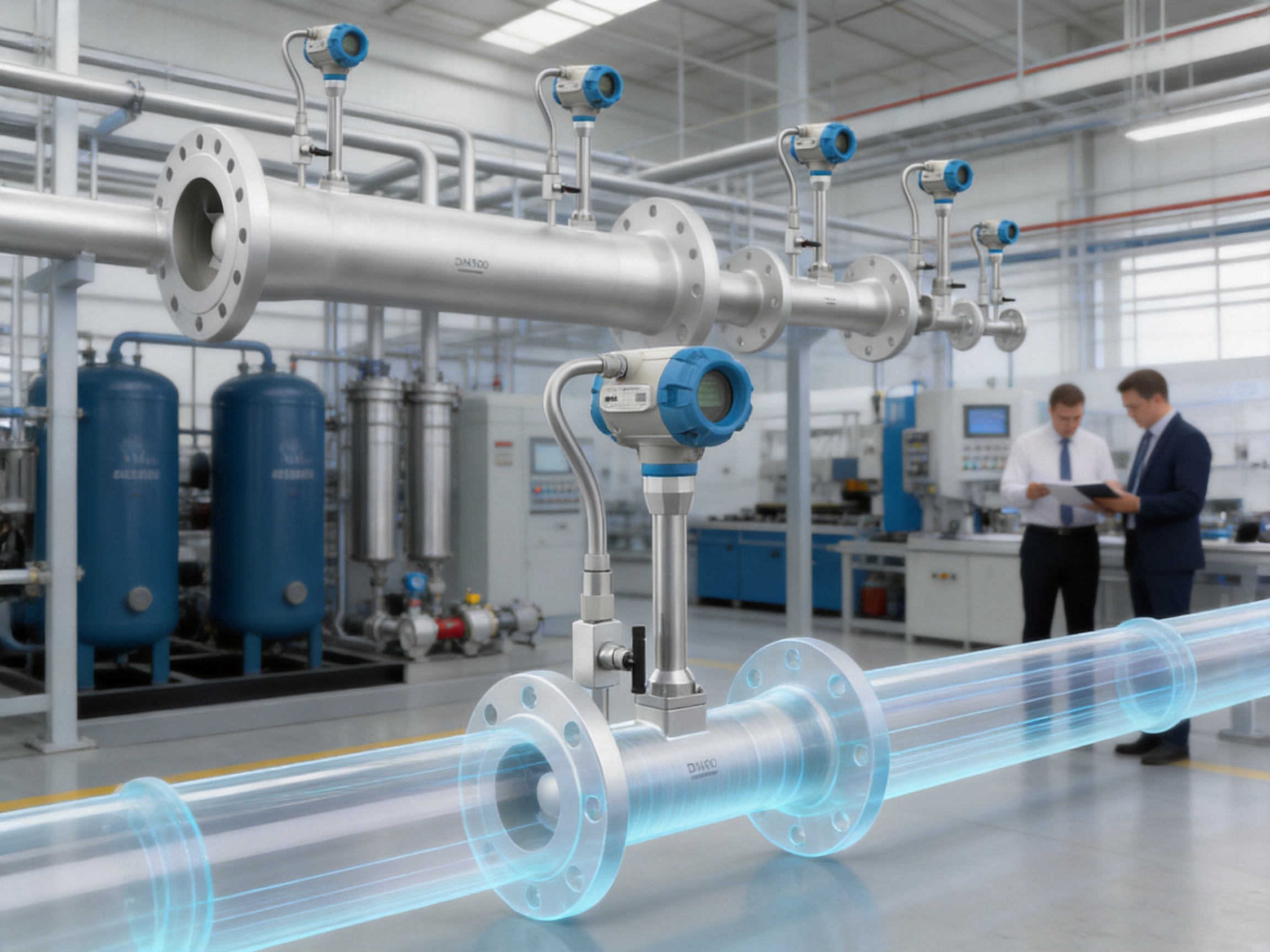
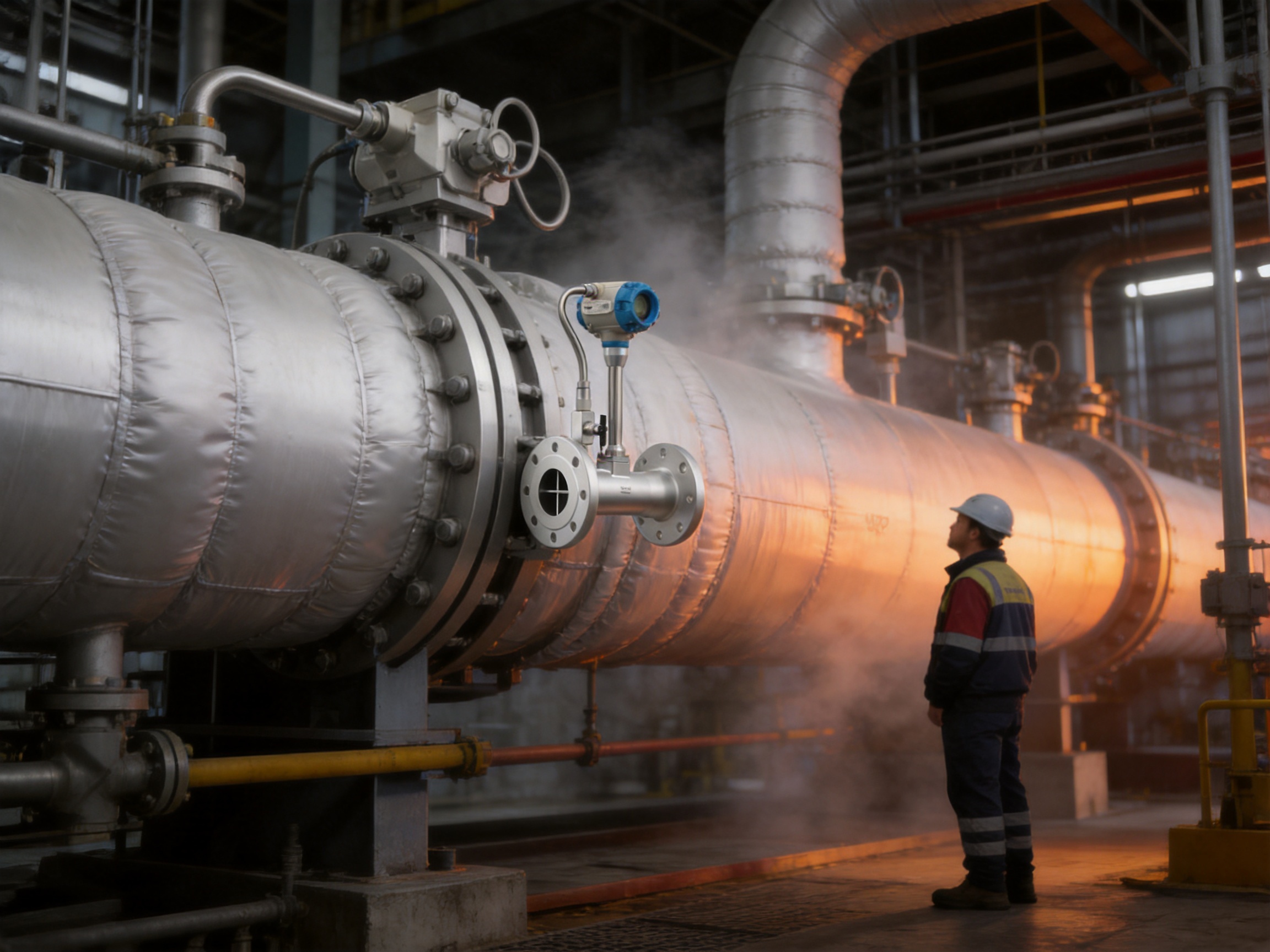
Accurate flow measurement is essential wherever steam, compressed air, nitrogen, fuel gas, or other industrial gases are produced, distributed, consumed, and billed. In these applications, measuring only operating volumetric flow is often insufficient. Gas and steam volume changes significantly with temperature and pressure, so a reading taken without compensation may not represent the actual quantity delivered under reference conditions. This can affect process control, energy accounting, equipment efficiency, production reporting, and cost allocation.
The SA80T-TP Series Temperature/Pressure Compensation Swirl Flowmeter is designed for these demanding measurement tasks. It combines swirl flow measurement with integrated temperature and pressure measurement, allowing the converter to calculate compensated flow values in real time. In addition to operating volumetric flow, the instrument can provide standard volume flow and media-dependent mass flow for steam and gases.
Based on the established SA80T swirl, or vortex precession, measuring principle, the SA80T-TP Series provides a practical alternative to conventional uncorrected flowmeters and more complex multi-instrument measurement assemblies. Its no-moving-parts construction, integrated compensation functions, configurable outputs, and industrial materials make it suitable for energy monitoring, utility metering, process control, and sub-metering applications.
Manufactured by Jiangsu VNER Electronic Technology Co., Ltd., the product is supported by an engineering-oriented organization with experience in electromagnetic, Coriolis, vortex, swirl, turbine, thermal mass, ultrasonic, and rotameter technologies. The company’s facilities, technical personnel, calibration capability, and project experience support the production of customized flow measurement solutions for industrial users, engineering contractors, original equipment manufacturers, and system integrators.
Why Temperature and Pressure Compensation Matters
For liquids, volumetric flow can often be used directly because liquid density changes are relatively limited within a defined operating range. Gases and steam behave differently. Their density depends strongly on pressure and temperature. A fixed volume at high pressure contains more mass than the same volume at low pressure, while heating a gas or steam flow causes expansion and changes the volume occupied by the medium.
A flowmeter installed in a compressed air network may report the volume flowing through the pipe at the actual line pressure and temperature. This is known as operating, or actual, volumetric flow. However, plant managers may need to compare consumption between different areas using a common reference condition. In that case, the operating volume must be converted into standard volume.
Steam applications require the same consideration. Saturated steam density varies with pressure and temperature, while superheated steam density depends on both variables and the degree of superheat. A reading based solely on operating volume may not accurately represent the steam mass delivered to a process, boiler section, heat exchanger, reactor, or building.
The SA80T-TP Series measures flow frequency together with process temperature and pressure. The converter uses these inputs and configured medium parameters to calculate a compensated result. Depending on the application and configuration, available variables include operating volumetric flow, standard volumetric flow, mass flow, and accumulated totals.
Real-time compensation is particularly valuable when process conditions fluctuate. Instead of relying on a fixed correction factor, the instrument continuously updates the calculation based on measured temperature and pressure. This helps operators obtain a more representative flow value during changes in load, production rate, weather conditions, compressor operation, boiler pressure, or steam demand.
Swirl Flow Measurement Principle
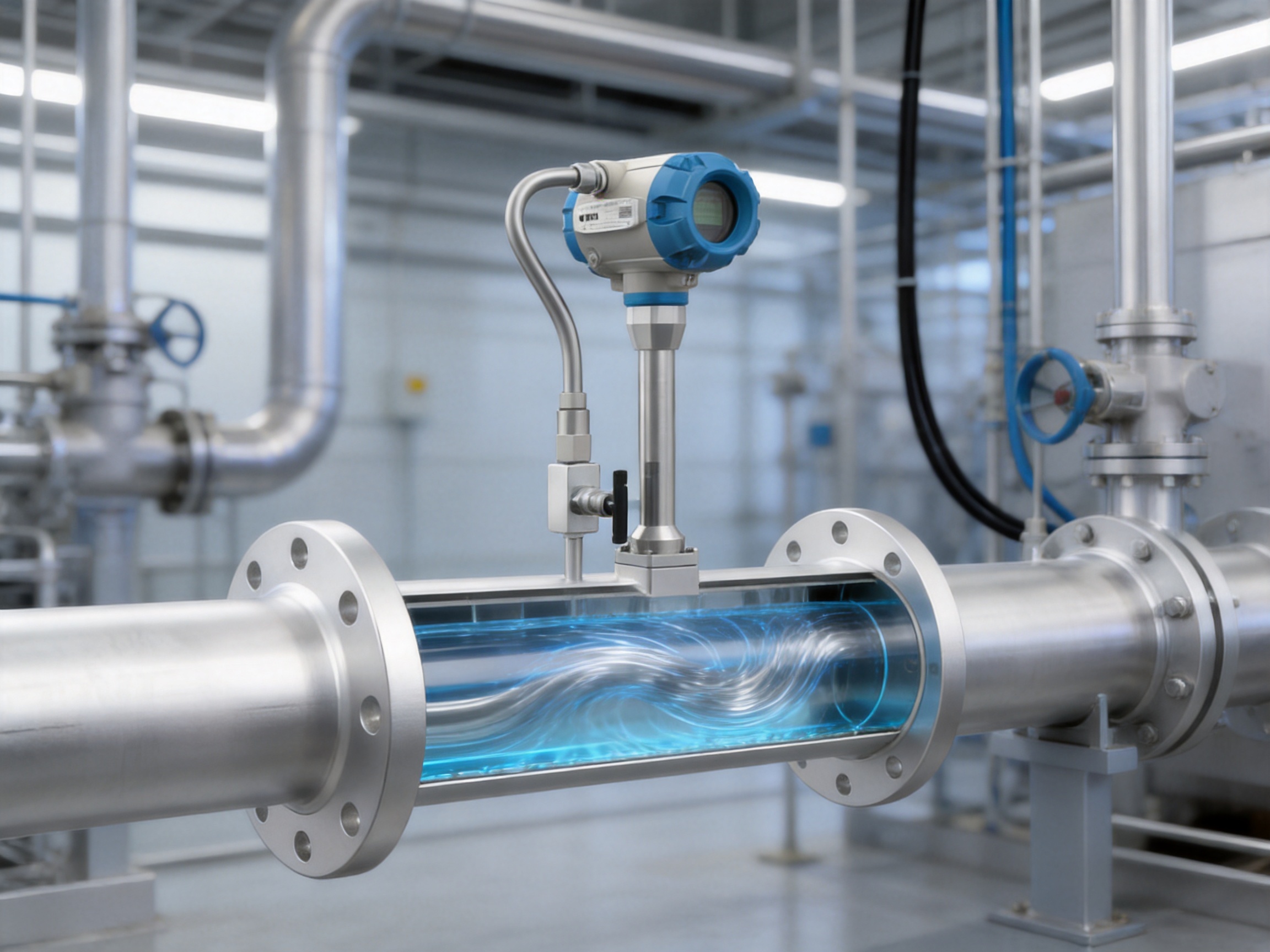
The SA80T-TP Series uses the swirl or vortex precession principle. A specially designed swirl generator introduces rotational motion into the flowing medium. Downstream of the generator, the rotating flow forms a precessing vortex. The frequency of this precession is related to the volumetric flow rate within the applicable measuring range.
The sensor detects the pressure or mechanical effects associated with the precessing vortex. A piezoelectric sensor is used as the standard sensing element, while a capacitive sensor can be selected for certain applications. The converter processes the signal, applies the configured measurement parameters, and produces flow outputs for indication, control, transmission, and totalization.
Because the measuring principle is based on frequency rather than a moving impeller or mechanical displacement element, the flowmeter does not require rotating parts inside the flow path. This reduces mechanical wear and avoids the lubrication, bearing, and replacement issues associated with some mechanical meters.
The swirl structure also makes the instrument suitable for a broad range of industrial media. The product can be applied to liquids, gases, saturated steam, and superheated steam, provided that the medium is compatible with the selected materials and the process conditions remain within the specified limits.
The measurement system is not simply a frequency transmitter. In its temperature and pressure compensated configuration, it is a compact flow calculation platform. Flow frequency, temperature, and pressure are combined in the converter to deliver information that would otherwise require separate transmitters, a remote flow computer, additional wiring, and external programming.
Integrated Measurement and Calculation
The most important feature of the SA80T-TP Series is the integration of flow, temperature, and pressure measurement in one instrument assembly. The flow sensor provides the basic frequency signal, while the integrated temperature and pressure channels supply the process information needed for compensation.
For compressed gases, the converter can calculate standard volume flow according to configured reference conditions. These conditions may include a specified reference temperature and pressure selected for the plant’s reporting or billing system. The result allows users to compare gas consumption between production lines, workshops, buildings, and utility zones on a consistent basis.
For steam, the converter can be configured for saturated or superheated service. The calculation uses the measured process conditions and configured steam parameters to determine a compensated flow value. The result can support boiler performance monitoring, steam balance analysis, distribution management, and internal cost allocation.
Mass flow calculation is media-dependent. It requires suitable configuration and must be evaluated against the actual application, pressure range, temperature range, medium quality, and required measurement uncertainty. The instrument is therefore best selected through an engineering review rather than by nominal pipe size alone.
In addition to instantaneous readings, the converter can provide totalized flow. Totalizers are useful for daily consumption reports, batch monitoring, shift-based accounting, utility management, and energy performance studies. Users can assign analog and pulse outputs to operating or compensated variables according to the needs of the control system.
Key Technical Characteristics
| Item | Description | Application Value |
|---|---|---|
| Measuring principle | Swirl or vortex precession; frequency proportional to volumetric flow | Stable measurement without moving parts |
| Measured media | Liquids, gases, saturated steam, and superheated steam | One platform for multiple industrial services |
| Integrated inputs | Flow frequency, temperature, and pressure | Real-time compensation within the converter |
| Calculated variables | Operating volume, standard volume, and media-dependent mass flow | Supports process control and utility accounting |
| Typical volumetric accuracy | Liquids: ±0.5% of rate; gases and steam: ±1.0% of rate under calibrated conditions | Suitable for many industrial monitoring duties |
| Turndown ratio | Up to 1:20 depending on medium and installation | Maintains useful measurement across changing demand |
| Temperature capability | Standard up to 250°C; extended versions up to 400°C | Supports standard and higher-temperature steam service |
| Pressure rating | 1.6 MPa, 2.5 MPa, or 4.0 MPa depending on model | Allows selection for different process pressure classes |
| Outputs | 4–20 mA and pulse; HART and Modbus RTU optional | Integrates with control and monitoring systems |
| Process connections | GB, DIN, ANSI, and other options upon request | Adaptable to common industrial piping standards |
| Construction | Fully welded flow path with no moving parts | Supports long-term industrial operation |
The figures in the table represent typical product characteristics. Actual performance depends on sizing, medium properties, installation quality, calibration conditions, process stability, and the selected model. A complete application review should be performed before final selection.
Advantages Compared with Uncompensated Flow Measurement
An uncompensated flowmeter can be adequate when the process operates at a nearly constant temperature and pressure or when only local operating volume is required. However, such a solution may become unreliable for plant-wide comparison and energy accounting when conditions vary. A temperature and pressure compensated flowmeter provides a more meaningful value for gases and steam because it responds to actual process conditions.
The SA80T-TP Series reduces dependence on manual correction factors. Manual calculations can introduce errors when operators use outdated pressure data, incorrect reference conditions, or simplified assumptions. Automatic calculation improves consistency and reduces the workload associated with spreadsheet-based correction.
Another advantage is the ability to provide several flow variables from one measuring point. Operators may view operating volume for immediate process awareness, standard volume for gas utility reporting, and mass flow for material or energy balance calculations. This flexibility helps different departments use the same field instrument for different operational purposes.
The integrated approach can also reduce system complexity. A conventional installation may use a separate flowmeter, pressure transmitter, temperature transmitter, signal junctions, a flow computer, and additional configuration software. The SA80T-TP Series brings the primary measurement and compensation functions together in a single product, which can simplify procurement, installation, commissioning, and maintenance.
Fewer separate instruments can also mean fewer potential sources of wiring errors and signal mismatch. The final system still requires proper engineering, but the integrated design provides a clear measurement architecture and reduces the number of individual devices that must be coordinated.
Advantages Compared with Mechanical Flowmeters
Mechanical flowmeters commonly depend on moving parts such as turbines, rotors, bearings, or displacement chambers. These components can be affected by wear, contamination, lubrication conditions, vibration, and changes in mechanical resistance. In high-cycle industrial service, maintenance requirements may increase as the instrument ages.
The SA80T-TP Series has no moving parts in the flow path. Its swirl generator and electronic sensor arrangement are designed for industrial service without internal rotating assemblies. This supports lower mechanical maintenance requirements and makes the instrument attractive for utility networks that are difficult to access frequently.
Steam and compressed gas systems can experience rapid changes in flow demand. A meter with a fixed mechanical element may require careful protection against overspeed or damage caused by unsuitable operating conditions. The swirl design avoids an internal rotating element, although correct sizing, filtration where appropriate, and adherence to pressure and temperature limits remain essential.
No-moving-parts construction does not eliminate all installation requirements. The piping must be properly aligned, the flow direction must be correct, and the medium must satisfy the product’s application limits. Nevertheless, the absence of rotating components is a meaningful advantage for users seeking durable, low-maintenance flow measurement.
Advantages Compared with Basic Vortex and Swirl Meters
A standard vortex or swirl flowmeter can measure volumetric flow effectively, but it may not include integrated temperature and pressure compensation. When the application requires standard volume or mass flow, users may need to install external sensors and a separate calculation device.
The SA80T-TP Series extends the basic swirl meter concept by incorporating temperature and pressure inputs into the measurement package. This provides a more complete solution for steam and gas services without changing the fundamental robust flow body used by the standard SA80T platform.
The integrated converter can provide compensated values through analog, pulse, display, or digital communication interfaces. HART and Modbus RTU options support remote reading and configuration of measured and calculated parameters, depending on the selected version.
This combination is especially useful for plants that are modernizing utility metering systems. A user can begin with local indication and analog transmission, then connect the instrument to a supervisory system or energy management platform through digital communication. The same field device can therefore support both basic and more advanced measurement architectures.
Steam Measurement Applications
Steam is one of the most important applications for the SA80T-TP Series. In a boiler house, the flowmeter can be installed at the boiler outlet or on a main steam header to monitor production. Compensated measurement helps operators compare steam generation with fuel consumption, water treatment, and plant demand.
In process industries, steam is commonly distributed to reactors, reboilers, dryers, evaporators, heat exchangers, and sterilization systems. Measuring compensated steam flow at these users provides better visibility into process energy consumption. It can also help identify abnormal demand, leaking valves, poor insulation, or changes in production efficiency.
Saturated steam and superheated steam require different considerations. Saturated steam is closely related to its pressure-temperature relationship, while superheated steam has additional temperature above the saturation point. The selected configuration must match the actual service, and the installation must provide reliable temperature and pressure information for the intended calculation.
District steam and plant utility systems often require sub-metering for individual buildings, departments, production areas, or tenants. A compensated flowmeter can provide a common basis for energy reporting and cost allocation. This is more useful than comparing uncorrected operating volume when pressure and temperature vary between different branches of the distribution network.
Clean steam applications in pharmaceutical and biotechnology facilities may require careful material selection, hygienic design review, and validation procedures. The flowmeter can be considered for sterilization, clean-in-place, and steam distribution monitoring when the process requirements, surface condition, connection configuration, and applicable site standards are satisfied.
Compressed Air and Gas Applications
Compressed air is often one of the largest utility costs in an industrial plant. However, its consumption may be difficult to control because demand changes across shifts, production lines, and operating areas. Compensated flow measurement allows the plant to compare usage using standardized volume values rather than fluctuating line volume.
The SA80T-TP Series can be applied to compressed air networks, nitrogen systems, instrument air, fuel gas, and other compatible industrial gases. Typical uses include monitoring compressor output, tracking branch consumption, identifying abnormal demand, and supporting leak detection programs.
Compressed air leakage can be expensive because compressors must operate longer to maintain network pressure. By installing meters at the compressor discharge, main headers, and selected production branches, users can compare generated volume with measured consumption. A persistent difference may indicate leakage, unmetered use, or measurement problems requiring investigation.
Nitrogen and utility gas systems may also benefit from standardized flow reporting. In chemical, petrochemical, metal processing, electronics, and general manufacturing facilities, gas usage can be linked to production quantity, operating hours, or cost centers. Consistent compensated measurement improves the quality of these comparisons.
Fuel gas measurement can support burner management and furnace efficiency monitoring. The flowmeter may be used to track gas consumption alongside temperature, production output, and combustion performance. The suitability of the instrument must be reviewed against gas composition, pressure, temperature, flow range, hazardous-area requirements, and local installation regulations.
Materials and Mechanical Construction
The flow body can be manufactured from carbon steel, SS304, or SS316L, with customization available upon request. The selected body material should be compatible with the medium, pressure, temperature, ambient environment, and maintenance philosophy of the installation.
Sensor wetted materials include SS304, SS316L, Hastelloy C, Hastelloy B, and titanium options. This range allows the product to be considered for applications where corrosion resistance is more demanding than ordinary utility service. Material selection should be based on the complete chemical composition of the process medium rather than on a general industry label alone.
The fully welded flow path supports structural integrity and reduces the number of potential leakage points within the primary measuring body. A robust body is particularly important in steam and gas installations, where pressure containment, thermal cycling, and long operating periods can affect equipment reliability.
Flanged process connections are standard, with GB, DIN, ANSI, and other configurations available according to project requirements. This flexibility helps the flowmeter fit into different piping standards and international engineering specifications.
Manufacturing Strengths and Engineering Capability
Jiangsu VNER Electronic Technology Co., Ltd. is a specialized industrial flowmeter manufacturer based in Yangzhou, China. Since 2011, the company has concentrated on flow measurement products for liquid, gas, slurry, steam, and utility applications.
The company’s product range covers electromagnetic, Coriolis, vortex, swirl, turbine, thermal mass, ultrasonic, and rotameter technologies. This broad portfolio is valuable because application conditions differ widely. A manufacturer that understands multiple measuring principles can compare technologies more objectively and recommend a product according to medium, conductivity, density, pressure, temperature, pipe size, accuracy, and installation constraints.
With approximately 23,000 square meters of modern facilities across three plants and a technical team of more than 150 people, the company has an organizational foundation for product development, assembly, testing, and engineering support. Its reported project experience includes more than 2,000 engineering projects in over 30 countries.
This international project background helps expose the engineering team to different piping standards, climate conditions, plant layouts, communication systems, and industry expectations. Experience across oil and gas, petrochemical, polysilicon, power, water and wastewater, and general industrial applications supports more practical product selection and customization.
The company’s manufacturing approach emphasizes in-house calibration, quality processes, traceability, product consistency, and increasingly automated manufacturing. These capabilities are important for flowmeters because performance depends not only on electronic design but also on mechanical dimensions, sensor assembly, signal processing, calibration procedures, and final inspection.
In-house calibration allows the manufacturer to evaluate completed instruments under controlled conditions before shipment. Calibration data can be used to verify performance, support product documentation, and identify deviations before the meter reaches the customer. For project orders requiring multiple instruments, controlled calibration also helps maintain consistency across the batch.
Traceability supports the connection between components, production records, calibration results, inspection steps, and final product identification. This is useful when customers require documentation for commissioning, maintenance, quality audits, or long-term asset management.
Automated and increasingly standardized production processes can improve repeatability. Automation does not replace engineering judgment, but it can reduce variation in repetitive assembly and inspection tasks. Combined with technical supervision and application review, this approach supports stable production for both standard products and customized configurations.
Customization for Industrial Projects
Industrial flowmeter projects often require more than selecting a nominal diameter. The instrument may need a specific body material, sensor material, pressure class, flange standard, temperature rating, communication protocol, output assignment, display language, cable entry, or installation orientation.
The SA80T-TP Series can be configured for different pressure ratings, process connection standards, temperature capabilities, sensor materials, and communication options. Extended steam versions can support temperatures up to 400°C when the selected model and application conditions permit.
Output configuration is also important. A control system may require 4–20 mA transmission of compensated mass flow, while a local energy monitoring system may use pulse output for totalized flow. Digital communication can provide access to several measured and calculated values through a single connection.
For EPC contractors and system integrators, configurable products can reduce the need to combine different brands or devices in one project. Consistent product documentation, defined engineering data, and application support can simplify the preparation of technical specifications and procurement schedules.
For OEM customers, the product can be evaluated as part of a packaged boiler system, compressed air skid, gas distribution unit, heat management package, or process utility module. The final design should account for the complete package, including straight pipe, vibration, heat exposure, drainage, insulation, electrical classification, and maintenance access.
Installation Considerations
Correct installation is essential for any flowmeter. The SA80T-TP Series typically requires approximately three pipe diameters of straight pipe upstream and one pipe diameter downstream, although the final requirement should be confirmed for the selected model and actual installation conditions.
The upstream pipe should be aligned with the meter body, and internal protrusions, abrupt reducers, partially open valves, or unsuitable elbows should be located far enough from the meter to avoid excessive flow disturbance. If the piping arrangement is complex, a detailed review should be performed before installation.
The meter must be installed in the correct flow direction. Flanges, gaskets, bolts, and pressure ratings must match the piping system. The line should be adequately supported so that external mechanical loads are not transferred to the flowmeter body.
Steam installations require attention to condensate management, thermal expansion, insulation, and temperature exposure. The meter should not be placed where accumulated condensate can create an unsuitable flow condition or where thermal conditions exceed the selected product rating.
For compressed gas service, the piping should be evaluated for contamination, liquid carryover, vibration, pulsation, and pressure fluctuations. Where necessary, upstream filtration, drainage, or conditioning equipment should be considered. The flowmeter should not be treated as a substitute for proper utility network design.
Temperature and pressure sensors must be exposed to representative process conditions. If the temperature or pressure measurement is not representative of the flow at the sensing location, the compensation calculation may not reflect the actual medium density. Sensor placement and thermodynamic conditions should therefore be included in the installation design.
Diagnostics and Operational Reliability
The SA80T-TP Series includes diagnostic functions intended to help identify sensor faults, implausible temperature and pressure signals, and indications of zero drift. These functions can support maintenance teams by distinguishing between a process change and a possible measurement problem.
Diagnostic information is especially useful in utility networks because meters may be distributed across large facilities. Remote communication can allow technicians to review status information and measured variables without visiting every instrument. This can reduce response time when a reading appears abnormal.
Long-term reliability also depends on application suitability. A no-moving-parts design reduces mechanical wear, but the sensor, electronics, pressure boundary, and process connections still require proper protection. Periodic inspection and calibration verification should be established according to the criticality of the application and the site’s quality procedures.
For energy accounting, users should define how totalizers are managed during power interruptions, maintenance, configuration changes, and communication failures. Clear procedures help ensure that flow data remains consistent and auditable over the operating life of the instrument.
Energy Management and Cost Allocation
Industrial energy management depends on reliable sub-metering. A plant may know the total amount of steam or compressed air generated but still lack visibility into how much is used by each production area. Without branch-level measurement, efficiency programs are difficult to evaluate.
Compensated flow values allow users to compare different branches on a common basis. A production line operating at a different pressure from the main header can still be evaluated using standard volume or mass flow. This supports cost-center allocation and makes internal utility charging more transparent.
In steam systems, totalized mass flow can be combined with enthalpy data to estimate thermal energy usage when the necessary process information is available. In compressed air systems, standardized volume can be compared with compressor power, pressure stability, and production output.
When several SA80T-TP meters are connected to a supervisory system, the plant can develop a utility balance. The balance may include boiler output, main header flow, branch consumption, returned condensate, compressor production, and area-level demand. Differences between supply and measured consumption can identify leakage, unmetered connections, or data quality issues.
Selection Guidelines
Product selection should begin with the medium. Users should identify whether the application involves saturated steam, superheated steam, compressed air, nitrogen, fuel gas, another industrial gas, or liquid service. Medium composition and cleanliness should also be considered.
The next factors are minimum, normal, and maximum flow rates; operating temperature; operating pressure; line size; pressure rating; required output variables; and desired accuracy. Flowmeters should not be selected solely according to pipe diameter because the actual velocity range determines whether the meter will operate effectively.
For compensated applications, the required reference conditions must be defined. Standard volume may be based on different reference temperatures and pressures depending on the plant, industry, or contract. The configuration must match the reporting basis used by the control system and energy management program.
Users should also specify process connection standards, body and sensor materials, communication requirements, hazardous-area or environmental requirements where applicable, display needs, cable entry arrangements, and installation orientation.
Engineering support is particularly important when the application involves high-temperature steam, fluctuating pressure, corrosive gases, unusual pipe arrangements, or strict energy accounting requirements. A complete process data sheet allows the manufacturer to confirm suitability and recommend the correct model.
Competitive Value for Different Users
For Plant Owners
Plant owners can use the SA80T-TP Series to improve visibility into steam and gas consumption while reducing the number of separate instruments in a measurement point. The ability to obtain compensated flow, mass flow, and totalized data can support energy efficiency programs and internal cost control.
For EPC Contractors
EPC contractors benefit from a product platform that supports common flange standards, multiple materials, several pressure ratings, digital communication options, and configurable output variables. The manufacturer’s experience across industrial projects can help during technical clarification, sizing, documentation, and commissioning.
For System Integrators
System integrators can connect the meter to process control systems, energy management platforms, remote terminal units, and supervisory software using 4–20 mA, pulse, HART, or Modbus RTU options. Multiple measured and calculated values can be made available without installing separate transmitters for every variable.
For OEM Manufacturers
OEMs can consider the product for packaged equipment that requires integrated steam or gas measurement. Configurable materials, pressure ratings, outputs, and process connections support adaptation to boiler packages, utility skids, and process modules.
Four Important Benefits in Summary
First, the SA80T-TP Series improves the relevance of gas and steam measurement by combining flow frequency with real-time temperature and pressure data. This makes compensated values more useful than uncorrected operating volume when process conditions vary.
Second, the product combines several measurement functions in one industrial assembly. This can reduce system complexity, wiring requirements, and dependence on external calculation equipment.
Third, the no-moving-parts swirl design supports long-term service with reduced mechanical wear. The product is suitable for demanding utility and process environments when properly sized and installed.
Fourth, the manufacturer provides a broad engineering and production foundation, including multiple flow technologies, in-house calibration, controlled quality processes, traceability, technical personnel, and experience with international industrial projects.
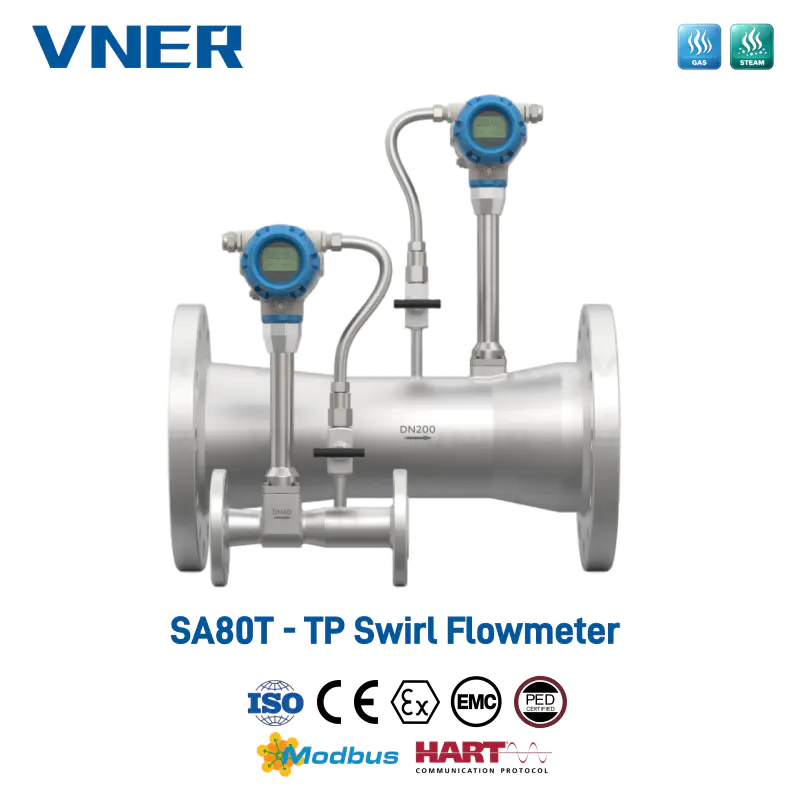
SA80T-TP Series Temperature/Pressure Compensation Swirl Flowmeter
Practical Application Example: Main Steam Header
Consider a plant with several production areas supplied by a common steam header. Boiler pressure changes according to demand, and steam temperature varies between operating periods. A basic volumetric meter may show changing flow even when the actual mass delivered to a process remains similar. Conversely, a stable volume reading may conceal a change in mass flow caused by pressure or temperature variation.
A SA80T-TP meter installed on the main header measures the swirl frequency, process temperature, and pressure. The converter calculates a compensated value and totalizes the result. Branch meters can then be installed at major consumers, allowing the plant to compare boiler output with departmental consumption.
If the main header total is significantly higher than the sum of branch totals, the difference may indicate unmetered users, leakage, measurement errors, or condensate-related issues. The measurement system therefore supports not only billing or reporting but also operational investigation.
Practical Application Example: Compressed Air Network
In a compressed air system, the compressor room may operate at a pressure different from remote production areas. Temperature can also change as air passes through aftercoolers, dryers, filters, and long pipe runs. A meter that reports only actual line volume may not provide a consistent basis for comparing compressor production and branch consumption.
With temperature and pressure compensation, the SA80T-TP Series can report standardized gas volume according to configured reference conditions. Meters installed at the compressor outlet and production branches can provide a network-wide view of air use.
When production stops but the measured flow remains high, the plant may have a leakage problem or equipment that has not been isolated. By using totalized and instantaneous readings, maintenance teams can prioritize surveys and evaluate the effect of corrective action.
Quality, Calibration, and Documentation
Flowmeter quality is determined by more than the appearance of the finished enclosure. Critical elements include dimensional control of the flow body, sensor installation, electronic stability, compensation algorithms, pressure testing, calibration, and documentation.
In-house calibration provides an important foundation for quality management. Each instrument can be evaluated against controlled flow conditions appropriate to its design and application. Calibration records help users verify the delivered product and establish a baseline for future maintenance.
Quality processes and traceability are also important for projects involving many instruments. A consistent documentation package can support receiving inspection, installation records, commissioning, maintenance planning, and audits. For critical measurement points, users should confirm the required calibration range, uncertainty, test medium, and documentation format during the procurement stage.
The manufacturer’s broad product portfolio also supports technology matching. Some applications are best served by electromagnetic measurement, while others require Coriolis, turbine, thermal mass, ultrasonic, vortex, swirl, or rotameter technology. Access to multiple technologies allows the engineering team to focus on application suitability rather than forcing every service into one measurement principle.
Maintenance Recommendations
Routine maintenance should include inspection of the process connections, cable glands, enclosure, display, communication signals, and installation supports. The user should check for unusual vibration, external corrosion, signs of leakage, or insulation damage.
For steam systems, inspection should also consider condensate management, thermal cycling, insulation condition, and possible water hammer. For gas systems, users should monitor contamination, liquid carryover, pressure pulsation, and filter condition where upstream conditioning equipment is installed.
Diagnostic information should be reviewed when the measured value appears inconsistent with production conditions. Operators can compare flow, temperature, pressure, totalizer values, and communication data to identify whether the issue is related to the process, installation, sensor, or configuration.
Calibration intervals should be based on application criticality, regulatory requirements, historical stability, and the consequences of incorrect measurement. High-value energy accounting points may require more frequent verification than general monitoring points.
Limitations and Responsible Application
No flowmeter is suitable for every process. The SA80T-TP Series should be selected within the specified pressure, temperature, flow, material, and installation limits. Accuracy statements apply under defined calibration and operating conditions, and actual performance can be affected by flow profile, medium quality, pulsation, vibration, sensor placement, and process instability.
Compensated mass or standard volume results depend on correct configuration of the medium and reference conditions. If the process composition changes significantly, the calculation may need to be reviewed. Gas composition, compressibility, steam condition, and density assumptions should be considered during engineering selection.
Users should also confirm any site-specific requirements related to hazardous locations, electrical classification, hygienic service, pressure equipment, emissions, communication security, and regulatory metering. These requirements may influence the final model, installation method, and documentation package.
Responsible application combines the capabilities of the instrument with sound process engineering. Proper sizing, piping design, commissioning, calibration, and periodic verification are essential to obtain the expected results.
Questions and Answers
What is the main purpose of the SA80T-TP Series?
The main purpose is to measure flow while compensating for the effects of process temperature and pressure. It is intended especially for steam, compressed air, and industrial gas applications where operating volume alone is not sufficient.
What flow values can the instrument provide?
Depending on the medium and configuration, the instrument can provide operating volumetric flow, standard volumetric flow, media-dependent mass flow, and totalized values. Outputs can be assigned according to the requirements of the control or energy management system.
Does the flowmeter contain moving parts?
No. The flowmeter uses a swirl or vortex precession measuring principle with an electronic sensor. Its fully welded flow path has no internal moving mechanical components such as turbine blades or bearings.
Can it measure both saturated and superheated steam?
Yes. The product is designed for saturated and superheated steam applications when the selected model, temperature rating, pressure rating, installation, and configuration are suitable for the process.
What is the temperature capability?
The standard temperature capability is up to 250°C. Extended steam versions can support temperatures up to 400°C when specified and selected for the application.
What pressure ratings are available?
Model-dependent pressure ratings include 1.6 MPa, 2.5 MPa, and 4.0 MPa. The final pressure rating must be selected according to the actual operating pressure, design pressure, temperature, flange standard, and project requirements.
Can the meter be used for compressed air?
Yes. Compressed air is a typical application. Temperature and pressure compensation allows the user to obtain standardized volume information for utility monitoring, leak detection, and branch-level cost allocation.
What communications are available?
Primary outputs include 4–20 mA and pulse. HART and Modbus RTU are available as optional digital communication functions for remote configuration and reading of measured and calculated variables.
What materials are available?
Flow body materials include carbon steel, SS304, and SS316L. Sensor wetted materials include SS304, SS316L, Hastelloy C, Hastelloy B, and titanium options, subject to model and application requirements.
How much straight pipe is normally required?
A typical recommendation is approximately three pipe diameters upstream and one pipe diameter downstream. The actual requirement should be confirmed according to the selected model, piping arrangement, fittings, valves, and process conditions.
Can the instrument replace separate pressure and temperature transmitters?
For the integrated flow compensation function, the product includes temperature and pressure measurement channels. Whether it can replace separate transmitters for all process control or safety functions depends on the plant’s instrumentation philosophy, redundancy requirements, and regulatory rules.
Is the product suitable for billing?
It can support internal utility accounting and cost allocation when properly selected, installed, calibrated, configured, and maintained. Formal trade or custody-transfer applications may require additional project-specific approval, certification, redundancy, or verification requirements.
What information is needed for product selection?
Important data includes medium, composition, minimum and maximum flow, normal flow, line size, operating pressure, design pressure, operating temperature, required accuracy, connection standard, body and sensor material, output type, reference conditions, and installation details.
What manufacturing strengths support the product?
The manufacturer provides multiple flow measurement technologies, in-house calibration, quality processes, traceability, engineering support, modern production facilities, and experience with industrial projects in many countries. These capabilities support both standard products and customized project requirements.
Conclusion
The SA80T-TP Series Temperature/Pressure Compensation Swirl Flowmeter addresses a common weakness in steam and gas measurement: the difference between operating volume and a meaningful compensated flow value. By combining swirl flow measurement with integrated temperature and pressure inputs, it provides a compact solution for calculating operating volume, standard volume, mass flow, and totalized consumption.
Its no-moving-parts design, welded flow path, industrial material options, configurable outputs, digital communication capabilities, and support for saturated steam, superheated steam, compressed air, and other gases make it suitable for a broad range of process and utility applications.
The product is particularly valuable for plants seeking better energy visibility, branch-level utility accounting, compressed air management, steam balance analysis, and process optimization. Compared with basic uncompensated meters, it delivers more relevant information when pressure and temperature vary. Compared with multi-instrument assemblies, it can simplify the measurement architecture by integrating primary flow measurement and compensation functions.
Its value is further supported by the manufacturer’s engineering and production capabilities. Experience across multiple flow technologies, in-house calibration, traceability, quality management, modern facilities, and international project experience provide a foundation for consistent product delivery and application support.
When correctly sized, installed, configured, and maintained, the SA80T-TP Series can become an important part of a modern industrial measurement system—helping users improve control, understand energy consumption, allocate costs, and make better decisions based on compensated flow data.
References
1. Product technical information for the SA80T-TP Series Temperature/Pressure Compensation Swirl Flowmeter.
2. Product information for industrial swirl and vortex precession flow measurement systems.
3. Industrial process instrumentation principles for steam, compressed air, and gas measurement.
4. General engineering practices for flowmeter installation, straight-pipe requirements, and process measurement accuracy.
5. Technical guidance on temperature and pressure compensation for gases and steam.
6. Industrial energy management practices for utility sub-metering and cost allocation.
7. Manufacturer information concerning flow measurement technologies, calibration, quality processes, and engineering project experience.
Product: SA80T-TP Series Temperature/Pressure Compensation Swirl Flowmeter



Products
Contact Information
-

+86 18652789521
+86-0514-83633600 / 83633900 -

+86-0514-83633600 / 83633900
-

s@vner.com.cn
katherine@vner.com.cn -

No. 11 Xingye Road, Chenji Town Industrial Park, Yizheng, Yangzhou, China
