
 0
0
 EN
EN  English
 عربى
عربى Español
 русский
If you need any help, please feel free to contact us
Home / Author / Ding Yuchun — Overseas After-Sales Support Engineer / Compact Multi-Parameter Electromagnetic Flowmeter for Intelligent Utility and Process Measurement
Compact Multi-Parameter Electromagnetic Flowmeter for Intelligent Utility and Process Measurement

Introduction
Modern industrial plants increasingly require more information from each field instrument. Measuring flow alone may no longer be sufficient for water treatment, utility distribution, equipment protection, process supervision, and intelligent manufacturing. Operators may also need to understand liquid temperature, conductivity, equipment status, alarm conditions, and communication data without installing several separate devices.
The VE803 compact electromagnetic flowmeter addresses this requirement through an integrated measurement platform for conductive liquids. It combines electromagnetic flow measurement with temperature and conductivity monitoring in a single compact instrument. The sensor and transmitter are installed in one housing, reducing the physical footprint and simplifying installation where panel space, piping access, or maintenance clearance is limited.
Designed for utility water and industrial process applications, the instrument provides a practical combination of stable measurement, digital connectivity, local visualization, and compact construction. Its available 4–20 mA, Modbus, and Bluetooth outputs allow it to serve both conventional control systems and newer mobile commissioning or intelligent manufacturing environments.
The product is manufactured by Jiangsu Vner Electronic Technology Co., Ltd., a specialized flow measurement company based in Yangzhou, China. Since 2011, the company has developed electromagnetic, Coriolis, vortex, swirl, turbine, thermal mass, ultrasonic, and metal tube rotameter technologies for liquid, gas, and slurry applications. This broader product experience supports the engineering, calibration, manufacturing, and application knowledge required to produce dependable industrial flow instruments.
What Is a Compact Electromagnetic Flowmeter?
An electromagnetic flowmeter measures the velocity of a conductive liquid by applying a magnetic field across the measuring tube. As the liquid moves through the magnetic field, a voltage is induced in proportion to the average flow velocity. Electrodes positioned in contact with the liquid detect this voltage, and the transmitter converts the signal into a flow rate and totalized value.
Because the measuring principle does not require a moving rotor, turbine wheel, impeller, or obstruction placed in the flow path, an electromagnetic flowmeter can offer long-term stability with minimal mechanical wear. The unobstructed measuring tube also produces negligible additional pressure loss compared with many mechanical flow technologies.
The VE803 extends this basic principle with multiple measurement functions. In addition to flow, it measures liquid temperature and conductivity. This combination gives users additional process information without requiring a separate temperature transmitter or conductivity instrument for every measurement point.
The instrument is available in nominal diameters from DN6 to DN50. This range supports small utility lines, laboratory or skid-mounted equipment, compact process packages, dosing systems, and branch piping. The appropriate diameter should be selected according to actual flow range, velocity, process pressure, liquid properties, connection requirements, and installation conditions.
Core Product Specifications
The VE803 is intended for conductive liquid measurement in applications where compact installation, reliable signal transmission, and integrated diagnostics are important. Its primary specifications are summarized below.
| Parameter | Specification |
|---|---|
| Product type | Compact electromagnetic flowmeter |
| Nominal diameter | DN6, DN15, DN25, DN40, DN50 |
| Measurement functions | Flow rate, temperature, and conductivity |
| Accuracy | ±0.5% F.S. |
| Maximum process pressure | Up to 1.6 MPa |
| Medium temperature | –10°C to +70°C |
| Ambient temperature | –10°C to +60°C |
| Wetted liner | PEEK |
| Electrode material | 316L stainless steel |
| Housing materials | 304 stainless steel and PMMA |
| Protection class | IP65 |
| Output signals | 4–20 mA, Modbus, and Bluetooth |
| Power supply | 24 VDC |
These specifications make the VE803 particularly suitable for compact utility installations and moderate-temperature conductive liquid services. Final product selection should always consider the liquid conductivity, pipe configuration, pressure rating, temperature conditions, grounding requirements, and expected operating flow range.
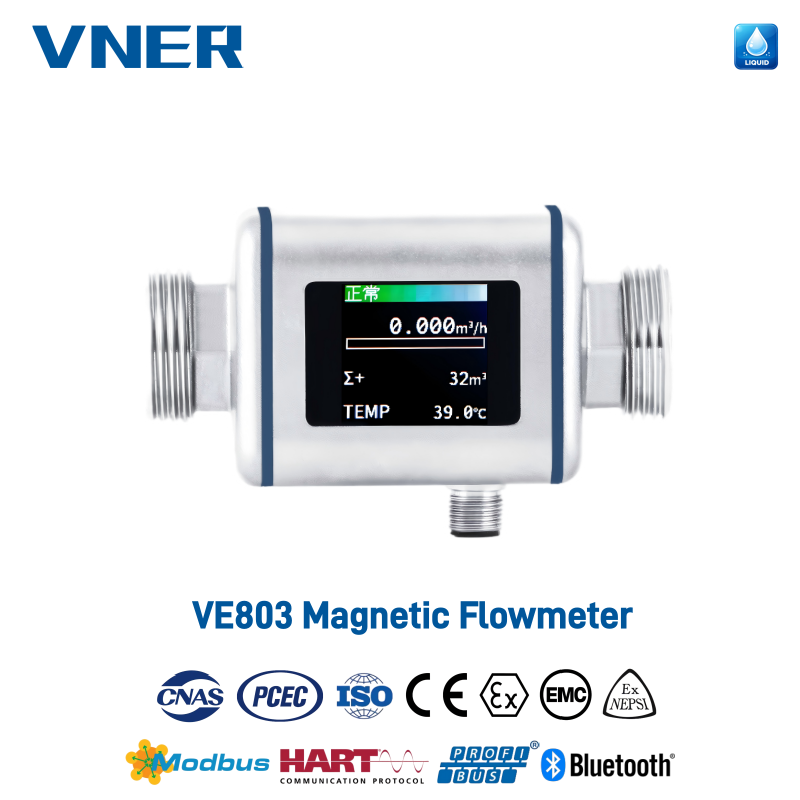
VE803 Compact Electromagnetic Flowmeter
Multi-Parameter Measurement in One Instrument
Flow Measurement
The primary function of the VE803 is accurate electromagnetic flow measurement. With a stated accuracy of ±0.5% F.S., the device is designed for general industrial process monitoring, utility water measurement, equipment control, and system supervision. The absence of internal moving parts helps reduce mechanical wear and supports repeatable operation over an extended service period.
Electromagnetic measurement is especially valuable when the liquid contains suspended particles or when the process would be affected by an internal obstruction. Since the measuring tube remains open and unobstructed, there is no turbine rotor to clog or mechanical assembly to wear in the flow path. This can simplify maintenance compared with some traditional mechanical meters.
Temperature Measurement
Temperature can influence process performance, material compatibility, equipment safety, and the interpretation of other process values. By integrating temperature measurement into the same device, the VE803 helps users observe the thermal condition of the measured liquid at the flow point itself.
The stated medium temperature range is –10°C to +70°C, while the ambient temperature range is –10°C to +60°C. These conditions cover many ordinary utility water and industrial process applications. Temperature information can be used for monitoring, alarm logic, trend analysis, and operating confirmation. It can also help maintenance personnel identify abnormal conditions that may not be visible from flow data alone.
Conductivity Measurement
Conductivity provides useful information about the electrical properties of a liquid. For conductive water and process liquids, conductivity trends may indicate changes in concentration, contamination, dilution, chemical addition, or water quality. The VE803 incorporates conductivity monitoring so that users can obtain an additional process indicator from the same measuring point.
Combining flow and conductivity data can make the instrument more useful than a conventional single-variable flowmeter. For example, a utility operator may observe that flow remains stable while conductivity changes unexpectedly. This could prompt an inspection of water quality, chemical dosing, mixing, or upstream process conditions. The instrument does not replace specialized laboratory analysis where required, but it provides valuable real-time field information.
Reduced Instrument Count
A conventional installation may require an electromagnetic flowmeter, a separate temperature sensor, a conductivity transmitter, additional wiring, and several mounting or cabinet arrangements. The integrated design of the VE803 can reduce the number of field devices required at the measurement point.
Fewer instruments can simplify procurement, mechanical installation, electrical wiring, commissioning, and routine inspection. It may also reduce the number of display interfaces that operators must check. In compact skids and packaged systems, this reduction in equipment count can be particularly valuable.
Compact Integrated Construction
The VE803 combines the sensor and transmitter in one housing. This compact configuration eliminates the need to install a remote transmitter separately from the sensor in applications where a remote arrangement is not necessary. It is well suited to short pipe sections, utility cabinets, machine packages, water treatment modules, and process skids.
A compact integrated meter can also reduce cable length between the sensing element and signal processing electronics. Shorter connections may simplify installation and make the complete measurement point easier to identify during commissioning. The stainless steel and PMMA housing construction provides a practical combination of mechanical durability, visibility, and compact form.
Space-saving construction is not only an advantage for new installations. It can also help when upgrading an existing system. Older instruments may occupy large panels or use separate transmitters that are difficult to access. A compact replacement can provide additional functionality without requiring extensive changes to the surrounding equipment, subject to dimensional and connection compatibility.
The IP65 protection class provides protection against dust ingress and water jets from suitable directions. This supports use in many indoor industrial areas and protected outdoor installations. The installation environment should still be evaluated carefully, especially where the instrument may be exposed to continuous flooding, high-pressure cleaning, corrosive vapors, direct sunlight, severe vibration, or temperatures outside the specified range.
Unobstructed Measuring Tube and Low Pressure Loss
Pressure loss is an important consideration in utility and process piping. Every unnecessary restriction can increase pump energy consumption, reduce available downstream pressure, or affect the performance of an entire system. The VE803 uses an unobstructed electromagnetic measuring tube, allowing the liquid to pass through without a mechanical rotor or throttling element in the flow path.
This arrangement produces negligible pressure loss under normal operating conditions. Compared with some mechanical flowmeters, the absence of moving internal components can also reduce the risk of performance changes caused by bearing wear, rotor fouling, or debris interference.
For water and process systems operating continuously, low pressure loss can support efficient system design. It may help maintain pump performance and reduce the need to compensate for the pressure drop of the instrument. The actual system effect depends on pipe size, flow velocity, fittings, fluid properties, and the complete piping arrangement, so engineering evaluation remains important.
Materials Selected for Industrial Service
PEEK Liner
The wetted liner is made from PEEK, a high-performance engineering polymer known for mechanical strength, dimensional stability, and resistance to many industrial environments. In a flowmeter, the liner separates the measured liquid from the body while maintaining the internal geometry needed for stable measurement.
PEEK can be advantageous in compact flowmeter construction where the liner must withstand pressure, temperature, and repeated operating conditions. Its selection is consistent with the requirements of small-diameter industrial instruments that need a robust wetted surface. Chemical compatibility must nevertheless be checked against the actual medium, concentration, temperature, and cleaning chemicals used by the customer.
316L Electrodes
The electrodes are made from 316L stainless steel. This material is widely used in industrial instrumentation because of its corrosion resistance and suitability for many water and process applications. The electrodes are the direct sensing interface between the liquid and the measurement electronics, making material selection important for signal stability and service life.
As with all wetted materials, 316L compatibility depends on the liquid chemistry. Chloride concentration, acidity, oxidizing agents, high-temperature cleaning, and other process factors should be evaluated before final selection.
Stainless Steel Housing
The housing uses 304 stainless steel together with PMMA elements. Stainless steel provides structural strength and a durable external surface for industrial environments. PMMA can support display visibility and allow operators to read local information clearly.
The combination supports a balance between ruggedness and usability. A clear, high-resolution display allows users to see measured values, operating status, warnings, and alarm indications without relying entirely on a remote control system.
Bluetooth Connectivity and Digital Commissioning
Bluetooth connectivity is one of the product’s notable advantages in comparison with conventional flowmeters that rely exclusively on local pushbuttons or wired configuration tools. Built-in Bluetooth enables wireless configuration, commissioning, and data management through compatible mobile devices.
Wireless access can make startup more efficient when the instrument is mounted in a difficult-to-reach position or installed inside a compact package. Technicians may be able to check settings, review status information, and perform configuration tasks without opening the housing or connecting a temporary cable, subject to the applicable safety and site procedures.
Bluetooth can also support maintenance efficiency. During inspection, a technician can access instrument information at the measurement point rather than returning repeatedly to a control cabinet. This may shorten troubleshooting time and improve the documentation of operating conditions.
Wireless connectivity should be managed according to the customer’s cybersecurity and site-access policies. Bluetooth is an operational convenience and should complement, rather than replace, appropriate authorization, password management, network security, and industrial control procedures.
Communication and Control Integration
4–20 mA Output
The 4–20 mA signal remains one of the most widely used industrial outputs. It can be connected to programmable logic controllers, distributed control systems, data acquisition equipment, chart recorders, and other conventional automation devices. The signal is familiar to instrumentation technicians and can be transmitted over ordinary industrial cable runs.
For facilities with existing analog infrastructure, the 4–20 mA output allows the VE803 to be integrated without requiring a complete control-system modernization. It can provide a primary process value to a controller while the local display and Bluetooth interface support setup and maintenance.
Modbus Communication
Modbus communication allows digital data exchange with industrial control and supervisory systems. Compared with a single analog value, digital communication can provide access to more operating information, depending on the configured register map and system design. This may include measured values, diagnostic data, alarm states, and configuration information.
Digital communication can reduce the need for multiple analog signal cables when several variables must be made available to a control system. It also supports structured data collection for plant monitoring and historical analysis.
Bluetooth Access
Bluetooth provides a local wireless channel for configuration and data management. Together, 4–20 mA, Modbus, and Bluetooth give the VE803 flexibility across different levels of an automation architecture: analog control, digital system integration, and local mobile access.
Diagnostics, Alarms, and Local Display
Reliable measurement involves more than displaying a numerical value. Operators also need to know whether the instrument is functioning normally, whether the measured condition has changed, and whether an alarm requires attention. The VE803 includes clear diagnostics and alarm indications intended to improve operational awareness.
Intuitive warnings can help personnel identify abnormal conditions during startup or routine operation. Examples of situations that may require investigation include an unsuitable process condition, an unexpected measurement state, communication problems, or a condition outside the configured operating limits. The exact diagnostic behavior depends on instrument configuration and application conditions.
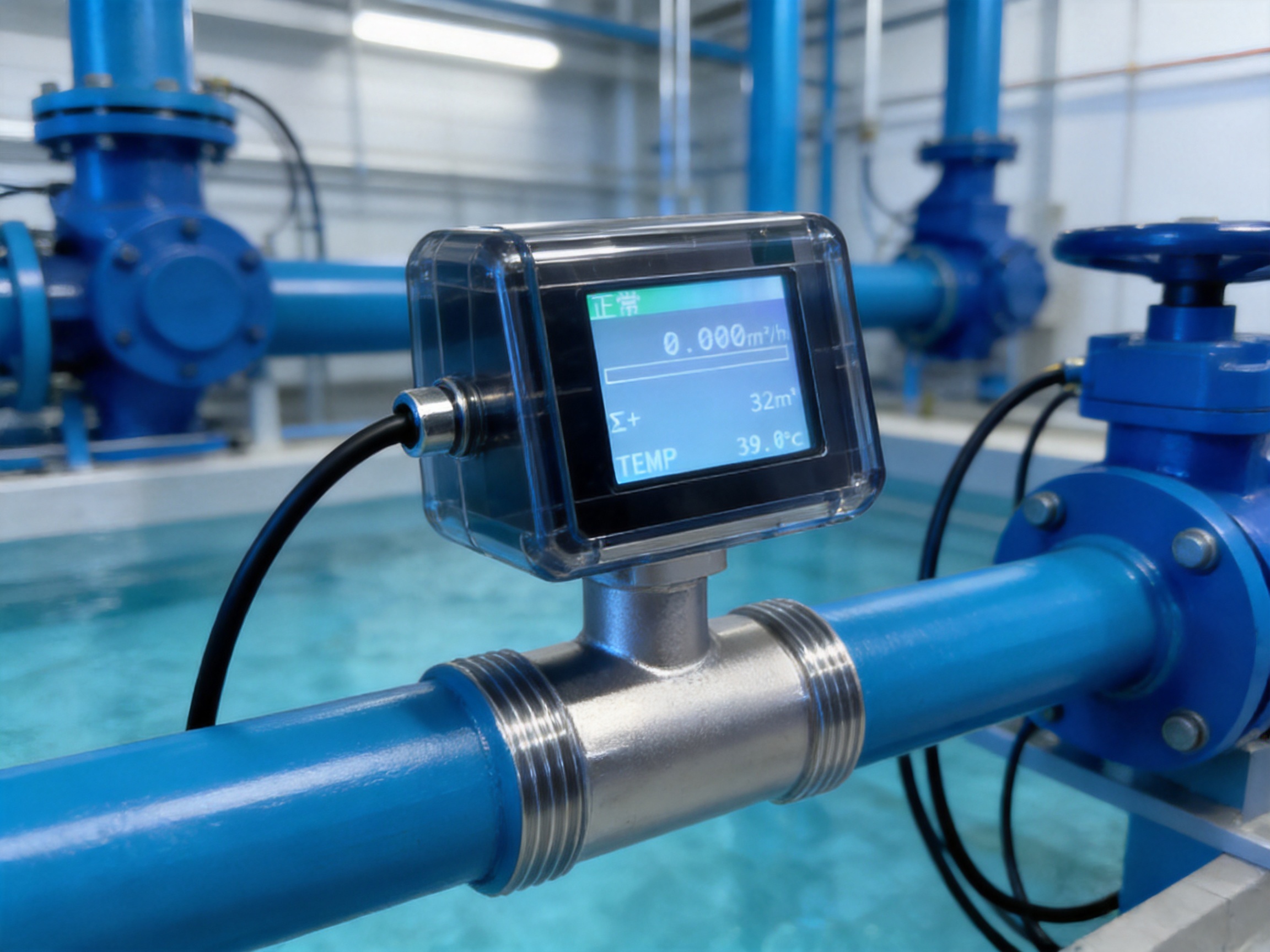
The large high-resolution display provides local visualization of measured values and operating status. This is useful during commissioning because technicians can compare the instrument reading with process conditions while standing at the pipe. It is also helpful during maintenance when the control room is unavailable or when a field technician needs immediate information.
Local display capability can reduce dependence on external indicators. However, it should be viewed as part of a complete instrumentation strategy. Critical applications may still require independent alarms, redundant measurements, safety interlocks, or validated process control systems.
Advantages Compared with Alternative Flowmeter Technologies
Compared with Mechanical Turbine Meters
Turbine meters use a rotating element that is driven by the moving liquid. They can provide useful measurement performance, but their moving parts may be affected by wear, suspended solids, contamination, or changes in mechanical friction. They may also require strainers and more frequent inspection in demanding services.
The VE803 has no rotating measuring element and provides an unobstructed flow path. This can reduce mechanical maintenance concerns and avoid additional pressure loss associated with internal moving assemblies. It also adds temperature and conductivity measurement, which a basic turbine meter does not normally provide as an integrated function.
Turbine meters may remain appropriate for some clean-liquid applications, especially where their specific accuracy, range, or cost characteristics are preferred. The advantage of the VE803 is its combination of solid-state electromagnetic measurement, multiple process variables, and digital connectivity.
Compared with Variable-Area Rotameters
Metal tube rotameters and other variable-area meters provide a simple visual indication of flow. They can be useful for local monitoring and do not necessarily require complex electronics. However, their information is often limited to a local flow indication unless additional transmitters are installed.
The VE803 provides electronic outputs, Modbus communication, Bluetooth access, alarm information, and a high-resolution display. It can therefore participate in automated monitoring rather than serving only as a local visual indicator. Its integrated temperature and conductivity functions further extend its capability.
Compared with Vortex Flowmeters
Vortex flowmeters are commonly applied to gases, steam, and some liquids. Their performance depends on flow conditions, pipe geometry, Reynolds number, and the formation of stable vortices behind an internal bluff body. They may not be the preferred option for every low-conductivity or particulate liquid service.
The VE803 uses electromagnetic measurement and is intended for conductive liquids. Its unobstructed tube is beneficial where pressure loss and internal restrictions are concerns. It should not be treated as a universal replacement for vortex technology, particularly in gas or steam services, but it offers a more appropriate measurement principle for many conductive-liquid applications.
Compared with Ultrasonic Flowmeters
Ultrasonic flowmeters can measure liquids using transit-time or Doppler techniques and may offer installation flexibility in certain configurations. Performance can depend on acoustic conditions, liquid composition, pipe material, flow profile, and installation quality.
The VE803 provides a dedicated wetted electromagnetic sensor with integrated electronics. For compatible conductive liquids and correctly prepared piping, it offers a direct measurement arrangement with a known liner and electrode construction. The best choice depends on whether the application prioritizes non-contact installation, portability, conductivity compatibility, pressure loss, or integrated process variables.
Compared with Coriolis Mass Flowmeters
Coriolis meters can measure mass flow and often provide density and temperature information. They are highly capable instruments for demanding applications, but their construction, installation requirements, and cost may be greater than necessary for ordinary utility water or general conductive-liquid monitoring.
The VE803 measures volumetric flow and adds temperature and conductivity in a compact design. For utility and process applications where volumetric flow is the required parameter, this may provide a more economical and space-efficient solution. Coriolis technology remains advantageous when direct mass flow, density measurement, or highly specialized process control is essential.
Application Areas
Utility Water Measurement
Utility water systems often contain multiple branches serving cooling, washing, production, and general plant services. A compact electromagnetic flowmeter can monitor individual branches without introducing significant pressure loss. Temperature and conductivity data can provide additional visibility into water quality and operating conditions.
The VE803 can be used in compact water distribution assemblies, equipment utility connections, water treatment skids, and plant service lines. Its 24 VDC supply and industrial signal outputs are compatible with many common automation architectures.
Industrial Process Control
Industrial processes frequently require stable flow information for batching, circulation, chemical dilution, cooling, washing, and material transfer. The VE803 can supply a continuous flow signal while also monitoring temperature and conductivity at the same point.
In process control, the combination of measurements may help operators detect changes earlier. A flow reduction may indicate a pump or valve issue. A conductivity change may suggest altered concentration or contamination. A temperature increase may indicate a cooling problem or abnormal process condition. These values can be used together for more informed supervision.
Intelligent Manufacturing Systems
Smart manufacturing depends on collecting reliable field data and making it available to control, monitoring, and maintenance systems. The VE803 supports this direction through Modbus communication, Bluetooth access, local diagnostics, and multiple measured variables.
Integrators can use the instrument as part of a machine package or production module. Its compact housing is suitable for installations where numerous devices must fit within a limited space. Digital information can support production records, equipment performance reviews, preventive maintenance, and process trend analysis.
Conductive Liquids in Compact Installations
Many skid-mounted systems have limited room for separate instruments. A single integrated device can reduce layout complexity and leave more space for valves, pumps, sampling points, and service access. The VE803 is suited to conductive-liquid measurement in these compact arrangements, provided that the liquid and process conditions fall within the specified limits.
Engineering and Installation Considerations
Confirm Liquid Conductivity
Electromagnetic flowmeters require a conductive liquid. Before ordering, the application engineer should confirm that the liquid has adequate conductivity for the selected meter and that the conductivity remains suitable throughout the expected operating range. Changes in composition, temperature, or concentration may affect conductivity.
Select the Correct Diameter
Available sizes include DN6, DN15, DN25, DN40, and DN50. Selecting the correct nominal diameter requires more than matching the existing pipe size. The expected minimum, normal, and maximum flow rates should be compared with the recommended velocity range for the instrument and process.
An oversized meter may operate at a very low velocity, reducing measurement resolution or stability. An undersized meter may create unnecessary velocity and process restrictions. Proper sizing should consider continuous operation, intermittent flow, startup conditions, pressure, and future capacity requirements.
Provide a Suitable Flow Profile
As with all flowmeters, installation should provide a stable flow profile. Excessive turbulence from pumps, elbows, control valves, reducers, or partially open valves can influence measurement performance. Straight-run requirements and installation orientation should be determined from the manufacturer’s technical documentation and the specific pipe arrangement.
The measuring tube should remain full during operation. A partially filled pipe, free-falling discharge, or poorly positioned installation can produce unstable readings. Air entrainment should be minimized, and the meter should be located where the liquid remains in contact with the electrodes.
Consider Grounding and Electrical Installation
Correct grounding and electrical installation are important for electromagnetic measurement. The installer should follow the product wiring instructions and ensure that the process connection, grounding arrangement, power supply, signal cables, and shielding are appropriate for the site.
The VE803 uses a 24 VDC power supply. The supply should be stable and suitably protected against electrical noise, transient conditions, and incorrect polarity. Signal cables should be routed in a manner that minimizes interference from high-power motors, variable-frequency drives, and switching equipment.
Review Pressure and Temperature
The maximum process pressure is up to 1.6 MPa, and the medium temperature range is –10°C to +70°C. These limits must be compared with actual operating, startup, shutdown, cleaning, and upset conditions. Pressure surges and temperature excursions should not be ignored simply because normal operation appears to be within range.
Plan for Maintenance Access
Although electromagnetic flowmeters generally require limited mechanical maintenance, the instrument should remain accessible for inspection, verification, wiring checks, and display observation. A compact design makes installation easier, but compactness should not result in an inaccessible location.
Manufacturing Strengths and Quality Approach
The performance of an industrial flowmeter depends not only on its measurement principle but also on the consistency of its manufacturing process. Sensor geometry, liner installation, electrode positioning, electronic assembly, sealing, calibration, software configuration, and final inspection all contribute to the quality of the finished product.
Jiangsu Vner Electronic Technology Co., Ltd. operates modern facilities totaling approximately 23,000 square meters across three plants. The company has a technical team of more than 150 people and has delivered over 2,000 engineering projects in more than 30 countries. This experience exposes the organization to a broad range of process conditions, installation practices, industries, and customer requirements.
Its product portfolio includes electromagnetic, Coriolis, vortex, swirl, turbine, thermal mass, ultrasonic, and rotameter technologies. This range is significant because different measurement principles require different engineering approaches. Experience across multiple technologies can strengthen product selection, application support, and system-level understanding.
In-House Calibration
In-house calibration is an important manufacturing capability for flow instrumentation. Calibration provides a controlled comparison between the instrument output and a known reference under defined conditions. It helps verify sensor and transmitter performance before shipment and supports product consistency across production batches.
A structured calibration process can also contribute to traceability. Calibration records, test conditions, instrument identification, and acceptance criteria can be used to support quality documentation for industrial customers, EPC contractors, and OEM partners.
Certified Quality Processes
Certified quality processes provide a framework for controlling design, purchasing, production, inspection, nonconformance handling, and continuous improvement. For an industrial instrument manufacturer, systematic quality management is essential because a flowmeter is often installed as part of a larger process where measurement errors can affect energy use, product quality, water balance, or equipment protection.
Quality control should cover incoming materials, machining and fabrication, wetted component assembly, electronics, enclosure sealing, software and parameter configuration, calibration, visual inspection, and final functional testing. These controls are especially important for a product that combines multiple measurement functions and communication interfaces.
Engineering-Driven Sizing and Selection
Choosing a flowmeter based only on pipe diameter can lead to poor results. Vner’s engineering-driven approach emphasizes the relationship between process conditions, fluid properties, flow range, pressure, temperature, material compatibility, and installation arrangement.
For the VE803, this approach helps determine whether electromagnetic measurement is suitable, whether the liquid is sufficiently conductive, which nominal diameter is appropriate, and whether the available materials match the medium. Good engineering selection reduces the risk of oversizing, undersizing, incompatible materials, unstable flow, and unexpected commissioning difficulties.
Automated Manufacturing Development
Increasingly automated manufacturing can improve repeatability and production efficiency when combined with appropriate inspection and process controls. Automation may support consistent assembly, reduce variation in repetitive operations, improve production records, and help maintain stable output as demand grows.
Automation alone does not guarantee quality. Its value depends on correct process design, calibration of production equipment, operator training, inspection standards, and traceable documentation. The company’s focus on product consistency and long-term reliability places manufacturing automation within a broader quality strategy.
Traceability and Long-Term Reliability
Industrial customers often require more than a device that works during initial commissioning. They need consistent replacement products, clear technical data, reliable service support, and confidence that the instrument will continue to perform in the field.
Traceability helps connect the finished meter with its components, production records, calibration results, and inspection status. This is valuable for EPC projects, OEM equipment, plant expansions, and regulated industrial environments. It also supports more efficient investigation if a customer reports an abnormal operating condition.

Value for EPC Contractors, OEMs, and End Users
For EPC Contractors
EPC contractors benefit from instruments that are clearly specified, available in practical sizes, straightforward to install, and compatible with common control systems. The VE803’s 4–20 mA and Modbus outputs allow it to fit into different project architectures, while its compact form can simplify layout in packaged systems.
Integrated temperature and conductivity measurement may also reduce the number of separate instrument tags, supports, cables, and installation points required for a project. Project engineers must still confirm all required specifications, certifications, connection standards, and site conditions during design.
For OEM Equipment Builders
OEMs often need compact, repeatable instruments that can be installed in machines or skids produced in series. The VE803’s integrated construction and 24 VDC supply are suitable for many equipment packages. Bluetooth commissioning can make parameter setup more efficient during factory acceptance testing and field installation.
The availability of multiple sizes helps OEMs adapt the meter to different machine capacities. A common product family can simplify training, spare parts, documentation, and service procedures across a range of equipment models.
For End Users
End users can obtain flow, temperature, and conductivity information from a single measurement point. The local display supports immediate field observation, while Modbus and 4–20 mA outputs allow connection to existing automation systems. Bluetooth provides an additional tool for authorized configuration and maintenance.
The unobstructed tube and absence of moving measuring parts can reduce concerns associated with mechanical wear and pressure loss. Durable wetted and housing materials support use in suitable industrial environments, provided that application conditions remain within the product limits.
How the VE803 Supports Total Cost Control
Total cost is influenced by purchase price, installation effort, control-system integration, energy use, maintenance, downtime, spare parts, and replacement requirements. A compact multi-parameter device can affect several of these factors at the same time.
One instrument may reduce the need for separate temperature and conductivity hardware. Integrated construction may reduce mounting and wiring work. Low pressure loss may avoid unnecessary hydraulic penalties. Solid-state electromagnetic measurement may reduce maintenance related to rotating parts. Digital communication and Bluetooth may shorten commissioning and troubleshooting activities.
These potential benefits should be evaluated over the complete application lifecycle rather than through initial purchase price alone. The financial value will depend on the number of measurement points, labor rates, system architecture, process criticality, maintenance practices, and the cost of downtime.
Recommended Selection Checklist
Before specifying the VE803, users should prepare a complete application data sheet. The following checklist can help identify important design factors.
| Selection item | Questions to confirm |
|---|---|
| Liquid | Is the medium conductive and chemically compatible with PEEK and 316L? |
| Flow range | What are the minimum, normal, maximum, and occasional flow rates? |
| Pipe size | Which available nominal diameter provides the correct operating velocity? |
| Pressure | Does the operating and surge pressure remain within the pressure rating? |
| Temperature | Are normal, cleaning, startup, and upset temperatures within –10°C to +70°C? |
| Ambient conditions | Will the surrounding temperature remain within –10°C to +60°C? |
| Installation | Will the pipe remain full and provide a stable flow profile? |
| Power | Is a suitable 24 VDC supply available? |
| Signals | Should the system use 4–20 mA, Modbus, Bluetooth, or a combination? |
| Maintenance | Is the display and wiring area accessible for inspection and service? |
| Environment | Is IP65 adequate for moisture, dust, cleaning, and site exposure? |
Completing this checklist before purchase can reduce specification changes, installation delays, and commissioning problems. Where the process is unusual or critical, a detailed engineering review should be requested.
Q&A
What type of liquid can the VE803 measure?
The VE803 is designed for conductive liquids. Utility water and many industrial process liquids are suitable candidates, but conductivity and chemical compatibility should be confirmed before selection. It is not intended as a general-purpose meter for nonconductive liquids, gases, or steam.
What variables does the instrument measure?
The instrument measures flow rate, liquid temperature, and conductivity. These values can be viewed locally and made available through the supported output and communication functions, subject to configuration.
Does the VE803 have moving parts?
No. Electromagnetic flow measurement uses a magnetic field and electrodes rather than a rotating turbine or mechanical impeller. The unobstructed measuring tube helps minimize pressure loss and reduces mechanical wear concerns.
What accuracy is specified?
The stated accuracy is ±0.5% F.S. Actual performance depends on correct sizing, installation, grounding, liquid conductivity, flow conditions, calibration, and operation within the specified limits.
Which sizes are available?
The available nominal diameters are DN6, DN15, DN25, DN40, and DN50. Selection should be based on the actual flow range and process conditions rather than pipe size alone.
What are the pressure and temperature limits?
The process pressure is up to 1.6 MPa. The medium temperature range is –10°C to +70°C, and the ambient temperature range is –10°C to +60°C. The complete application should be checked for pressure surges and temporary temperature conditions.
Can the instrument connect to a PLC or control system?
Yes. The VE803 provides 4–20 mA and Modbus outputs. These interfaces support connection to many conventional and digital industrial automation systems.
What is the purpose of Bluetooth?
Built-in Bluetooth supports wireless configuration, commissioning, and data management through compatible mobile devices. It can make field setup and maintenance more convenient, especially when the instrument is installed in a compact or difficult-to-access location.
Is the VE803 suitable for outdoor use?
The instrument has an IP65 protection class and may be suitable for protected outdoor installations when the temperature, moisture, chemical exposure, vibration, and installation conditions are appropriate. It should not be installed where it will be continuously submerged or exposed to conditions beyond its specified protection and environmental limits.
Why is the unobstructed tube important?
An unobstructed tube allows liquid to pass without a rotor or throttling element inside the measuring path. This helps produce negligible pressure loss and avoids maintenance issues associated with mechanical moving parts.
Can conductivity measurement replace laboratory testing?
No. Integrated conductivity measurement provides useful real-time process information, but it does not replace laboratory analysis or specialized water-quality testing when those are required. The reading should be interpreted according to the process and the configured instrument conditions.
What materials are in contact with the liquid?
The stated wetted materials are a PEEK liner and 316L electrodes. Chemical compatibility should be checked against the exact liquid, concentration, temperature, cleaning agents, and operating cycle.
How does the compact design help installation?
The sensor and transmitter are integrated into one housing. This reduces the installation footprint, eliminates a separate remote transmitter in suitable applications, and can simplify wiring and commissioning in compact utility or process packages.
What should be reviewed before ordering?
Users should review liquid conductivity, chemical compatibility, flow range, nominal diameter, process pressure, medium and ambient temperature, pipe layout, grounding, power supply, communication requirements, environmental protection, and maintenance access.
Conclusion
The VE803 compact electromagnetic flowmeter is designed for a growing class of applications that require more process information from less installation space. By combining flow, temperature, and conductivity measurement in one device, it can provide a more complete view of conductive-liquid conditions than a basic single-variable flowmeter.
Its electromagnetic measuring principle avoids moving parts and maintains an unobstructed flow path, supporting negligible pressure loss and reduced mechanical wear concerns. The compact integrated construction is valuable for utility systems, industrial skids, intelligent manufacturing equipment, and other installations where space and wiring simplicity matter.
Bluetooth connectivity adds a practical commissioning and maintenance function, while 4–20 mA and Modbus outputs enable connection to established and modern automation systems. The high-resolution display, diagnostics, and alarms improve local visibility and support more efficient field operation.
The product’s value is reinforced by the manufacturing capabilities of Jiangsu Vner Electronic Technology Co., Ltd. Its broad flowmeter portfolio, modern multi-plant production base, technical team, in-house calibration, quality processes, engineering-driven selection, and focus on traceability provide a foundation for industrial supply and project support.
As with every flow measurement application, successful performance depends on correct sizing, compatible materials, proper installation, suitable grounding, stable power, and operation within the specified limits. When these factors are properly addressed, the VE803 offers a compact and versatile solution for reliable conductive-liquid measurement and more intelligent process monitoring.
References
1. Manufacturer product information for the VE803 Compact Electromagnetic Flowmeter.
2. Manufacturer technical information covering electromagnetic flow measurement, multi-parameter monitoring, output interfaces, and installation requirements.
3. General industrial instrumentation practices for electromagnetic flowmeter sizing, grounding, calibration, and commissioning.
4. Industrial process measurement principles for conductive-liquid flow, temperature monitoring, and conductivity analysis.
5. Quality management and calibration practices for industrial flow instrumentation manufacturing.
6. General engineering guidance for material compatibility, pressure selection, temperature limits, and installation of process measurement devices.
Product: VE803 Compact Electromagnetic Flowmeter


We offer all our products and services at international standards.
Products
Contact Information
-

+86-18652789521
+86-18052582295
+86-0514-83633600 / 83633900 -

+86-0514-83633600 / 83633900
-

shawn@vnerflow.com
info@vnerflow.com -

No. 11 Xingye Road, Chenji Town Industrial Park, Yizheng, Yangzhou, China
