
 0
0
 EN
EN  English
 عربى
عربى Español
 русский
If you need any help, please feel free to contact us
Home / Author / Ding Yuchun — Overseas After-Sales Support Engineer / Economical General-Purpose Electromagnetic Flowmeter for Reliable Industrial Measurement
Economical General-Purpose Electromagnetic Flowmeter for Reliable Industrial Measurement
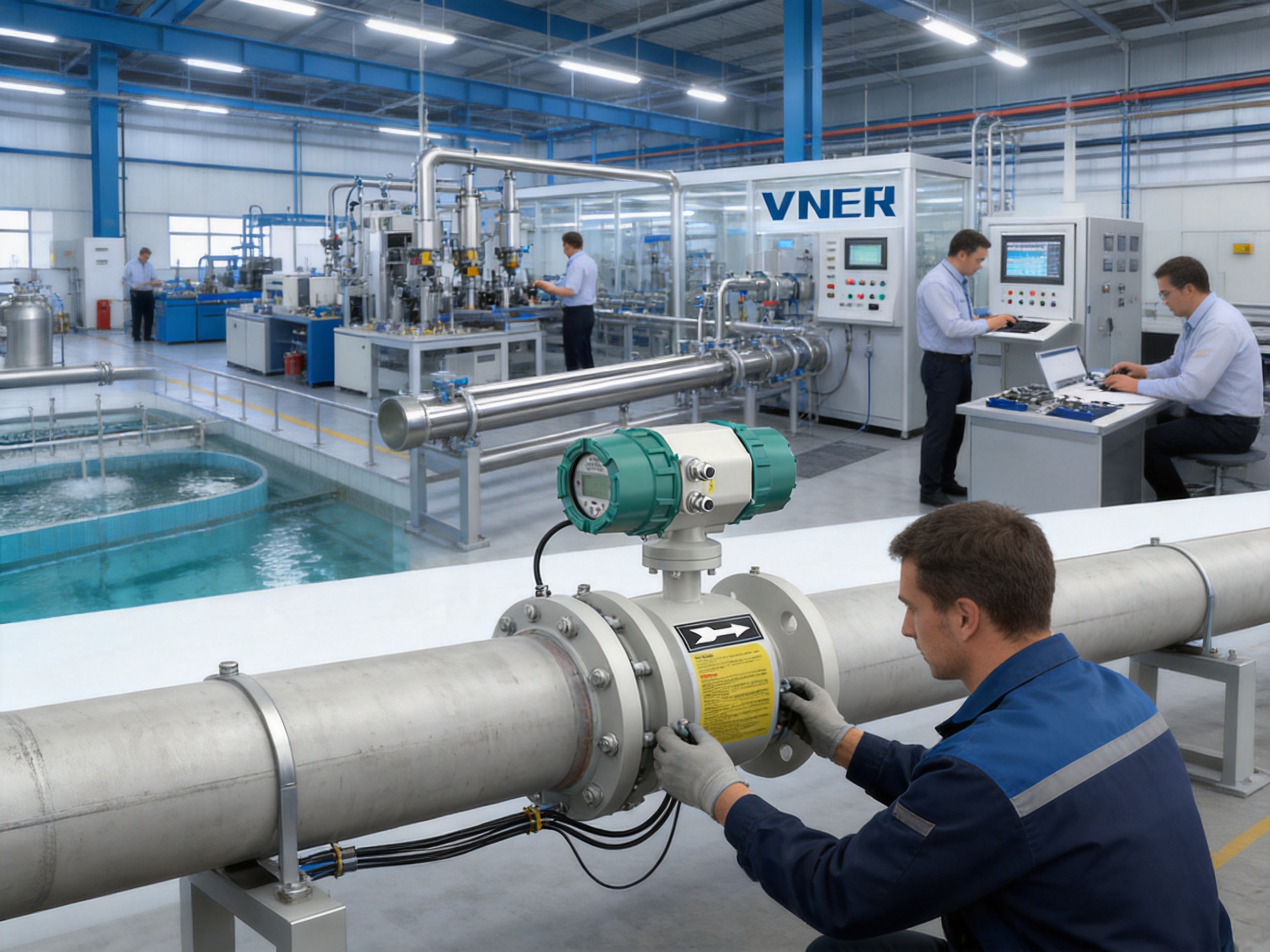
Accurate flow measurement is essential wherever liquids must be monitored, controlled, transferred, or accounted for. Municipal water networks, wastewater plants, agricultural irrigation systems, chemical handling facilities, HVAC installations, food-processing lines, and general manufacturing operations all depend on dependable flow information. However, not every application requires the advanced functions, specialized materials, or high investment associated with premium electromagnetic flowmeter systems. Many users need a stable, practical, and easy-to-integrate instrument that delivers reliable measurement at a reasonable total cost.
The LDG Economy General-Purpose Electromagnetic Flowmeter is designed for this requirement. It is a cost-effective magmeter for electrically conductive liquids with a minimum conductivity of approximately 5 μS/cm. The instrument combines a full-bore electromagnetic sensor with a digital transmitter in an integrated structure. By using Faraday’s law of electromagnetic induction, it measures liquid velocity without moving components, mechanical throttling elements, or internal obstructions.
This design makes the LDG suitable for clean water, treated water, wastewater, process water, selected chemical liquids, irrigation fluids, and uniform liquid-solid mixtures such as suspensions and pulp. It provides a practical balance between measurement performance, installation convenience, material flexibility, communication capability, and purchase cost.
Manufactured by Jiangsu Vner Electronic Technology Co., Ltd., the LDG benefits from the company’s specialization in industrial flow instrumentation, in-house calibration, engineering-based sizing, certified quality processes, and automated production development. The result is a general-purpose electromagnetic flowmeter intended not merely to provide a low purchase price, but to reduce installation effort, routine maintenance, replacement frequency, and long-term operating costs.
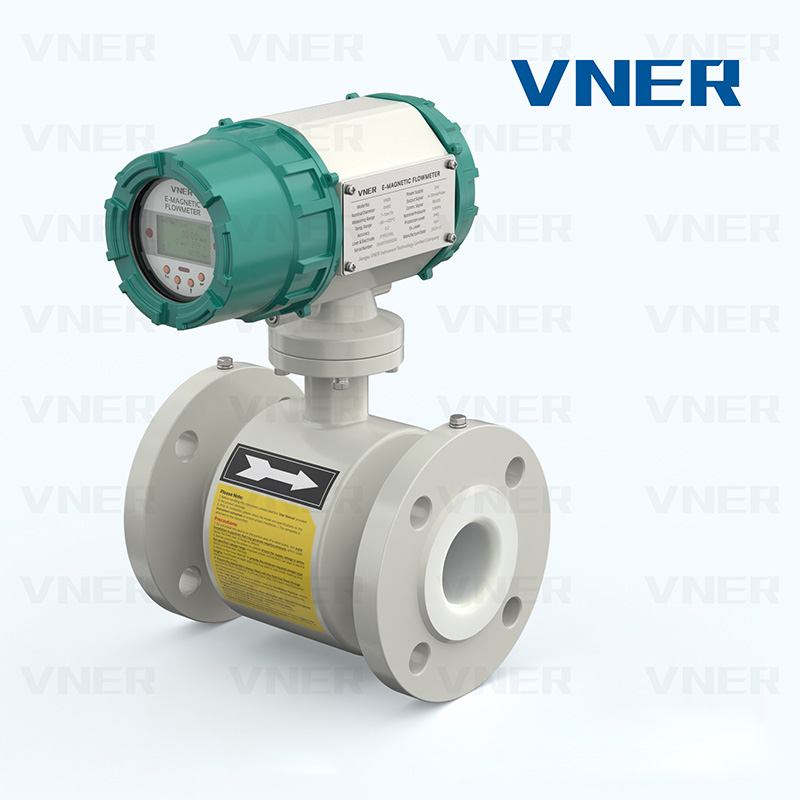
LDG Economy General-Purpose Electromagnetic Flowmeter-副本
1. What Is an Electromagnetic Flowmeter?
An electromagnetic flowmeter, also called a magnetic flowmeter or magmeter, measures the volumetric flow of conductive liquids. Its operating principle is based on Faraday’s law, which states that a voltage is induced when a conductive medium moves through a magnetic field.
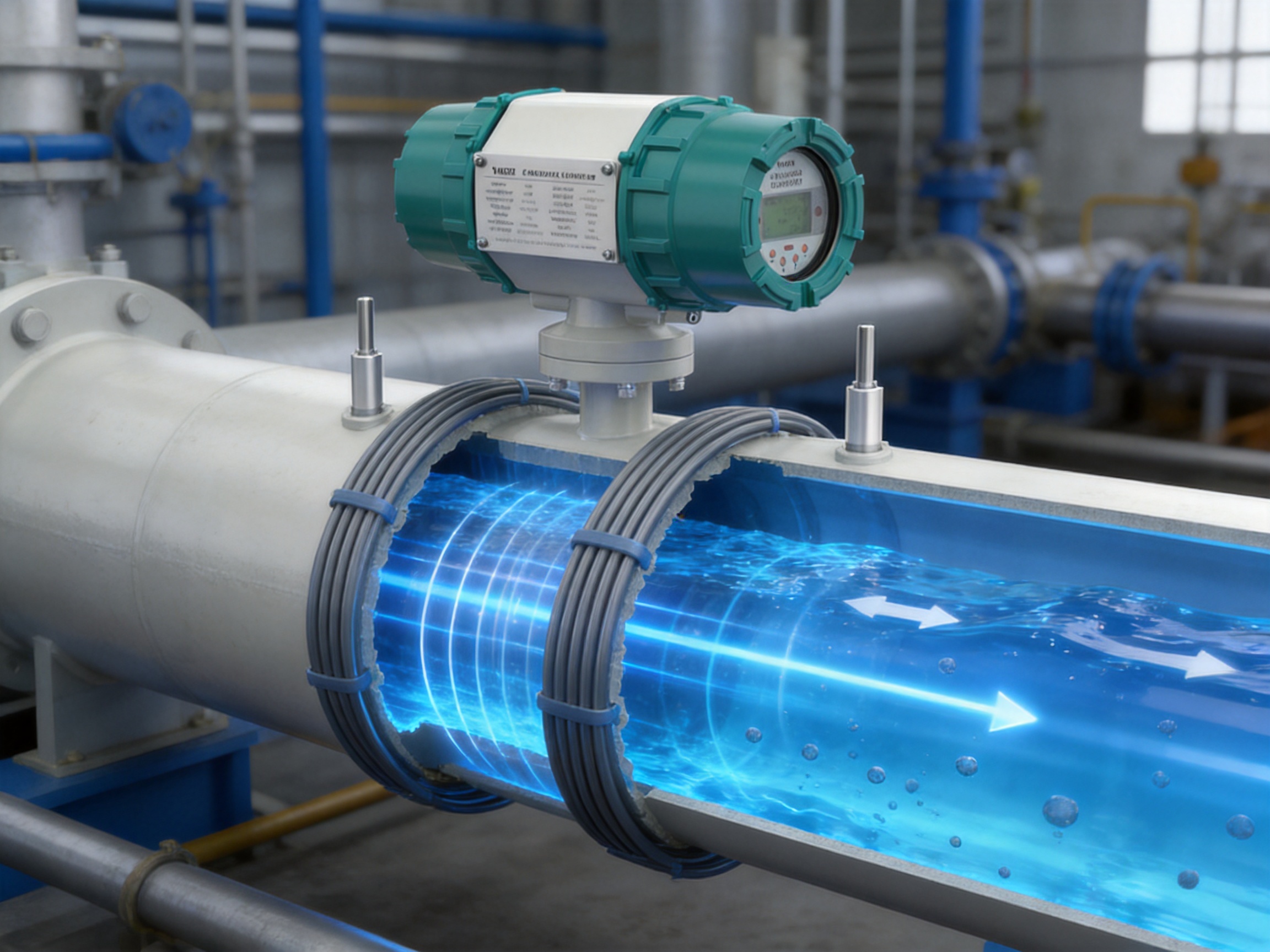
Inside the LDG measuring tube, electromagnetic coils generate a controlled magnetic field across the flow path. As the conductive liquid passes through this field, the liquid acts as a moving conductor. A small electrical voltage is generated between electrodes mounted on opposite sides of the measuring tube. This voltage is proportional to the average velocity of the liquid.
The transmitter receives the electrode signal, processes it through digital electronics, and converts the result into a volumetric flow value. Depending on the selected configuration, the instrument can provide a local display, a 4–20 mA output, a pulse output, and optional RS485 or Modbus communication. Forward and reverse flow can also be identified and totalized.
Unlike turbine, vortex, or variable-area flowmeters, the electromagnetic principle does not require an impeller, rotor, restriction, float, or bluff body in the fluid path. The measuring tube remains open across its full nominal diameter. This is especially useful for wastewater, slurry, pulp, and other liquids that may contain suspended solids or fibers.
The technology is not suitable for every fluid. The liquid must have sufficient electrical conductivity, and the measuring tube must remain completely filled during operation. Hydrocarbons, gases, oils with very low conductivity, and other non-conductive fluids generally require a different measurement principle. Within its intended range, however, electromagnetic measurement offers an effective combination of accuracy, low pressure loss, and low maintenance.
2. Product Overview of the LDG Economy Series
The LDG Series Economy Electromagnetic Flowmeter is a general-purpose instrument developed for routine industrial and utility flow applications. It consists of a sensor and transmitter, with the integrated version combining these elements in a compact housing. This arrangement reduces the amount of field wiring and simplifies mounting where a local display and direct access to the transmitter are preferred.
The product is intended for conductive liquids with conductivity of at least approximately 5 μS/cm. Actual suitability depends on the fluid composition, temperature, electrode and liner selection, pipe conditions, and application requirements. The instrument can be used with water, wastewater, many aqueous chemical solutions, agricultural liquids, process fluids, and uniform liquid-solid mixtures.
In general-purpose applications, the LDG provides accuracy up to ±0.5% of reading. This performance is appropriate for process monitoring, utility management, equipment control, water distribution, wastewater measurement, and other applications where dependable repeatability is more important than extremely high-end custody-transfer performance.
The system uses pulse excitation and digital signal processing to support stable measurement. These features help the transmitter distinguish the useful flow signal from electrical interference, process noise, and changing operating conditions. Proper grounding, full-pipe installation, suitable liner selection, and correct sizing remain essential to achieving the specified performance.
| Item | LDG General-Purpose Configuration | Application Significance |
|---|---|---|
| Measurement principle | Faraday’s law of electromagnetic induction | Measures conductive liquid without moving parts |
| Applicable medium | Electrically conductive liquids and selected liquid-solid mixtures | Suitable for water, wastewater, process liquid, suspensions, and pulp |
| Minimum conductivity | Approximately 5 μS/cm | Confirms whether the liquid is suitable for electromagnetic measurement |
| Reference accuracy | Up to ±0.5% of reading | Supports general industrial monitoring and control |
| Construction | Full-bore sensor with integrated transmitter option | Simplifies flow passage, installation, and local operation |
| Outputs | 4–20 mA, pulse, and optional RS485/Modbus | Supports connection to PLC, DCS, meters, and basic automation systems |
| Flow direction | Forward and reverse flow measurement | Useful in bidirectional pipelines and closed-loop systems |
| Electrode choices | 316L, Hastelloy, titanium, and tantalum | Allows material selection according to fluid compatibility |
| Liner choices | PTFE, PFA, FEP, rubber, and other available options | Helps adapt the meter to temperature, abrasion, and chemical conditions |
| Display | Optional local LCD | Provides convenient access to flow rate and totalized values |
3. Main Advantages Compared with Competing Flowmeter Technologies
3.1 No Moving Parts
The absence of moving parts is one of the LDG’s most important advantages. Turbine flowmeters use rotating components that may wear, become contaminated, or lose performance when exposed to solids, fibers, deposits, or excessive mechanical stress. Mechanical components can also require periodic inspection and replacement.
The LDG sensor has no rotor, bearing, gear, or internal valve element. The liquid flows through an unobstructed tube while the measurement is performed electrically. This reduces mechanical wear and supports long service intervals. For operators, the practical benefit is fewer consumable parts, fewer unplanned shutdowns, and less routine maintenance.
Removing internal moving elements also reduces sensitivity to moderate suspended solids and makes the instrument more appropriate for wastewater, sludge-related applications, pulp, and process liquids that are not perfectly clean. The fluid must still be compatible with the selected liner and electrodes, and heavily abrasive or settling media require careful application engineering. Nevertheless, the full-bore electromagnetic design is often more tolerant than mechanical meters in these conditions.
3.2 Negligible Additional Pressure Loss
Because the LDG has a full-bore flow passage without an internal obstruction, it introduces negligible additional pressure loss under normal installation conditions. This differs from flowmeters that require a restriction, impeller, float, or bluff body in the pipe.
Low pressure loss can reduce the energy required to move liquid through a system. In pumping applications, even a modest reduction in permanent pressure loss can contribute to lower operating costs over the life of the equipment. It can also help preserve available pressure for downstream users, control valves, spray systems, heat exchangers, and treatment equipment.
This advantage is particularly useful in large water pipelines, long irrigation systems, wastewater pumping stations, and process loops where pumping energy is a significant part of operating expenditure.
3.3 Strong Compatibility with Suspended Solids
Electromagnetic flowmeters measure the movement of the conductive liquid phase and can generally handle uniform liquid-solid mixtures when the solids are carried consistently through the pipe. Since the measurement tube contains no narrow mechanical passage or rotating element, the risk of blockage caused by ordinary suspended particles is reduced.
This makes the LDG suitable for applications such as wastewater effluent, pulp mixtures, treatment slurries, irrigation water containing moderate suspended material, and certain mineral or process suspensions. The liquid-solid mixture should remain reasonably homogeneous. If solids settle rapidly, collect at the bottom of the pipe, or cause severe abrasion, the installation and material selection must be reviewed carefully.
3.4 Practical Accuracy for General Industrial Service
The LDG can achieve accuracy up to ±0.5% of reading, making it suitable for a broad range of routine measurement tasks. Many industrial users do not require the extreme accuracy or specialized diagnostic functions associated with premium instruments. They need a stable signal for monitoring, control, allocation, production tracking, and maintenance decisions.
By focusing on the essential functions required in common applications, the LDG offers a more economical alternative to high-end magmeters while retaining the core advantages of electromagnetic measurement. Its value is particularly clear when multiple meters are required across a plant, when a water network must be expanded, or when an existing mechanical meter is being replaced.
3.5 Integrated Structure and Easier Installation
The integrated configuration places the transmitter and sensor in one compact assembly. This reduces the distance between the sensing electrodes and signal-processing electronics and can simplify the overall installation. It also reduces the number of separate brackets, cable runs, and field connections required by a remote-mounted arrangement.
For standard pipelines in accessible locations, an integrated meter can reduce installation labor and commissioning time. Operators can read the local LCD, configure parameters, and inspect the instrument at the measurement point. The design is especially convenient for water treatment skids, utility rooms, pump stations, HVAC plant rooms, and general process lines.
3.6 Flexible Electrode and Liner Materials
Different liquids impose different requirements on wetted materials. The LDG supports multiple electrode options, including 316L stainless steel, Hastelloy, titanium, and tantalum. These materials provide different levels of resistance to corrosion, chemical attack, and process contamination.
The liner separates the process liquid from the meter body and must be selected according to fluid chemistry, temperature, pressure, abrasion, and vacuum conditions. Available options include PTFE, PFA, FEP, and rubber-based materials. Fluoropolymer liners can be suitable for many chemically demanding liquids, while rubber liners may be advantageous in selected water, slurry, or abrasion-related applications.
Material selection should not be based solely on the name of the liquid. Concentration, temperature, impurities, cleaning chemicals, operating pressure, and the possibility of vacuum conditions can all influence compatibility. VNER’s engineering and application support can help users select a suitable electrode and liner combination before production.
3.7 Bidirectional Flow Measurement
Many basic flowmeters are optimized primarily for one flow direction. The LDG can measure forward and reverse flow and provide totalization for both directions. This function is useful in pipelines where operating modes change, in closed-loop systems, in reversible pumping arrangements, and in temporary transfer lines.
Bidirectional measurement can also help identify unexpected reverse flow caused by pump shutdown, valve sequencing, siphoning, or pressure imbalance. Instead of treating reverse movement as an unexplained loss, the control system can record it as a separate operating condition.
3.8 Standard Industrial Outputs
The instrument provides standard output options such as 4–20 mA and pulse signals, with optional RS485/Modbus communication for basic automation integration. These interfaces allow the flowmeter to communicate with programmable logic controllers, data acquisition systems, building management systems, remote displays, and supervisory control platforms.
The 4–20 mA signal is widely used for analog flow-rate transmission. Pulse output can be connected to totalizers or controllers that calculate accumulated volume. RS485 and Modbus provide a practical digital connection for reading process values, totalized flow, status information, and configuration data where supported by the selected version.
4. Construction and Measurement Design
4.1 Full-Bore Measuring Tube
The measuring tube forms the liquid passage and contains the electrode and coil assembly. A full-bore configuration means that the internal flow area is not intentionally reduced by a sensing obstruction. Maintaining the normal pipe diameter helps minimize pressure loss and supports passage of liquids containing suspended particles.
The tube must be installed so that it remains full during operation. A partially filled pipe can expose the electrodes to air and cause unstable or incorrect readings. The preferred installation location is normally a section where the liquid remains completely filled, such as a vertical pipe with upward flow or a properly designed horizontal section away from free-surface conditions.
4.2 Electrodes
The electrodes detect the induced voltage generated by the moving conductive liquid. Their material must be compatible with the process medium. 316L stainless steel is widely used for general water and many neutral liquid applications. Hastelloy, titanium, or tantalum may be considered when corrosion resistance or chemical compatibility requirements are more demanding.
Electrode contamination can affect measurement stability, particularly in liquids that form deposits, biological films, crystallized material, or insulating layers. The no-moving-parts design reduces mechanical maintenance, but it does not eliminate the need for proper process evaluation. Where deposits are expected, cleaning procedures, suitable electrode materials, and appropriate installation should be considered during selection.
4.3 Liner
The liner protects the meter body and provides the internal surface exposed to the liquid. PTFE, PFA, FEP, and rubber options allow the instrument to be adapted to a wide range of water, chemical, slurry, and process applications.
Fluoropolymer liners are often selected where chemical resistance and cleanability are important. Rubber liners may be selected for certain water or slurry services where flexibility and abrasion performance are relevant. The correct choice depends on temperature, pressure, fluid chemistry, particle characteristics, and whether the pipeline may experience vacuum.
4.4 Digital Transmitter
The transmitter supplies the excitation current for the magnetic field, detects the electrode signal, performs digital processing, calculates flow rate, and manages outputs and display functions. Pulse excitation and low-power electronics support stable operation while helping control energy consumption.
Digital processing can improve repeatability by applying filtering and signal-conditioning methods appropriate to the measured signal. Configuration parameters may include flow range, units, damping, totalizer settings, output behavior, flow direction, and alarm functions depending on the selected version.
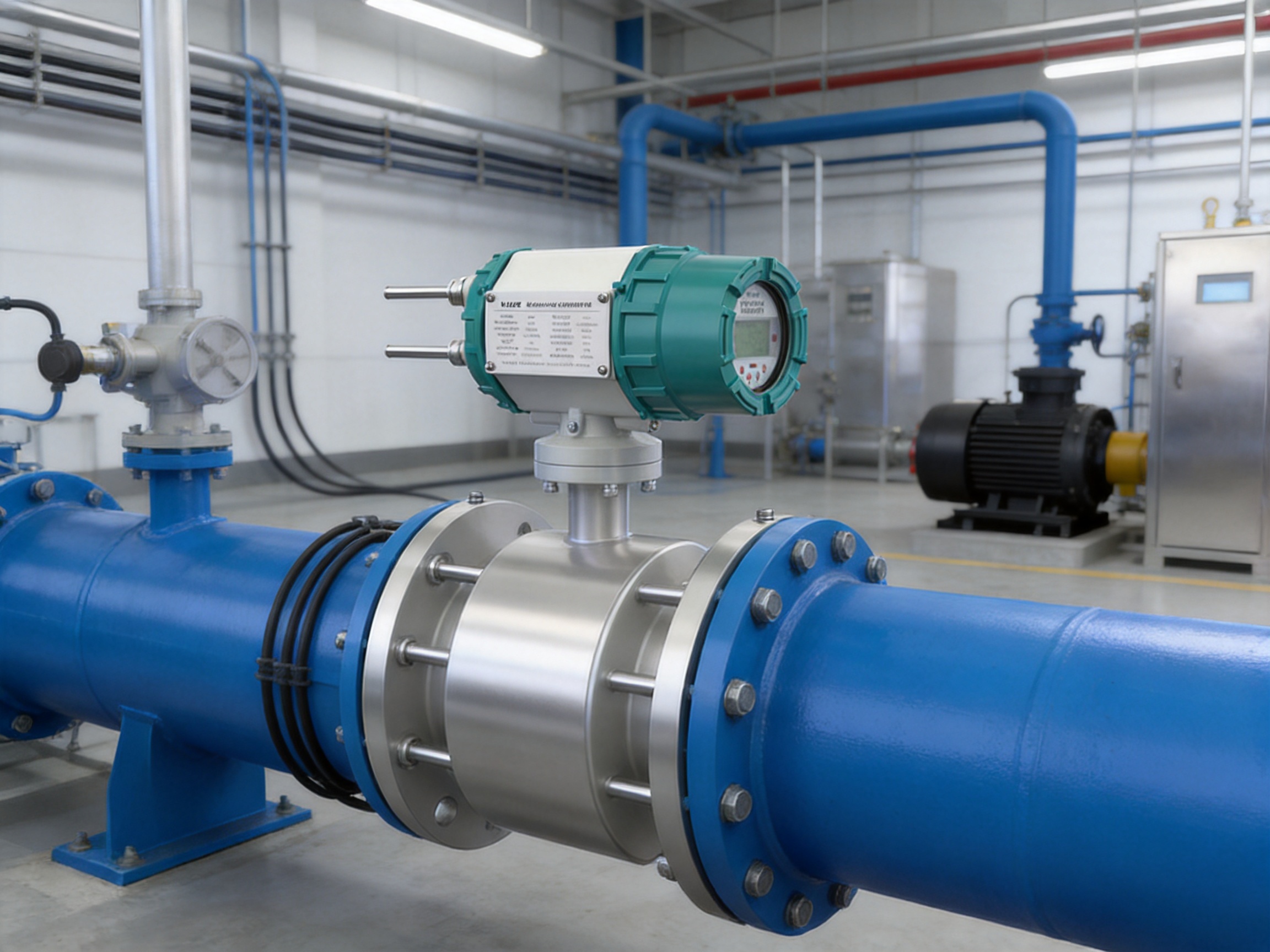
5. Application Areas
5.1 Water Supply and Distribution
Water utilities use flowmeters to measure treated water production, transmission, distribution, district consumption, storage-tank filling, and pump-station output. The LDG is suited to conductive water and can provide a stable signal for monitoring daily demand and detecting abnormal operating conditions.
In municipal distribution pipelines, flow data can support water balance calculations, pump scheduling, pressure management, and leakage investigations. The local display is useful during field inspection, while the 4–20 mA, pulse, or digital communication outputs can transfer data to the central control system.
5.2 Wastewater Treatment
Wastewater commonly contains suspended solids, organic matter, fibers, and other materials that can challenge mechanical flowmeters. The LDG’s unobstructed measuring passage makes it appropriate for many influent, effluent, return-flow, and process-water applications.
Typical measurement points include plant inlet lines, treated effluent discharge, sludge-related transfer systems, aeration process water, chemical dilution water, and internal recycle streams. The appropriate liner and electrode selection should be confirmed based on the wastewater composition, temperature, solids concentration, and cleaning requirements.
5.3 Agriculture and Irrigation
Irrigation systems require flow information to manage water distribution, verify fertilizer delivery, detect blocked lines, and compare the performance of pumps or irrigation zones. The LDG can measure conductive irrigation water and selected fertilizer or nutrient solutions when the fluid conductivity and material compatibility are suitable.
Its negligible pressure loss is beneficial in systems where available pumping head is limited. Bidirectional measurement can be useful in networks with reversible pumping or seasonal changes in flow direction. For outdoor installations, environmental protection, grounding, cable routing, and protection from direct mechanical damage must be considered.
5.4 Food and Beverage Facilities
Water, process water, cleaning water, and CIP-related streams are frequently measured in food and beverage plants. The LDG can support raw-water monitoring, utility measurement, rinse-water tracking, and general process control when the selected materials and hygienic requirements are appropriate for the application.
Users should identify whether the instrument is being installed in a hygienic process line, a utility line, or a non-product-contact service. Product-contact installations may require specific sanitary connections, surface finishes, certifications, and cleaning validation beyond a general-purpose configuration.
5.5 Chemical Industry
The instrument can be used with selected acids, alkalis, and other chemically aggressive liquids when the electrode and liner materials are properly selected. In less demanding chemical services, the LDG provides a cost-effective alternative to more specialized meters.
For chemical applications, the selection process should consider concentration, temperature, pressure, chemical mixtures, conductivity, crystallization, and the possibility of chemical attack during flushing or cleaning. A material compatibility review is essential before finalizing the meter specification.
5.6 HVAC and Building Utilities
Heating, ventilation, and air-conditioning systems use flow data to monitor chilled water, condenser water, heating water, boiler loops, and energy-transfer circuits. The LDG can support closed-loop flow control, pump performance verification, balancing, and maintenance diagnostics.
Because it introduces little additional pressure loss and has no moving internal parts, the meter is well suited to utility systems that operate continuously. The local display helps technicians verify flow during commissioning, while analog or digital outputs can be connected to building automation systems.
5.7 Metallurgy and Cooling Water Systems
Industrial cooling systems require dependable monitoring of water movement through furnaces, heat exchangers, casting equipment, and production machinery. Flow interruption can cause overheating, process instability, or equipment damage.
The LDG can be installed on conductive cooling water lines and used with alarm or control systems. Correct sizing is particularly important because cooling circuits may operate across a wide range of flow rates. The instrument should be selected to provide sufficient velocity for a stable signal while avoiding excessive pressure loss or unnecessarily high operating velocity.
6. How the LDG Reduces Total Cost of Ownership
Purchase price is only one part of the economic evaluation of a flowmeter. The total cost of ownership includes installation, wiring, commissioning, energy consumption, maintenance, spare parts, calibration, downtime, and eventual replacement. The LDG is designed to control these costs across the product life cycle.
First, its general-purpose architecture avoids unnecessary premium features when the application only requires dependable routine measurement. Second, the integrated structure can reduce installation complexity in suitable locations. Third, the full-bore design minimizes permanent pressure loss and can reduce the energy burden on pumps. Fourth, the no-moving-parts construction reduces wear-related maintenance.
Material flexibility can also reduce lifecycle cost. Selecting a liner and electrode combination suited to the actual medium can extend service life and prevent premature corrosion or deterioration. Standard outputs simplify integration with existing industrial control systems, reducing the need for specialized interface equipment.
Finally, a stable and repeatable measurement signal supports better process decisions. Accurate flow information can help identify leaks, optimize chemical dosing, verify production volumes, balance water consumption, and detect pump or valve problems before they become major failures.
7. Manufacturing Strengths and Quality Approach
7.1 Specialized Flow Instrumentation Experience
Jiangsu Vner Electronic Technology Co., Ltd. has focused on industrial flow measurement since 2011. Its product range includes electromagnetic, Coriolis, vortex, swirl, turbine, thermal mass, ultrasonic, and metal-tube rotameter technologies. This breadth gives the company experience across liquid, gas, slurry, utility, and process applications.
Experience with multiple measurement principles is valuable because it encourages application-based selection rather than a one-product approach. The company can compare electromagnetic measurement with turbine, vortex, ultrasonic, thermal, or Coriolis technologies and help determine which principle is most appropriate for fluid properties, accuracy requirements, pressure conditions, installation limitations, and budget.
7.2 Modern Production Facilities
The company operates approximately 23,000 square meters of modern facilities across three plants and employs a technical team of more than 150 people. This manufacturing scale supports coordinated engineering, assembly, inspection, calibration, and customer service activities.
A multi-plant structure can also provide flexibility for product development and production scheduling. For customers purchasing multiple instruments, project consistency is important. Standardized production procedures, controlled component sourcing, documented inspection, and traceability help reduce variation between individual meters and production batches.
7.3 In-House Calibration
Calibration is central to flowmeter quality. A flowmeter may contain high-quality electronics and materials, but its performance must be verified against a controlled reference. In-house calibration enables the manufacturer to test completed instruments before shipment and to identify errors or inconsistencies during production.
Calibration activities can include checking flow-rate response, zero stability, output performance, totalizer behavior, display values, and transmitter configuration. The exact calibration capability depends on the instrument size, selected range, and applicable procedure. For project orders, calibration records and documentation can support commissioning, quality review, and future maintenance.
In-house calibration also helps the manufacturer improve process control. If repeated testing identifies a trend in sensor assembly, coil performance, electrode response, or transmitter configuration, corrective action can be taken within the production process instead of waiting for field feedback.
7.4 Engineering-Driven Sizing and Selection
Correct sizing is one of the most important factors in electromagnetic flowmeter performance. A meter that is too large may operate at an unnecessarily low velocity, while a meter that is too small may create excessive velocity, pressure stress, or measurement range limitations. The selected size should match normal, minimum, and maximum flow conditions.
VNER supports engineering-based sizing and selection rather than treating every order as a standard catalog transaction. The evaluation can consider line size, flow range, fluid conductivity, temperature, pressure, density, suspended solids, liner requirements, electrode materials, installation arrangement, and output requirements.
This approach benefits OEMs, EPC contractors, and end users who may be working with incomplete or changing process information. It can also reduce the risk of ordering an instrument that is technically compatible in principle but poorly matched to actual operating conditions.
7.5 Certified Quality Processes and Traceability
Industrial customers require more than a functional instrument. They need consistency, documentation, traceability, and confidence that the product supplied for one project will perform similarly to the product supplied for the next project. Certified quality processes help establish repeatable procedures for purchasing, assembly, testing, inspection, and shipment.
Traceability supports investigation and service when questions arise about a particular instrument. Records may relate to the product configuration, material selection, calibration results, inspection status, and production information. This is especially useful for water projects, process plants, OEM systems, and international orders involving multiple instruments.
7.6 Increasing Automation in Manufacturing
VNER is developing increasingly automated manufacturing practices. Automation can improve repeatability in assembly, reduce manual variation, increase production efficiency, and help standardize critical process steps. It can also support better collection of manufacturing data for quality analysis.
Automation does not replace engineering judgment. Electromagnetic flowmeters still require correct material selection, careful sensor assembly, electrical inspection, calibration, and application review. The strongest manufacturing approach combines automated consistency with experienced technical supervision and final performance verification.
7.7 Project and OEM Capability
The company has delivered more than 2,000 engineering projects in over 30 countries and supports EPC contractors, end users, and OEM partners. This experience is relevant to customers who require more than a single off-the-shelf meter.
Project support may include product selection, documentation, configuration review, communication requirements, batch consistency, packaging, and after-sales assistance. OEM customers may require specific labels, parameter settings, output arrangements, or integration details. A manufacturer with experience in customized industrial instruments is better positioned to manage these requirements systematically.
8. Installation Considerations
8.1 Keep the Measuring Tube Full
The pipe must remain full at the measuring location. The meter should not normally be installed at the highest point of a pipeline where air can accumulate, immediately upstream of a free discharge, or in a section that may drain during normal operation.
Vertical upward-flow installations are often advantageous because the liquid naturally fills the tube. Horizontal installations can also perform well when the pipe is continuously full and the electrodes are correctly oriented. The actual arrangement should be reviewed according to the pipeline profile and process conditions.
8.2 Provide Suitable Straight Pipe Conditions
Flow disturbances from elbows, reducers, valves, pumps, and tees can affect measurement stability. Suitable upstream and downstream straight lengths should be provided according to the manufacturer’s installation recommendations and the specific piping arrangement.
Where space is limited, the application should be reviewed before installation. A meter installed too close to a strong disturbance may still display a value, but the uncertainty and repeatability may not meet the user’s expectations.
8.3 Ensure Proper Grounding
Electromagnetic flowmeters detect a small electrical signal from the liquid. Proper grounding and electrical bonding are therefore important. Poor grounding, electrical noise, inadequate shielding, or incorrect cable routing can create unstable readings.
The installation should follow the supplied wiring diagram and local electrical requirements. Signal cables should be kept away from high-power cables where possible, and the sensor, pipeline, grounding rings, and transmitter should be connected in a manner appropriate to the pipe material and process conditions.
8.4 Select the Correct Flow Range
The normal flow should fall within a useful portion of the selected measuring range. The minimum and maximum flow rates should be considered, not only the nominal design flow. A suitable velocity range helps maintain a stable signal and allows the output to represent meaningful process changes.
Oversizing can reduce operating velocity and may make low-flow measurement less effective. Undersizing can increase velocity and may create unnecessary pressure or abrasion concerns. Engineering-based sizing is therefore preferable to selecting a meter solely by matching the existing pipe diameter.
8.5 Protect the Instrument from Mechanical Stress
The flowmeter should not be used to support the weight of adjacent piping. Pipe supports should be provided before installation, and excessive force should not be applied to the flanges or connections. Thermal expansion, vibration, pump pulsation, and external impact should also be considered.
For outdoor installations, the enclosure should be protected from conditions outside its rated environmental capability. Direct sunlight, flooding, chemical spray, condensation, and severe vibration can affect long-term reliability if not properly managed.
9. Choosing Materials for Different Media
Material compatibility is a technical decision that directly affects service life. The process liquid should be described in sufficient detail before ordering, including concentration, temperature range, pressure, conductivity, suspended solids, cleaning chemicals, and possible abnormal conditions.
316L electrodes are commonly used for clean water, treated water, and many general-purpose liquids. Hastelloy may be considered for more challenging chemical environments. Titanium can be advantageous in selected corrosive or saline services, while tantalum is used in applications where a high level of chemical resistance is required.
PTFE, PFA, and FEP liners provide fluoropolymer options for many chemically demanding liquids. Rubber liners may be useful for selected water and slurry services, subject to temperature and chemical limitations. The final choice should be confirmed against a material compatibility chart and the actual operating conditions rather than based only on a general fluid category.
Where the medium contains abrasive solids, particle size, concentration, velocity, and shape should be evaluated. No liner is universally suitable for every abrasive slurry. A realistic service-life expectation requires consideration of both chemical resistance and mechanical wear.
10. Integration into Industrial Control Systems
The LDG can be integrated into basic automation systems through standard outputs. The 4–20 mA output is appropriate for continuous flow-rate transmission to a PLC, DCS, recorder, or controller. Pulse output can be used for total flow calculation or connection to a frequency-based input.
Optional RS485/Modbus communication can provide a digital connection for applications that require centralized monitoring, remote parameter access, or multiple instruments on a communication network. Digital integration can reduce the need for separate signal converters and allow process data to be displayed alongside pump, valve, pressure, level, and temperature information.
The local LCD provides a practical commissioning and maintenance interface. Technicians can check the instantaneous flow rate and totalizer values at the instrument without connecting a laptop or opening a control-room screen. This is particularly helpful in remote pump stations, utility rooms, and distributed water systems.
When integrating the flowmeter, users should confirm the required signal type, power supply, communication protocol, output scaling, alarm behavior, totalizer direction, and cable requirements. Clear definition of these details before production reduces commissioning delays.
11. Maintenance and Long-Term Reliability
The LDG requires less mechanical maintenance than flowmeters with moving internal components. There is no rotor or bearing to lubricate, no float to inspect, and no internal turbine assembly to replace. Routine maintenance generally focuses on visual inspection, electrical connections, grounding, display and output verification, and confirmation that the pipe remains full.
In difficult services, the electrodes and liner should be monitored for deposits, scaling, chemical attack, or abrasion. If the process can coat the electrode surface, cleaning may be required. The appropriate frequency depends on the medium and operating conditions.
Periodic verification can compare the flowmeter’s output with a known reference, a calibrated portable instrument, a tank-fill test, or another suitable method. The verification interval should be determined by the application’s quality requirements, regulatory obligations, criticality, and historical performance.
A stable installation environment contributes to long-term reliability. Proper grounding, appropriate cable routing, protection from vibration, and prevention of condensation can be as important as the meter’s internal design. The most reliable result comes from combining a suitable instrument with disciplined installation and maintenance practices.
12. Why This Product Is a Practical Alternative
The LDG is not positioned as a universal replacement for every flowmeter. Coriolis meters remain preferable when direct mass-flow measurement and high-density or concentration information are required. Vortex meters are useful for many gas, steam, and clean-liquid applications. Turbine meters can be effective for relatively clean fluids where a mechanical rotor is acceptable. Ultrasonic meters may be preferred when non-invasive installation is essential.
The LDG is strongest where the liquid is conductive, the pipeline can remain full, low pressure loss is desirable, suspended solids may be present, and the user wants a stable volumetric flow measurement at a controlled cost. In these conditions, it offers a combination that is difficult for mechanical alternatives to match.
Compared with premium electromagnetic meters, the LDG focuses on essential functionality for general industrial applications. It provides appropriate accuracy, flexible wetted materials, standard outputs, local display options, bidirectional measurement, and digital processing without necessarily adding the cost of advanced features that may not be needed.
Compared with low-cost instruments of uncertain origin, the LDG benefits from a manufacturer with dedicated flowmeter experience, in-house calibration, engineering support, project experience, and structured production processes. The difference is important because the cost of an unreliable meter can extend far beyond the purchase price through incorrect dosing, undetected leakage, production interruptions, and repeated replacement.
13. Selection Checklist for Buyers
Before selecting an LDG electromagnetic flowmeter, users should prepare accurate process information. This helps the manufacturer recommend the correct size, lining, electrode material, connection, output, and transmitter configuration.
Identify the liquid and provide its chemical composition where possible.
Confirm that the liquid conductivity is at least approximately 5 μS/cm.
Provide normal, minimum, and maximum flow rates.
State the existing pipe diameter and connection requirements.
Provide operating and design temperature.
Provide operating and design pressure.
Describe suspended solids, fibers, particles, pulp, or abrasive material.
Identify whether the flow is normally forward, reverse, or bidirectional.
Specify local display, 4–20 mA, pulse, RS485, Modbus, or other required outputs.
Describe the available straight pipe length and installation orientation.
State the power supply and environmental conditions.
Identify documentation, calibration, inspection, and certification requirements.
Providing complete information at the beginning allows the technical team to evaluate the application instead of relying on assumptions. This is particularly important for chemical liquids, slurries, high-temperature fluids, partially filled lines, and applications with severe electrical interference.
14. Value for Different Types of Customers
14.1 End Users
End users benefit from a meter that is straightforward to install, operate, and maintain. The LDG can provide the flow information needed for process control, utility management, water accounting, and equipment protection without creating unnecessary complexity for maintenance teams.
14.2 EPC Contractors
EPC contractors often need consistent products, clear technical documentation, dependable delivery, and support for multiple application points. The manufacturer’s engineering-based selection and project experience can help contractors reduce specification errors and coordinate instrument requirements across a complete installation.
14.3 OEM System Builders
OEM customers may integrate the flowmeter into water-treatment skids, chemical-dosing systems, irrigation packages, HVAC units, cooling systems, or other equipment. A compact integrated structure, standard signals, configurable display, and production consistency are useful for repeatable system design.
14.4 Distributors and Industrial Resellers
Distributors need products that cover a broad range of common applications while remaining easy to explain and specify. The LDG provides a clear value proposition: conductive-liquid measurement, no moving parts, low pressure loss, standard outputs, material flexibility, and cost-effective general-purpose performance.
15. Frequently Asked Questions
Q1: What liquids can the LDG electromagnetic flowmeter measure?
The LDG can measure electrically conductive liquids such as clean water, treated water, wastewater, process water, many aqueous chemical solutions, irrigation liquids, and selected suspensions or pulp mixtures. The liquid should normally have conductivity of at least approximately 5 μS/cm.
Q2: Can it measure oil, gasoline, or other hydrocarbons?
Most oils and hydrocarbons have very low electrical conductivity and are generally unsuitable for a standard electromagnetic flowmeter. A different measurement principle, such as turbine, Coriolis, positive displacement, or another suitable technology, may be required.
Q3: Does the meter have moving parts?
No. The LDG uses electromagnetic induction and has no rotor, bearing, float, or other moving element inside the measuring tube. This reduces mechanical wear and helps lower maintenance requirements.
Q4: Can the LDG measure wastewater containing solids?
Yes, it can measure many wastewater streams and uniform liquid-solid mixtures. The full-bore passage does not contain a mechanical obstruction. However, the concentration, particle size, settling behavior, abrasiveness, and chemical composition must be evaluated to confirm the liner and electrode selection.
Q5: What is the accuracy of the LDG?
The stated performance can reach up to ±0.5% of reading for suitable configurations and operating conditions. Actual performance depends on sizing, installation, grounding, fluid conductivity, full-pipe conditions, calibration, and process stability.
Q6: Can it measure reverse flow?
Yes. The LDG supports forward and reverse flow measurement with totalization. This makes it useful for bidirectional pipelines, reversible pumps, and closed-loop systems.
Q7: What output signals are available?
Standard options include 4–20 mA and pulse outputs. RS485/Modbus communication is available as an option for applications requiring digital integration with PLCs, data systems, or industrial automation networks.
Q8: Is a local display available?
Yes. A local LCD option can display real-time flow rate and totalized flow values, helping operators perform commissioning, inspection, and maintenance at the measurement point.
Q9: How should the electrode material be selected?
Electrode selection depends on the liquid’s chemistry, concentration, temperature, impurities, and cleaning conditions. Available options include 316L, Hastelloy, titanium, and tantalum. The selection should be confirmed through a compatibility review rather than based only on the general name of the fluid.
Q10: How should the liner be selected?
The liner should be selected according to chemical compatibility, temperature, pressure, vacuum risk, abrasion, and process cleanliness. PTFE, PFA, FEP, and rubber options are available for different application conditions.
Q11: Does the meter create a significant pressure drop?
No. The full-bore design has no internal obstruction and introduces negligible additional pressure loss under normal conditions. This can be beneficial in pumped water, irrigation, wastewater, and utility systems.
Q12: Can the meter be used in an HVAC system?
Yes. It can be used for conductive chilled water, condenser water, heating water, boiler-loop water, and other suitable utility fluids. Proper pipe filling, grounding, sizing, and environmental protection are required.
Q13: What information should be provided for a quotation?
Users should provide the liquid name and composition, conductivity, flow range, pipe size, temperature, pressure, suspended solids, connection requirements, installation orientation, power supply, outputs, communication needs, and any certification or calibration documentation requirements.
Q14: What manufacturing support is available?
Jiangsu Vner Electronic Technology Co., Ltd. provides flowmeter engineering, in-house calibration, product configuration support, quality documentation, project coordination, and OEM assistance. The company serves end users, EPC contractors, and system integrators in international industrial markets.
16. Conclusion
The LDG Economy General-Purpose Electromagnetic Flowmeter provides a balanced solution for conductive-liquid measurement. It combines the fundamental advantages of electromagnetic technology with an economical configuration intended for everyday industrial service.
Its no-moving-parts construction supports low maintenance. Its full-bore passage minimizes additional pressure loss and accommodates many liquids containing suspended solids. Its integrated structure simplifies installation and local operation. Its electrode and liner options provide flexibility for different media, while standard 4–20 mA, pulse, and optional RS485/Modbus outputs support connection to common automation systems.
For water supply, wastewater, agriculture, HVAC, food and beverage utilities, chemical handling, metallurgy, and general process applications, the LDG offers practical measurement performance without unnecessary complexity. Accuracy up to ±0.5% of reading, bidirectional measurement, local display options, and digital processing make it suitable for monitoring and control tasks across a wide range of facilities.
The product’s value is further supported by the manufacturing capabilities of Jiangsu Vner Electronic Technology Co., Ltd. Since 2011, the company has developed expertise across several industrial flow measurement technologies. Its modern facilities, technical team, in-house calibration, certified quality processes, traceability practices, engineering-driven selection, and expanding automation provide a foundation for consistent product delivery.
When correctly sized, specified, installed, and maintained, the LDG can help users obtain reliable flow data while controlling capital expenditure and lifecycle cost. It is a strong choice for organizations seeking a dependable, serviceable, and cost-effective electromagnetic flowmeter for general industrial applications.
References
Faraday, Michael. Experimental Researches in Electricity. Royal Society scientific publications.
International Electrotechnical Commission. IEC 60041, Field Acceptance Tests to Determine the Hydraulic Performance of Hydraulic Turbines, Storage Pumps and Pump-Turbines.
International Electrotechnical Commission. IEC 60534 and related industrial process measurement guidance.
International Organization for Standardization. ISO 6817, Measurement of Conductive Liquid Flow in Closed Conduits.
International Organization for Standardization. ISO 5167, Measurement of Fluid Flow by Means of Pressure Differential Devices.
American Society of Mechanical Engineers. Fluid Flow Measurement engineering practices and application guidance.
Manufacturer technical information for LDG Series Economy Electromagnetic Flowmeters.
Manufacturer application and material-selection guidance for electromagnetic flow measurement.
Product: LDG Economy General-Purpose Electromagnetic Flowmeter-副本

We offer all our products and services at international standards.
Products
Contact Information
-

+86-18652789521
+86-18052582295
+86-0514-83633600 / 83633900 -

+86-0514-83633600 / 83633900
-

shawn@vnerflow.com
info@vnerflow.com -

No. 11 Xingye Road, Chenji Town Industrial Park, Yizheng, Yangzhou, China
