
 0
 EN
 English
 عربى
 Español
 русский
If you need any help, please feel free to contact us
Home / Author / Ding Yuchun — Overseas After-Sales Support Engineer / VE13 Hygienic Electromagnetic Flowmeter: Compact, Cleanable and Reliable Flow Measurement for Conductive Liquids
VE13 Hygienic Electromagnetic Flowmeter: Compact, Cleanable and Reliable Flow Measurement for Conductive Liquids
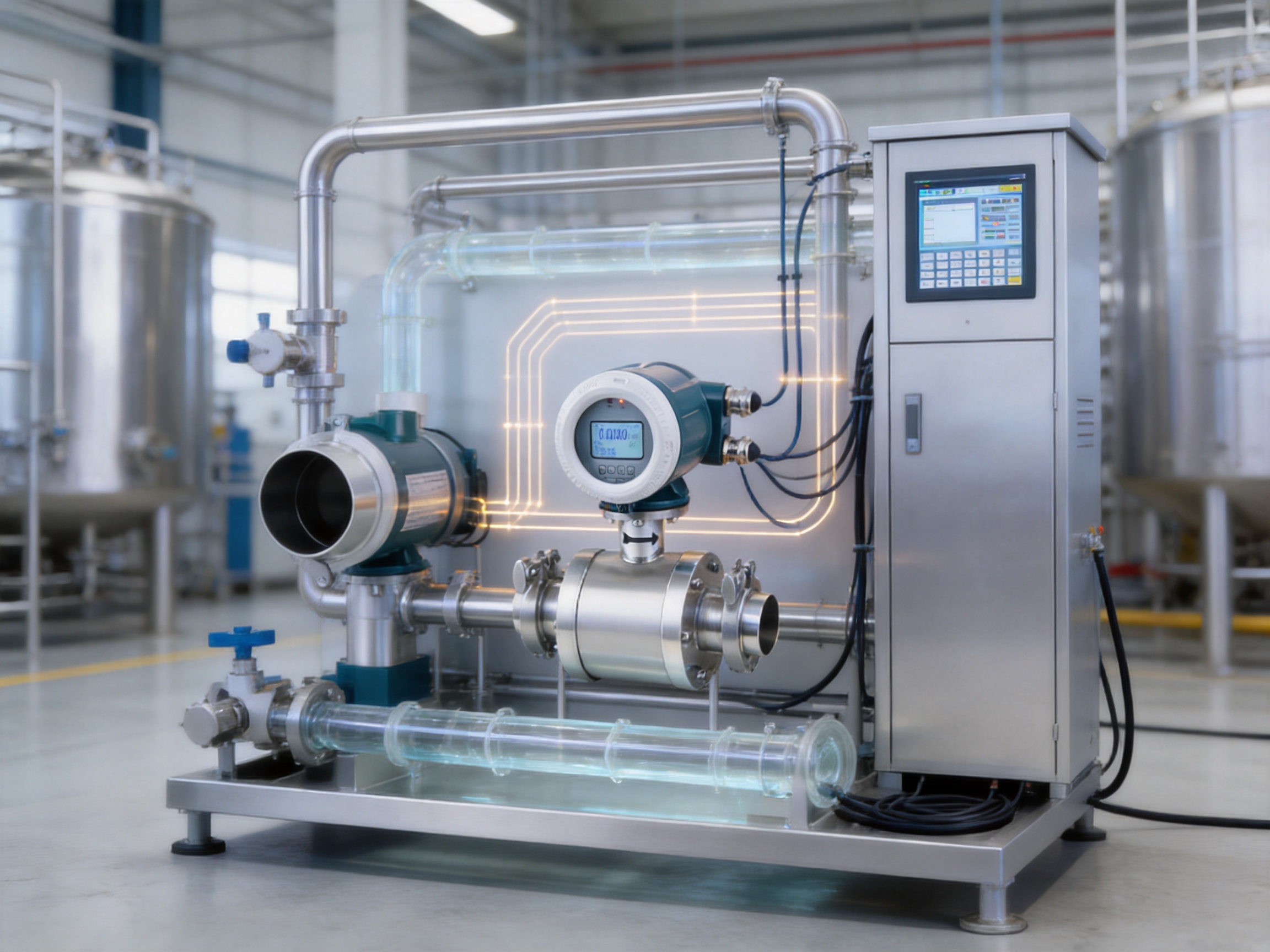
Accurate flow measurement is essential wherever liquids must be transferred, dosed, blended, cleaned, or monitored under controlled process conditions. In food and beverage production, chemical processing, water treatment, equipment skids, and other industrial applications, the selected flowmeter must provide more than a numerical flow reading. It must also suit the process connection, withstand the operating environment, minimize maintenance, integrate with control systems, and remain dependable when the line is operated repeatedly over long periods.
The VE13 Hygienic Electromagnetic Flowmeter is designed for these requirements. It is a compact, small-bore electromagnetic flowmeter for electrically conductive liquids and slurries. Its full-bore measuring tube, stainless-steel construction, hygienic connection options, modern signal processing, and flexible communication functions make it suitable for applications where cleanliness, repeatability, and installation efficiency are important.
Based on Faraday’s law of electromagnetic induction, the VE13 measures volumetric flow without moving components or intrusive obstructions inside the pipe. This gives the instrument a valuable advantage over many mechanical flowmeters: the measured liquid does not need to drive a rotor, turbine, or other moving assembly. The unobstructed bore also helps reduce pressure loss and lowers the risk of mechanical wear or blockage.
The instrument is available with threaded and Tri-Clamp process connections, stainless-steel body options, FEP or PFA lining, and several electrode materials. It can provide 4–20 mA and pulse outputs, while Modbus RS-485 and HART communication support integration with PLC, DCS, batch control, and supervisory systems. Depending on the selected configuration, explosion-proof Ex d versions are available for designated hazardous locations.
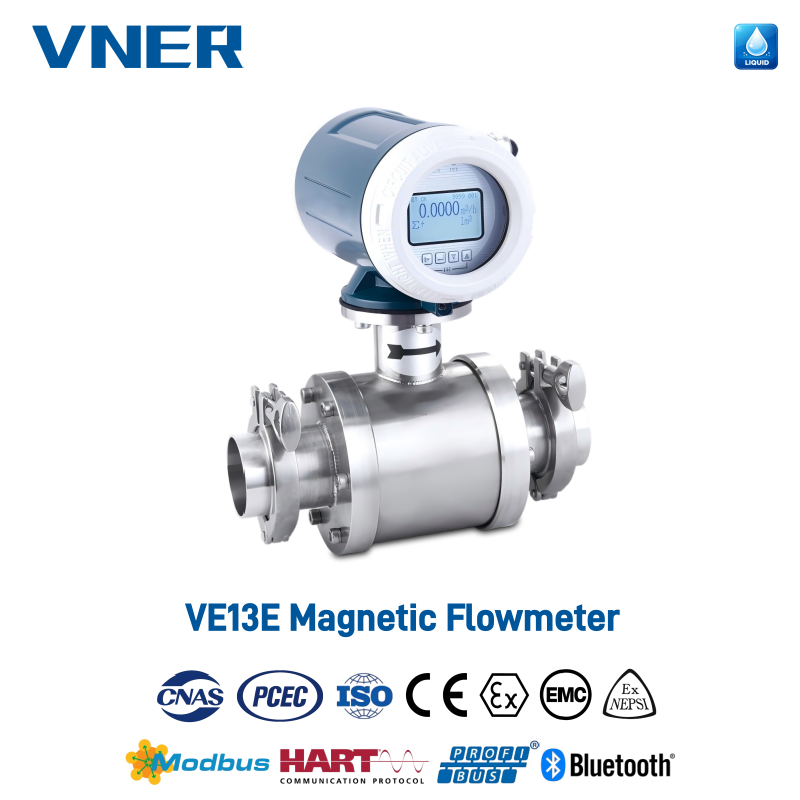
VE13 Hygienic Electromagnetic Flowmeter
Designed for Hygienic and Small-Bore Process Lines
Many process lines do not require a large, heavy flowmeter. Compact equipment, package skids, dosing systems, pilot plants, and small transfer lines often have limited installation space and relatively small nominal pipe sizes. Installing a conventional full-scale instrument in these locations can result in unnecessary weight, excessive installation complexity, or poor compatibility with the surrounding pipework.
The VE13 addresses this need with nominal diameters from DN10 to DN125, approximately equivalent to 3/8 inch through 5 inches. This range allows the flowmeter to serve small utility lines, beverage transfer systems, chemical dosing lines, compact treatment units, and equipment frames without sacrificing the fundamental benefits of electromagnetic measurement.
Its stainless-steel construction supports applications where corrosion resistance, cleanability, and a professional hygienic appearance are required. Stainless-steel body options include 304, 316, and 316L, allowing users and engineers to select a material that matches the process medium, cleaning regime, and project requirements. In applications involving food, beverages, wash water, or chemically active liquids, material selection should be confirmed against the actual fluid and cleaning agents.
Threaded connections can provide a practical solution for general industrial and compact utility lines. Tri-Clamp connections are suited to hygienic installations where equipment must be dismantled efficiently or where sanitary piping standards are required. The connection selection can therefore be matched to the construction of the existing process line rather than forcing the entire system to adopt a single connection style.
Electromagnetic Measurement Principle
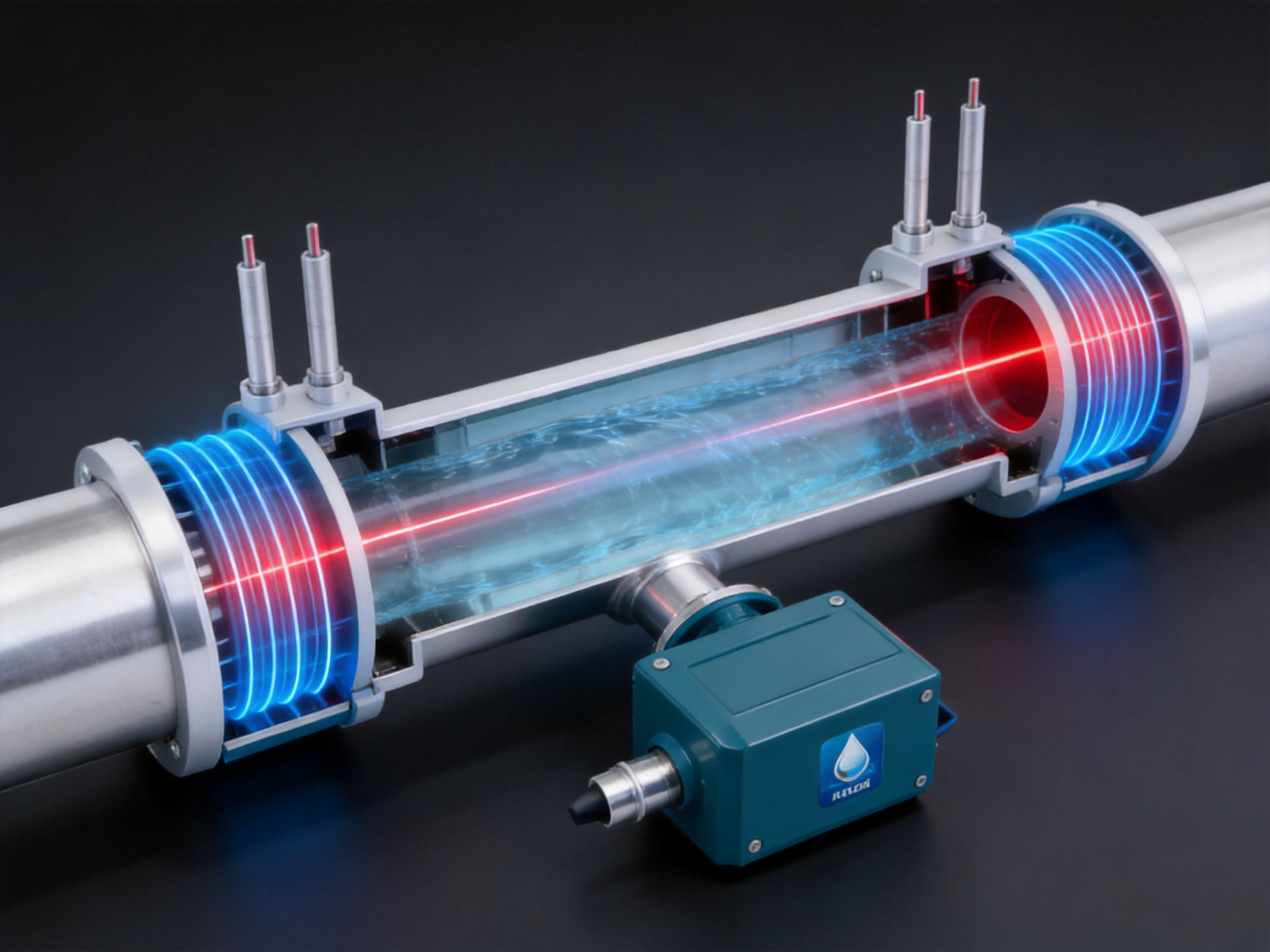
The VE13 operates according to Faraday’s law of electromagnetic induction. During measurement, coils generate a magnetic field across the measuring tube. When an electrically conductive liquid passes through this magnetic field, a voltage is induced in proportion to the liquid’s velocity. Electrodes positioned in the measuring tube detect this voltage, and the converter processes the signal to calculate volumetric flow.
This measurement principle has several important process advantages. The instrument does not require an impeller, rotor, gear, paddle, or other moving part. It also does not place an obstruction into the flow path. As a result, the flowmeter can measure liquid without adding the mechanical friction, bearing wear, or rotor contamination concerns associated with many mechanical meters.
Electromagnetic measurement is also largely independent of liquid density and viscosity. This is particularly useful when the liquid changes in concentration or viscosity during normal operation. For example, a viscous liquid, a water-based solution, or a conductive beverage can be measured using the same general technology, provided the conductivity, temperature, lining, electrode, and connection requirements are satisfied.
Pressure and temperature do not directly determine the measured volumetric flow in the way they can influence certain other flow technologies. However, the selected materials and pressure-temperature ratings remain important for safe and reliable operation. Process conditions must always remain within the specified limits of the complete flowmeter configuration.
The technology is intended for conductive liquids and slurries. It is not suitable for nonconductive liquids whose conductivity is below the required measurement threshold. Before ordering, the user should confirm the conductivity of the medium, the minimum and maximum flow rate, the process temperature, the pressure, the chemical compatibility of wetted materials, and the presence of solids or suspended particles.
Key Technical Specifications
| Item | Specification | Engineering Significance |
|---|---|---|
| Measuring principle | Electromagnetic, based on Faraday’s law | Non-mechanical volumetric flow measurement for conductive liquids |
| Product type | Compact hygienic and small-bore electromagnetic flowmeter | Suitable for equipment skids, small process lines, and space-restricted installations |
| Measured media | Conductive liquids and slurries | Applicable to water, beverages, chemical solutions, and selected viscous liquids |
| Accuracy | ±0.5% of rate | Supports general process measurement, transfer monitoring, and dosing applications |
| Repeatability | Typically 0.16% of rate | Useful for stable process control and repeated batch operations |
| Flow velocity range | 0.3 to 10 m/s | Provides a broad operating range for correctly sized installations |
| Nominal diameters | DN10 to DN125 | Covers approximately 3/8 inch to 5 inch pipe sizes |
| Process connections | Threaded and Tri-Clamp | Supports industrial and hygienic installation requirements |
| Connection standards | DIN and ANSI/ASME | Facilitates project-specific piping and equipment design |
| Nominal pressure | 1 MPa | Must be checked against actual line pressure and temperature |
| Medium temperature | -40 to +200 °C, configuration dependent | Requires verification of liner, electrode, seal, and connection selection |
| Protection class | IP65 | Provides protection for designated industrial installation environments |
| Body materials | 304, 316, and 316L stainless steel | Allows material selection according to corrosion and hygiene requirements |
| Lining materials | FEP and PFA | Supports chemical resistance and process-temperature requirements |
| Electrode materials | 316L stainless steel, Hastelloy, and titanium | Allows the wetted electrode material to be matched to the medium |
| Outputs | 4–20 mA and pulse | Suitable for analog control, totalization, and flow-based batching |
| Digital communication | Modbus RS-485 and HART | Supports configuration, data collection, and diagnostics |
| Explosion protection | Ex d versions available | Supports designated hazardous-area applications when correctly certified |
| Electrical connection | M20 × 1.5 and 1/2-14 NPT | Provides common cable-entry choices for industrial installations |
| Power supply | 24 V DC or 220 V AC | Allows integration with control panels and plant power systems |
Advantages Over Mechanical Flowmeters
No Moving Parts
A primary advantage of the VE13 is the absence of moving parts in the measuring tube. Mechanical flowmeters may contain rotors, shafts, bearings, gears, or other components that are exposed to the liquid. These components can be affected by abrasive particles, sticky fluids, corrosion, deposits, or repeated start-stop operation.
By contrast, the VE13 uses an electromagnetic field and electrodes to detect flow. There is no rotor to seize, no bearing to lubricate, and no moving internal mechanism to replace as part of normal measurement. This can reduce maintenance requirements and help maintain consistent performance over the service life of the instrument.
Low Flow Resistance
The full-bore design presents no internal mechanical obstruction to the process liquid. Under suitable installation conditions, it introduces practically no additional pressure loss. This is valuable in pumping systems, transfer lines, and gravity-fed systems where available pressure must be preserved.
Reduced pressure loss can also support energy-conscious system design. When a flowmeter does not significantly restrict the line, the pump does not need to compensate for unnecessary resistance created by the measuring device. The actual energy benefit depends on the complete system, including pipework, valves, filters, elevation, pump efficiency, and operating schedule.
Lower Risk of Clogging
Mechanical meters with narrow passages or moving assemblies can be vulnerable to deposits and suspended solids. The unobstructed bore of the VE13 helps reduce the risk of blockage in applications involving suitable conductive liquids and slurries. This does not eliminate the need for filtration or process cleanliness, but it can make the instrument more tolerant of normal process conditions than a delicate mechanical mechanism.
Reduced Sensitivity to Viscosity
Many mechanical meters are strongly influenced by viscosity because the liquid must move a mechanical element or pass through a carefully defined internal passage. The VE13 measures the induced electrical signal generated by the moving conductive liquid, so the measurement is largely independent of viscosity within the operating range and installation requirements.
This makes the technology attractive for liquids whose viscosity varies with temperature, concentration, or formulation. Examples include selected sugar solutions, beverages, chemical additives, and other conductive process liquids. Correct sizing remains essential because viscosity can still affect pump performance, flow profile, and the ability of the process to maintain the required velocity.
Hygienic Construction and Cleanability
Hygienic flow measurement requires attention to more than the electronics. The wetted materials, connection geometry, surface condition, cleaning method, temperature, pressure, and installation orientation all influence the suitability of an instrument for a sanitary process.
The VE13 can be equipped with stainless-steel construction and Tri-Clamp connections for applications where clean installation and convenient line access are important. Tri-Clamp fittings are widely used in hygienic process systems because they can be disconnected without complex threaded disassembly. This can simplify inspection, cleaning, maintenance, and equipment reconfiguration.
FEP and PFA lining options provide a barrier between the process liquid and the flowmeter body. These fluoropolymer materials are selected in applications that require chemical resistance or compatibility with specific temperature conditions. Electrode choices including 316L stainless steel, Hastelloy, and titanium allow the wetted sensing elements to be adapted to different media.
Material selection should be based on the complete process. A lining that is compatible with the liquid may still require review against cleaning chemicals, sterilization procedures, temperature cycles, and pressure conditions. Similarly, a stainless-steel electrode that is suitable for one beverage or water application may not be the best choice for an aggressive chemical solution. The final configuration should be confirmed through a project-specific compatibility review.
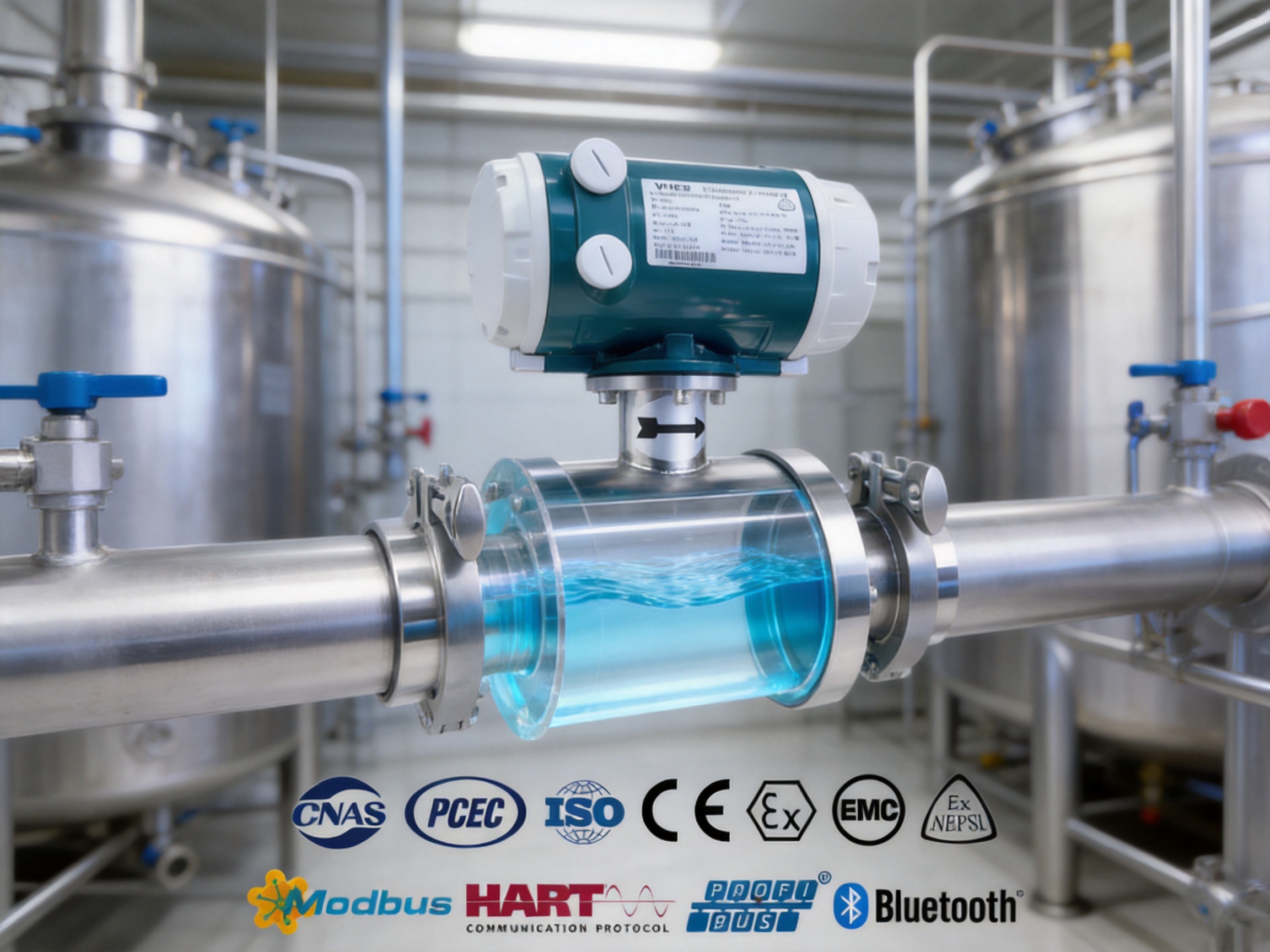
In beverage and liquid food transfer lines, the VE13 can be installed on stainless-steel pipework to measure syrups, beverages, process water, or other conductive liquids. The instrument’s hygienic connection options and cleanable construction are especially useful when the line is operated frequently or subjected to repeated cleaning cycles.
Signal Processing and Measurement Stability
Stable measurement depends on the sensor design, excitation method, signal conditioning, converter software, grounding, installation, and process conditions. The VE13 uses a microprocessor-based converter with programmable low-frequency rectangular excitation. This approach is intended to provide stable signal processing, useful noise immunity, and reliable measurement in demanding industrial environments.
The converter receives the low-level voltage signal detected by the electrodes and processes it into a usable flow value. Because the electrode signal can be affected by electrical noise, grounding conditions, empty-pipe status, and process disturbances, the quality of the electronic design is important. Modern surface-mount device and surface-mount technology construction support compact packaging and consistent electronic assembly.
The stated accuracy is ±0.5% of rate, with typical repeatability of 0.16% of rate. Accuracy and repeatability should not be confused. Accuracy describes how closely the measured value corresponds to the actual flow under specified conditions, while repeatability describes how consistently the instrument reproduces a reading when the same conditions are repeated.
Actual field performance depends on correct sizing and installation. The flowmeter should be selected so that the normal operating flow falls within the recommended velocity range of 0.3 to 10 m/s. The pipe should remain full at the measuring point, and the installation should provide suitable upstream and downstream conditions. Grounding and electrical bonding should follow the installation instructions and the characteristics of the process piping.
Flexible Outputs and Control-System Integration
The VE13 provides 4–20 mA and pulse outputs. The 4–20 mA signal is widely used for continuous flow indication in PLC, DCS, panel meters, and remote monitoring systems. The pulse output can be used for totalizers, batching systems, counters, and equipment controllers that require a pulse proportional to the measured volume.
Modbus RS-485 communication supports digital integration with industrial control systems. It can be used for remote configuration, reading process values, accessing status information, and supporting equipment diagnostics, subject to the selected electronics and communication configuration. HART communication adds another common method for digital interaction over a current-loop installation.
These functions help reduce the need for separate local indicators or manual data collection. In an OEM skid, for example, the flowmeter can provide a continuous analog signal to the main controller while also making digital data available to a service technician. In a dosing system, the pulse output can support batch volume calculation, while the 4–20 mA signal provides a real-time process value to the control system.
The power supply options include 24 V DC and 220 V AC. This flexibility allows the instrument to be specified for low-voltage control panels, packaged equipment, or plant power systems. Electrical connection options include M20 × 1.5 and 1/2-14 NPT, helping engineers coordinate cable entry requirements with regional and project-specific practices.
Application Areas
Food and Beverage Processing
Food and beverage plants frequently measure water, syrups, flavoring solutions, beverages, cleaning liquids, and other conductive media. A flowmeter used in these areas should be easy to clean, compatible with the selected process materials, and capable of repeated operation without excessive maintenance.
The VE13 is suitable for line flow measurement, liquid transfer, dosing support, and utility monitoring when its wetted materials and connection design are compatible with the process. A Tri-Clamp configuration can be considered for hygienic lines, while threaded versions may be suitable for general utility or equipment connections.
For a beverage transfer line, the instrument can be installed in stainless-steel pipework to measure the transfer of syrup, finished beverage, or process water. The full-bore construction avoids introducing a mechanical obstruction, and the electromagnetic principle is suitable for conductive liquids across a range of viscosities.
Chemical and General Industry
Chemical plants often handle conductive raw materials, additives, solutions, and mixtures whose viscosity or concentration may vary. In these applications, the choice of liner and electrode is particularly important. FEP or PFA lining and alternative electrode materials such as Hastelloy or titanium can help engineers configure the flowmeter for the required chemical environment.
The VE13 can support dosing, blending, transfer, and process monitoring in small-bore lines. Its digital communications can help operators retrieve measured values and instrument information without always accessing the local display or opening a control cabinet.
Engineers should verify conductivity, chemical compatibility, maximum temperature, maximum pressure, solids content, and cleaning conditions before selecting the final configuration. The flowmeter should not be treated as universally compatible with every chemical simply because it is electromagnetic.
Water, Wastewater, and Utility Systems
Electromagnetic flowmeters are widely used for conductive water-based liquids. The VE13 can be applied to cooling water, wash water, cleaning solutions, and selected treatment streams where the size and pressure requirements are appropriate.
Its compact construction is useful for utility skids and equipment packages where space is limited. The absence of moving parts can also be beneficial in services where suspended particles or deposits could reduce the reliability of mechanical flow elements.
OEM Equipment and Package Skids
OEM builders require instruments that can be installed repeatedly across multiple equipment designs. A compact flowmeter with flexible power, output, connection, and communication options can simplify standardization. The VE13 is suited to compact frames, dosing units, treatment skids, process modules, and other packaged systems.
Using a consistent meter family across several skid designs can simplify spare-parts planning, commissioning procedures, operator training, and service documentation. The available diameter range also allows the same general measurement technology to be applied across different flow capacities.
Engineering Selection Guidelines
Correct selection begins with the medium. Confirm that the liquid has sufficient electrical conductivity for electromagnetic measurement. Water-based liquids and many chemical solutions are conductive, but oils, hydrocarbons, and other low-conductivity fluids may not be suitable. If the medium is a mixture, conductivity should be evaluated under actual operating conditions rather than assumed from the main ingredient.
Next, determine the normal, minimum, maximum, and occasional flow rates. The meter should be sized so that normal operation is neither too close to the lower measurement limit nor unnecessarily close to the upper velocity limit. A velocity range of 0.3 to 10 m/s is provided, but the best operating point depends on the process, solids content, pressure drop requirements, and control objectives.
Pipe size is also important. Selecting a meter solely to match the nominal pipe diameter may not always produce the best result. In some systems, a smaller meter with suitable reducers can maintain an appropriate velocity and improve measurement performance. Any reduction or expansion should be designed with acceptable pressure loss and adequate straight-run conditions.
Temperature and pressure must be reviewed together. The listed medium temperature range extends from -40 to +200 °C depending on configuration, while the nominal pressure is 1 MPa. The actual allowable temperature can depend on the lining, electrodes, seals, connection type, and pressure rating. The project specification should therefore identify the maximum continuous temperature, short-duration temperature excursions, operating pressure, and possible thermal cycling.
Material compatibility should cover normal liquid contact as well as cleaning and flushing operations. Select the body, lining, electrodes, seals, and connection materials as a complete wetted-material package. For food and beverage use, the cleaning chemistry and temperature should be included in the review. For chemical service, the concentration and temperature of the chemical should be evaluated rather than relying only on its generic name.
Installation orientation should help keep the measuring tube full. Horizontal installation is often used, but the best orientation depends on the process line, fluid behavior, drainage requirements, and potential for air accumulation. The meter should not be installed at a location where the pipe can run partially empty during normal operation unless the instrument and process arrangement are specifically designed for that condition.
Installation and Commissioning Considerations
A good installation begins with a review of the piping layout. Avoid locations immediately downstream of pumps, partially closed valves, sharp elbows, or other disturbances unless the required straight lengths and flow-conditioning provisions are available. The objective is to provide a stable, full pipe and a representative velocity profile at the measuring tube.
Air entrainment can produce unstable readings. The meter should be positioned to reduce the likelihood of air pockets, and the piping should be designed to prevent the measuring point from draining during operation. In open discharge systems, a suitable arrangement may be needed to maintain back pressure and a full measuring tube.
Electrical grounding and bonding are essential for electromagnetic measurement. The installation should follow the manufacturer’s wiring instructions and account for the pipe material, lining, grounding rings, and surrounding electrical equipment. Signal cables should be routed in a way that reduces exposure to strong electromagnetic interference from motors, variable-frequency drives, and high-power switching equipment.
Before commissioning, verify the direction of flow, process connection tightness, cable terminations, supply voltage, output configuration, communication settings, and empty-pipe status. Confirm that the process liquid is conductive and that the line is full. When the instrument is connected to a PLC or DCS, compare the local reading, analog signal, pulse total, and digital communication value under controlled conditions.
Calibration and verification procedures should be established according to the application’s quality requirements. Critical dosing or custody-related applications may require traceable calibration and documented verification at defined intervals. General utility services may use a risk-based maintenance schedule based on process importance and historical performance.
Manufacturing Strengths and Quality Approach
Product performance is influenced not only by the measurement principle but also by how the instrument is engineered, assembled, tested, and supported. Jiangsu VNER Electronic Technology Co., Ltd. is a specialized industrial flowmeter manufacturer based in Yangzhou, China. Since 2011, the company has developed flow measurement products for liquid, gas, and slurry applications.
The company’s product range includes electromagnetic, Coriolis, vortex, swirl, turbine, thermal mass, ultrasonic, and metal tube rotameter technologies. This broad portfolio gives its engineering team experience across different flow regimes and process requirements. That experience can be valuable when customers need help comparing technologies or selecting an instrument for a difficult application.
VNER operates more than 23,000 square meters of modern facilities across three plants and has a technical team of more than 150 people. According to the provided company information, the organization has delivered more than 2,000 engineering projects in over 30 countries. This project exposure supports familiarity with different industrial standards, environmental conditions, control architectures, and procurement requirements.
In-house calibration is an important manufacturing strength. Flowmeters require more than mechanical assembly; they must be configured, tested, and checked as measurement instruments. Calibration activities help verify the relationship between actual flow and indicated output, while documented quality processes support consistency and traceability across production batches.
The company also emphasizes engineering-driven sizing and selection. This is important because even a technically advanced flowmeter can perform poorly if it is incorrectly sized, installed in an unsuitable location, or specified with incompatible wetted materials. Application review can help identify conductivity limitations, temperature restrictions, pressure concerns, output requirements, connection standards, and hazardous-area needs before production.
Surface-mount device and surface-mount technology assembly contribute to compact electronic construction and repeatable production. Modern automated or semi-automated manufacturing methods can improve component placement consistency, reduce assembly variation, and support reliable production of converter electronics. These benefits are especially important for instruments that must maintain stable low-level signal processing over long operating periods.
The company supports EPC contractors, end users, and OEM partners in industries including oil and gas, petrochemical, polysilicon, power, and water and wastewater. Although the VE13 is particularly suited to hygienic and small-bore applications, experience across these industrial sectors contributes to a broader understanding of process measurement, system integration, and project documentation.
Why the VE13 Can Be a Competitive Alternative
The VE13 competes with several categories of liquid flowmeters, including turbine, oval gear, variable-area, ultrasonic, and other electromagnetic meters. Its strongest advantages are not based on one specification alone, but on the combination of a compact form factor, hygienic connection options, no moving parts, flexible materials, low pressure loss, and broad signal integration.
Compared with turbine meters, the VE13 avoids rotor and bearing wear. This can be advantageous where the liquid contains suspended particles, where viscosity changes, or where maintenance access is limited. It also avoids the pressure loss and mechanical sensitivity associated with a rotating element.
Compared with positive-displacement meters, the VE13 has no complex internal measuring chambers or moving gears. This can simplify the flow path and reduce the risk of mechanical damage from unsuitable solids or deposits. Positive-displacement meters may remain preferable for some low-flow, highly viscous, or nonconductive applications, so the choice should be based on the actual process.
Compared with variable-area rotameters, the VE13 provides electronic outputs and digital communications rather than relying primarily on local visual indication. It is therefore better suited to automated systems, remote monitoring, and closed-loop control. A rotameter may still be appropriate where simplicity and direct local indication are the main priorities.
Compared with some ultrasonic flowmeters, the VE13 does not depend on acoustic transmission through the process liquid in the same way. Its full-bore electromagnetic principle can be well suited to conductive liquids and selected slurries. Ultrasonic technology may be preferable for nonconductive fluids or applications where noncontact installation is required.
Compared with larger conventional electromagnetic flowmeters, the VE13 emphasizes compactness and small-bore installation. It is a practical option for hygienic equipment, OEM packages, dosing lines, and space-restricted skids where a large remote sensor and extensive mounting structure would be unnecessary.
Maintenance and Long-Term Reliability
The VE13’s no-moving-parts design can reduce routine mechanical maintenance. However, every flowmeter still benefits from periodic inspection. Maintenance personnel should check the process connections, cable entries, grounding, display and output behavior, communication status, and signs of external damage or leakage.
In clean liquid services, inspection intervals can often be based on process criticality and operating history. In liquids that form deposits, the measuring tube and electrodes may require inspection if the process permits access. A coating on the electrodes or liner can affect signal quality, especially if the deposit changes the electrical relationship between the liquid and the sensing system.
Cleaning procedures should be compatible with the selected liner, electrodes, seals, and process connections. Sudden thermal shock should be avoided unless the complete configuration is designed for it. If the application uses aggressive cleaning chemicals or high-temperature cleaning cycles, these conditions should be included in the original specification and maintenance plan.
Digital communication can support troubleshooting by providing access to process values, configuration information, and selected diagnostic data. When a reading appears abnormal, technicians should first check whether the pipe is full, whether the liquid conductivity has changed, whether air is present, whether the grounding is correct, and whether a valve or pump is causing an unstable flow condition.
Long-term reliability is also affected by environmental conditions. The IP65 protection class is intended for suitable industrial environments, but the instrument should not be exposed beyond its rated conditions. Cable glands, covers, connectors, and enclosure interfaces should be installed correctly to preserve the intended protection level.
Application Example: Beverage and Liquid Food Transfer
Consider a stainless-steel transfer line used to move syrup, beverage concentrate, or process water between tanks and filling equipment. The line may operate frequently, require hygienic cleaning, and have limited space around the pipe. The liquid may also vary in viscosity depending on temperature and formulation.
A VE13 with Tri-Clamp connections can be integrated into the sanitary pipework. The full-bore measuring tube avoids placing a rotor or obstruction in the product path. The selected FEP or PFA lining and electrode material can be reviewed against the beverage, cleaning chemicals, and operating temperature. The 4–20 mA output can be sent to the plant control system, while the pulse output can support batch totalization.
If the line is part of an automated skid, Modbus RS-485 or HART can provide additional digital access for configuration and service. The compact design can simplify installation where the skid frame leaves little room for a large instrument assembly. During commissioning, the integrator would verify the pipe remains full, the medium is conductive, the meter is correctly grounded, and the selected range corresponds to actual transfer rates.
This example illustrates why product selection should consider the entire application rather than accuracy alone. Connection style, cleanability, materials, signal outputs, installation space, and control architecture all contribute to the value of the flowmeter.
Ordering and Project Specification Checklist
When specifying the VE13, the project documentation should identify the nominal pipe size and required connection type. State whether the installation uses threaded connections or Tri-Clamp fittings, and identify the applicable DIN or ANSI/ASME interface requirements.
Provide the measured medium, its electrical conductivity if available, normal and maximum flow rates, viscosity range, temperature range, pressure range, and any solids or suspended particles. Include cleaning chemicals, flushing fluids, sterilization cycles, and occasional operating conditions where relevant.
Specify the required body, lining, electrode, seal, and connection materials. For hygienic service, identify the cleaning standard and surface requirements that apply to the project. For chemical service, provide concentration and temperature information for all significant process and cleaning fluids.
Identify the power supply, output signals, communication protocol, cable-entry standard, display requirements, and hazardous-area classification. If Ex d protection is required, the exact certification and regional compliance requirements should be confirmed before purchase.
Finally, define calibration documentation, inspection records, certificates, spare-parts expectations, and commissioning support. A complete specification reduces the risk of receiving an instrument that is technically correct in principle but unsuitable for the actual line.
Frequently Asked Questions
What type of liquid can the VE13 measure?
The VE13 is designed for electrically conductive liquids and suitable slurries. Typical examples include water, beverages, sugar solutions, conductive chemical liquids, cleaning solutions, and selected viscous fluids. Conductivity must be within the required range, and material compatibility must be confirmed for the actual medium.
Can the VE13 measure nonconductive liquids such as oil?
Electromagnetic flowmeters require electrical conductivity in the measured medium. Many oils and hydrocarbon liquids have insufficient conductivity for this principle, so they may not be suitable. A different flow technology should be evaluated if the liquid is nonconductive.
Does the flowmeter contain a rotor or other moving part?
No. The VE13 uses an electromagnetic field and electrodes to measure flow. Its measuring tube has no moving mechanical element, which helps reduce wear, maintenance requirements, and the risk of blockage caused by internal moving parts.
What are the main hygienic connection options?
The VE13 is available with threaded and Tri-Clamp connections. Tri-Clamp connections are commonly selected for sanitary lines because they support convenient disassembly and cleaning. The correct connection should be chosen according to the piping standard and hygiene requirements of the application.
What accuracy can be expected?
The stated accuracy is ±0.5% of rate, with typical repeatability of 0.16% of rate. Actual performance depends on correct sizing, suitable conductivity, a full measuring tube, appropriate installation, grounding, stable flow conditions, and operation within the specified limits.
What is the available flow velocity range?
The specified flow velocity range is 0.3 to 10 m/s. The meter should be sized so that normal and maximum operating conditions fall within a suitable portion of this range rather than selecting a size based only on the nominal pipe diameter.
Can the VE13 be used for viscous liquids?
It can measure suitable conductive viscous liquids because electromagnetic measurement is largely independent of viscosity. However, viscosity can influence pumping, flow stability, startup behavior, and temperature control. These factors should be reviewed during sizing and installation.
What output signals are available?
The VE13 provides 4–20 mA and pulse outputs. Depending on the configuration, it also supports Modbus RS-485 and HART communication. These functions allow connection to PLC, DCS, batch controllers, totalizers, and supervisory systems.
Is an explosion-proof version available?
Ex d explosion-proof versions are available for designated hazardous locations, depending on the model and project requirements. The hazardous-area classification, certification, temperature class, installation method, and regional approval requirements must be confirmed before ordering.
What power supplies can be used?
The available power supply options include 24 V DC and 220 V AC. The selected supply should match the control panel or plant electrical system and should be confirmed in the final instrument specification.
How should the meter be installed?
The meter should be installed in a location where the measuring tube remains full and where the flow profile is stable. The installation should provide suitable upstream and downstream conditions, correct grounding, appropriate cable routing, and access for inspection and maintenance. Detailed installation instructions should be followed for the selected configuration.
What materials are available for the electrodes?
Electrode options include 316L stainless steel, Hastelloy, and titanium. The correct material depends on the liquid, concentration, temperature, cleaning chemicals, and corrosion conditions.
Why is the liner important?
The liner separates the process liquid from the meter body and contributes to chemical compatibility and temperature capability. FEP and PFA options are available. The liner must be selected together with the electrodes, seals, and process conditions rather than considered separately.
Who can benefit from the compact design?
OEM equipment builders, skid integrators, food and beverage processors, chemical plants, water-treatment operators, and users of small-bore process lines can benefit from the compact design. It is particularly useful where installation space is limited or where a large flowmeter would be unnecessary.
Conclusion
The VE13 Hygienic Electromagnetic Flowmeter combines the fundamental benefits of electromagnetic measurement with a compact design intended for small-bore and hygienic process lines. Its full-bore construction, no moving parts, low pressure loss, and reduced sensitivity to density and viscosity make it a strong alternative to many mechanical flowmeters for conductive liquids.
Its stainless-steel body options, FEP and PFA linings, alternative electrode materials, threaded and Tri-Clamp connections, and flexible electrical interfaces allow the instrument to be configured for a wide range of industrial requirements. The 4–20 mA, pulse, Modbus RS-485, and HART functions support both conventional and digitally connected control systems.
The product is particularly well suited to beverage and liquid food transfer, chemical dosing, utility water, cleaning systems, compact treatment equipment, and OEM skids. Its value is greatest when the application requires cleanable connections, minimal pressure loss, reliable repeatability, and reduced mechanical maintenance.
Behind the product is a manufacturer with experience across multiple flow technologies, in-house calibration capabilities, modern electronic assembly methods, engineering-based selection, and international project experience. Jiangsu VNER Electronic Technology Co., Ltd. supports EPC contractors, end users, and OEM partners with flow measurement products for demanding industrial environments.
As with any process instrument, the VE13 should be selected and installed according to the actual medium, conductivity, flow range, temperature, pressure, materials, piping arrangement, electrical environment, and control-system requirements. When these factors are correctly evaluated, the VE13 offers a practical and competitive solution for stable measurement of conductive liquids in compact and hygienic process systems.
References
1. Product technical information for the VE13 Hygienic Electromagnetic Flowmeter, including operating principle, materials, outputs, communication, and application data.
2. Faraday’s law of electromagnetic induction as applied to industrial electromagnetic flow measurement.
3. General engineering practices for electromagnetic flowmeter sizing, grounding, full-pipe installation, and process compatibility.
4. Industrial guidelines for hygienic piping, Tri-Clamp connections, cleanability, and material selection in food and beverage process systems.
5. General principles of process instrumentation calibration, repeatability, analog signaling, pulse totalization, Modbus communication, and HART integration.
6. Manufacturer information concerning Jiangsu VNER Electronic Technology Co., Ltd., its flowmeter product portfolio, facilities, technical team, project experience, and engineering support capabilities.
Product: VE13 Hygienic Electromagnetic Flowmeter



Products
Contact Information
-

+86 18652789521
+86-0514-83633600 / 83633900 -

+86-0514-83633600 / 83633900
-

s@vner.com.cn
katherine@vner.com.cn -

No. 11 Xingye Road, Chenji Town Industrial Park, Yizheng, Yangzhou, China
