
 0
0
 EN
EN  English
 عربى
عربى Español
 русский
If you need any help, please feel free to contact us
Home / Author / Guo Lanyue — Industrial Flow Meter Sales Manager / Gas Turbine Flowmeters for Accurate Industrial Gas Measurement
Gas Turbine Flowmeters for Accurate Industrial Gas Measurement
Industrial gas measurement is a critical requirement in energy management, process control, custody-related metering, and environmental supervision. Natural gas, nitrogen, hydrogen, compressed air, oxygen, argon, carbon dioxide, fuel gas, flare gas, and many other gases must be measured reliably before they enter a process, pass through a distribution network, or leave a production system. An inaccurate measurement can cause billing disputes, inefficient combustion, excessive energy consumption, unstable production, and difficulty demonstrating regulatory compliance.
The LWQ Series Gas Turbine Flowmeter is designed for industrial applications that require accurate volumetric gas measurement in a compact and intelligent instrument. It uses the kinetic energy of a moving gas stream to rotate a turbine rotor. The rotational speed is converted into a frequency signal that corresponds to the gas velocity and volumetric flow rate. With integrated temperature and pressure measurement, the instrument can also calculate compensated standard volume flow under changing operating conditions.
This combination of mechanical flow sensing, digital signal processing, pressure compensation, temperature compensation, communication capability, and local display creates a practical solution for modern gas measurement systems. It is suitable for clean and dry gases in industrial pipelines, utility networks, energy systems, chemical facilities, manufacturing plants, and gas distribution applications.
The instrument is supported by an engineering-oriented manufacturing organization with experience across electromagnetic, Coriolis, vortex, swirl, turbine, thermal mass, ultrasonic, and rotameter technologies. This broad product knowledge is valuable because gas measurement requirements vary substantially according to pressure, temperature, pipe size, gas composition, flow range, installation conditions, and communication requirements.
Why Accurate Gas Measurement Matters
Gas is compressible, which makes its measurement more complex than the measurement of many liquids. The volume occupied by a gas changes as pressure and temperature change. A pipeline may therefore carry the same mass of gas while its actual operating volume varies significantly throughout the day. If a flowmeter reports only operating volume without considering pressure and temperature, the result may not accurately represent the amount of gas consumed or transferred.
For this reason, many industrial systems need two different values. The first is actual volume flow, which describes the volume occupied by the gas at the meter operating conditions. The second is standard or normal volume flow, commonly expressed in units such as Nm³/h, which converts the measurement to a defined reference pressure and temperature. Standardized flow values make it easier to compare consumption, manage production, calculate energy use, and perform commercial settlement.
The LWQ Series addresses this requirement through integrated temperature and pressure compensation. Sensors monitor the operating conditions while the digital transmitter applies compensation algorithms. The result is a more useful measurement for systems in which pressure and temperature change during operation.
Reliable gas measurement also supports operational decisions. A boiler operator can compare fuel consumption with thermal output. A chemical plant can verify nitrogen use during inerting. A compressed-air manager can identify leaks and compare consumption between production lines. A refinery can monitor flare gas and support environmental reporting. A gas distributor can evaluate demand across branches of a network. In each case, dependable data is the foundation of effective control.
Operating Principle of the LWQ Series
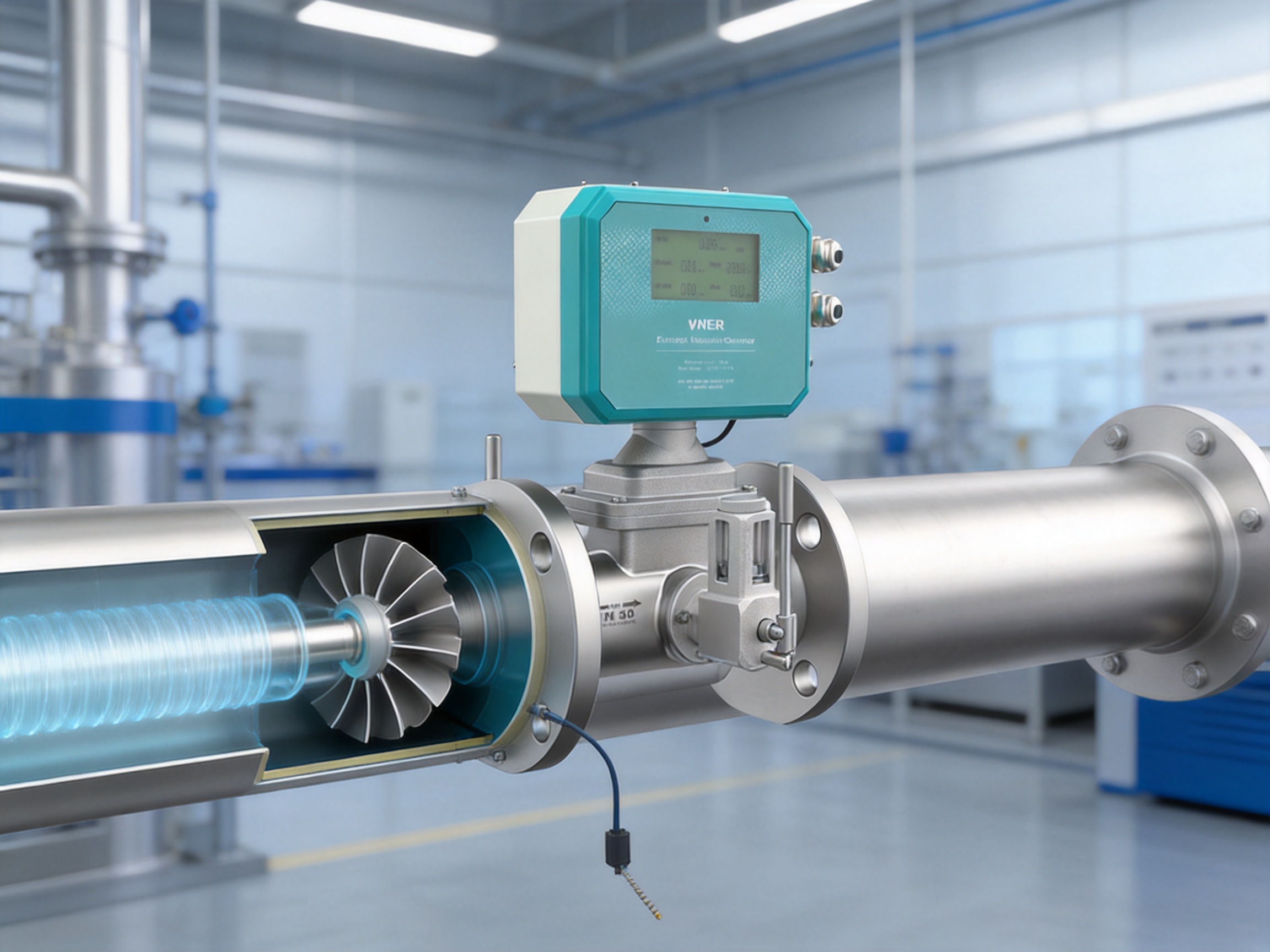
The LWQ Series Gas Turbine Flowmeter works according to the relationship between gas velocity and turbine rotor speed. Gas enters the flowmeter through the inlet section, where a flow straightener conditions the gas before it reaches the rotor.
In an untreated pipeline, gas may contain swirl, asymmetrical velocity distribution, and turbulence caused by elbows, valves, reducers, compressors, or other disturbances. These conditions can create measurement errors because the rotor may not experience a stable and representative flow profile. The inlet flow straightener reduces swirl and turbulence and helps produce a more uniform velocity distribution.
After conditioning, the gas acts on the blades of the multi-blade turbine rotor. The rotor turns at a speed related to the gas velocity. As the rotor rotates, an inductive or magnetic pickup detects the movement of the blades and generates electrical pulses. The frequency of these pulses is proportional to the volumetric flow rate within the calibrated operating range.
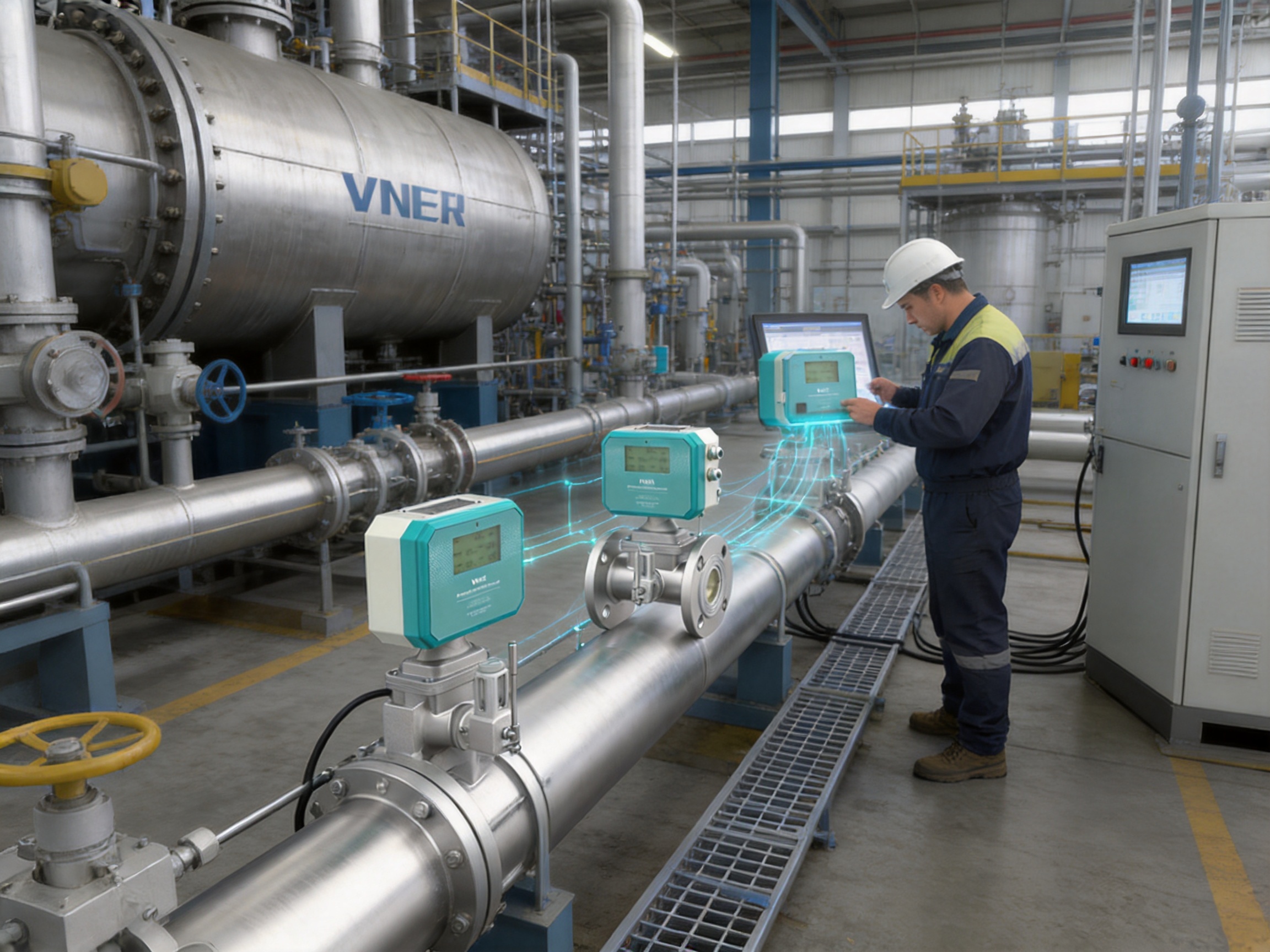
The transmitter receives the pulse or frequency signal and converts it into a flow value. Depending on the configuration, the instrument can display instantaneous flow, cumulative flow, pressure, and temperature. It can also provide pulse, frequency, analog, and RS485 Modbus communication outputs for connection to a control system or data platform.
Where standard volume measurement is required, the transmitter uses temperature and pressure data to compensate the measured gas volume. This allows the flowmeter to provide a more meaningful result than a basic uncorrected turbine meter. The compensation function is particularly useful in natural gas distribution, compressed gas systems, boiler fuel measurement, and process gas applications.
Signal Detection and Digital Processing
The pickup design allows the instrument to detect rotor movement without requiring a direct mechanical connection between the sensing element and the external electronics. The resulting frequency signal is processed by the transmitter and converted into engineering units.
Digital processing supports stable calculation, parameter configuration, cumulative totalization, alarm management, and communication with external systems. It also enables the instrument to combine flow, pressure, and temperature information in one integrated measurement platform.
Because the signal is based on rotor frequency, the flowmeter can provide a responsive indication of changing gas demand. This is useful for process control, line balancing, burner management, and monitoring of intermittent consumption patterns.
Key Advantages Compared with Conventional Gas Measurement Approaches
Different flowmeter technologies have different strengths. A well-designed turbine flowmeter is especially attractive when a user requires a practical combination of accuracy, repeatability, compact installation, fast response, and moderate cost for clean gas service.
High Accuracy and Repeatability
The turbine rotor provides a direct relationship between gas velocity and pulse frequency. Within the specified range, this creates a repeatable measurement signal that can be calibrated and verified. Repeatability is important in applications where operators compare consumption over time or use the flow signal for process adjustment.
Compared with simple mechanical indicators or estimation based on valve position, a digital turbine flowmeter provides a measured and traceable signal. Its frequency output also supports integration with electronic totalizers, supervisory systems, and energy-management software.
Low Starting Flow
The LWQ Series is designed to respond at relatively low gas flow rates. Low starting flow is valuable in systems where demand varies widely, such as production lines that alternate between standby and full operation. A meter that cannot respond until flow becomes relatively high may under-record consumption during low-demand periods.
A low starting flow characteristic also helps users monitor leakage, minimum utility demand, and small changes in gas usage. This can support preventive maintenance and energy-saving programs.
Low Pressure Loss
Pressure loss is a major consideration in compressed gas and natural gas systems. Excessive pressure loss can increase compressor duty, reduce downstream pressure, limit process performance, and raise operating costs.
The LWQ flow path and inlet conditioning structure are designed to achieve effective flow measurement without creating unnecessary backpressure. This makes the instrument suitable for systems in which pressure preservation is important. Lower pressure loss can be particularly beneficial in compressed-air distribution, instrument-air systems, and fuel gas pipelines.
Integrated Pressure and Temperature Compensation
A conventional flowmeter may require separate pressure and temperature instruments, additional wiring, external calculation, and a control-system program to determine standard volume flow. The integrated LWQ configuration reduces this complexity by combining flow sensing with pressure and temperature measurement in one instrument body.
Integrated compensation can improve installation consistency because the relevant measurements are located at the flowmeter rather than being distributed across multiple independent devices. It also simplifies the data path between the sensors and the calculation algorithm.
Compact Instrumentation
The compact integrated design combines sensing, calculation, display, and communication functions. This is useful when space is limited or when a project needs to reduce the number of components installed around a pipeline.
A compact design can also reduce the length of instrument cable, simplify commissioning, and make local verification easier. Maintenance personnel can view important operating values at the meter rather than relying exclusively on a remote control-room display.
Wide Display Capability
The segment LCD is designed for local readability, including operation at ambient temperatures down to approximately -30°C. The display can show real-time flow rate, cumulative flow, pressure, and temperature.
Local indication remains valuable even in highly automated facilities. During startup, maintenance, calibration checks, and troubleshooting, technicians often need to confirm the actual value at the pipeline. A clear local display reduces dependence on remote communication and helps identify wiring or configuration problems.
Digital Communication for Modern Control Systems
RS485 Modbus communication provides a standardized method for connecting the flowmeter to supervisory control and data acquisition systems, distributed control systems, programmable controllers, building-management platforms, and industrial Internet of Things gateways.
Through digital communication, users can access flow, totalized volume, pressure, temperature, status, and configuration information. This supports centralized monitoring and makes it easier to collect data from multiple meters across a facility.
The instrument can also be configured with pulse, frequency, and 4–20 mA analog outputs. These options allow the same product family to serve both modern digital installations and conventional control systems.
LWQ Series Gas Turbine Flowmeter-副本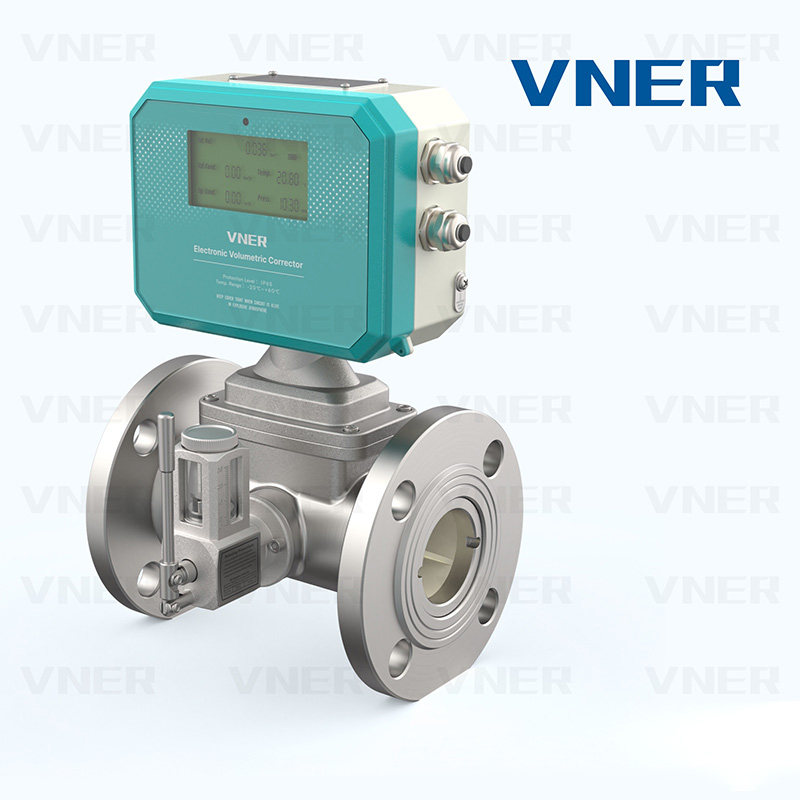
Application Areas
Natural Gas Distribution
Natural gas networks require dependable measurement at city-gate stations, industrial branches, boiler rooms, and commercial facilities. The LWQ Series can measure natural gas consumption for operational monitoring, internal allocation, energy management, and billing-related applications when the installation meets the required measurement standards and calibration conditions.
In an industrial distribution network, the flowmeter can be installed at the incoming gas line, at separate production workshops, or at individual high-consumption users. Comparing the total incoming flow with the sum of downstream measurements can help identify leakage, unmetered consumption, or abnormal operating conditions.
Boiler and Combustion Systems
Boiler efficiency depends on the relationship between fuel input and useful thermal output. Measuring gas flow allows operators to evaluate consumption, adjust burner operation, detect abnormal demand, and compare performance between operating periods.
Pressure and temperature compensation is important because fuel gas conditions can vary. Standardized flow data allows more consistent comparison and supports energy-performance calculations. The meter can also be connected to combustion-control systems through analog, pulse, frequency, or Modbus communication.
Chemical and Petrochemical Plants
Chemical facilities use gases for reaction, inerting, purging, blanketing, heating, oxidation, and utility services. Nitrogen flow measurement is common in tank blanketing and process protection. Hydrogen, oxygen, fuel gas, and other process gases may also need to be monitored at different stages of production.
The LWQ Series is suitable for clean and dry gases, making it appropriate for many prepared gas streams. Before selection, users should confirm gas composition, cleanliness, moisture level, pressure, temperature, corrosive properties, and required materials. Proper application review is essential for obtaining long-term reliability.
Oil and Gas Facilities
Oil and gas facilities may need to measure fuel gas, instrument air, natural gas, process gas, and flare gas. Monitoring these streams supports production control, equipment protection, energy management, and environmental supervision.
Flare gas measurement can be especially challenging because flow may be intermittent and conditions may change rapidly. A suitable flowmeter must be selected according to the expected minimum and maximum flow, gas composition, pressure, temperature, and installation arrangement. The LWQ Series can provide a practical measurement option for suitable clean gas services, subject to engineering verification.
Power Plants and Energy Systems
Gas-fired power plants and combined heat and power systems depend on stable fuel measurement. Flow data can be used to balance gas supply, monitor combustion performance, compare fuel input with generation output, and identify changes in operating efficiency.
Gas measurement is also useful for auxiliary systems, including boiler ignition, heating systems, emergency generators, and plant utilities. The flowmeter’s communication functions allow data to be incorporated into plant-wide energy dashboards.
Compressed Air and Industrial Utilities
Compressed air is often one of the most expensive utilities in a manufacturing plant because compressors consume substantial electrical energy. Measuring air use by production line can reveal leaks, excessive demand, pressure-control problems, and inefficient equipment operation.
The LWQ Series can be applied to clean, dry compressed air when the pressure, velocity, pipe size, and flow range are suitable. Its low pressure loss helps preserve useful line pressure, while digital communication supports consumption analysis across multiple branches.
Industrial Gas and Bottling Systems
Industrial gas facilities use oxygen, nitrogen, argon, carbon dioxide, and other gases in storage, distribution, blending, filling, and processing. Flow measurement helps verify transfer rates, monitor filling operations, and maintain consistency in gas blending.
In bottling or blending stations, the meter can provide instantaneous flow and totalized volume. When several gases are combined, individual flowmeters can transmit data to a control system for ratio management and batch documentation.
Steel, Metallurgy, and Furnace Operations
Steel and metallurgical plants use large volumes of fuel gas, compressed air, oxygen, nitrogen, and other gases. Stable gas delivery is essential for blast furnaces, reheating furnaces, converter operations, heat treatment, and protective atmospheres.
Flowmeters installed at major branches can support production planning and help operators compare gas consumption among furnaces. The local display is useful in harsh industrial environments where field technicians need immediate access to operating data.
HVAC and Building Utilities
Gas-fired heating and cogeneration systems require measurement for performance evaluation and fuel management. A flowmeter can be installed on the gas supply to heating equipment, combined heat and power units, or utility boilers.
When connected to a building-management or energy-management platform, the meter can contribute to daily, weekly, and seasonal consumption records. This data helps facility managers evaluate operating schedules and identify opportunities for reducing fuel use.
Technical Features That Support Reliable Operation
Inlet Flow Conditioning
The inlet flow straightener is an important part of the measurement system. It reduces the influence of swirl and turbulence and improves the uniformity of the flow entering the rotor. This helps the rotor respond more consistently to the actual gas velocity.
Although the flow straightener improves measurement stability, installation requirements must still be followed. Upstream and downstream straight pipe lengths, valve locations, reducers, elbows, pipe alignment, and internal obstructions can affect performance. The final installation should follow the supplier’s technical guidance and the project’s applicable standards.
Frequency-Based Measurement
The frequency signal generated by the pickup is well suited to electronic measurement and digital transmission. Frequency signals can be totalized over time and converted into flow units through calibrated coefficients.
The signal also allows rapid recognition of changing flow conditions. This is useful when demand fluctuates or when a process requires prompt feedback. The transmitter can use the signal together with programmed meter parameters to calculate and display flow values.
Pressure and Temperature Sensors
Gas density changes with pressure and temperature. The integrated sensors provide the information required to compensate the flow calculation. This makes the meter more suitable for applications where operating conditions are not constant.
Pressure data can also provide useful process information. An unexpected pressure reduction may indicate a blocked filter, a closed valve, a compressor problem, or excessive downstream demand. Temperature monitoring can help identify abnormal gas conditions and support equipment diagnostics.
Multiple Output Options
Different plants have different automation architectures. Some require a 4–20 mA signal for a conventional controller. Others use pulse outputs for totalizer inputs, frequency outputs for speed or flow interfaces, or Modbus for centralized digital data acquisition.
Offering several output options reduces the need for separate signal converters. It also allows the meter to be used in new projects, retrofit installations, and phased automation upgrades.
Local and Remote Access
Local indication supports field operation, while remote communication supports centralized supervision. Using both approaches provides a practical balance between maintenance convenience and automation capability.
Operators can inspect the display during routine rounds, while control-room personnel can observe flow trends and alarms through the plant network. This dual-access arrangement improves visibility and can shorten the time required to diagnose process deviations.
Comparison with Other Flowmeter Technologies
No flowmeter is ideal for every gas application. Technology selection should be based on the gas properties, required accuracy, flow range, pressure and temperature conditions, pipe size, installation space, maintenance expectations, and communication requirements. The LWQ Series has particular advantages when the gas is clean and dry and the user needs a turbine-based solution with integrated compensation.
| Technology | Typical Strength | Important Consideration | Position of a Gas Turbine Flowmeter |
|---|---|---|---|
| Gas turbine | Good accuracy, repeatability, fast response, and compact construction | Best suited to clean and relatively dry gases; moving parts require proper application | Strong choice for natural gas, compressed air, fuel gas, and industrial gas measurement |
| Vortex | Solid-state sensing and broad industrial use | Requires adequate velocity and can be affected by vibration and flow disturbances | Useful alternative where a different velocity-based principle is preferred |
| Thermal mass | Direct mass-flow indication and good sensitivity at low flow | Gas composition and thermal properties can affect calibration | May be preferred for low-flow gas or mass-based applications after gas-property review |
| Coriolis mass | Direct mass measurement and high accuracy | Higher cost, greater weight, and possible pressure-loss or size limitations | Often selected when direct mass measurement is more important than compact economical installation |
| Ultrasonic | No internal moving rotor and suitability for large pipelines | Requires careful installation, signal quality, and application validation | May be advantageous for large-scale gas transmission or specialized installations |
| Variable-area rotameter | Simple local indication and easy visual operation | Usually limited automation and lower functionality for networked measurement | More advanced solution when totalization, compensation, and remote communication are required |
The principal competitive advantage of the LWQ Series is not based on one isolated feature. It comes from the combination of a proven turbine principle, flow conditioning, low starting flow, low pressure loss, integrated pressure and temperature compensation, digital display, and multiple communication options.
Compared with a basic turbine meter without compensation, the LWQ configuration can provide more useful standardized gas-flow data. Compared with a separate meter, pressure transmitter, temperature transmitter, and external calculator, the integrated design can simplify installation and reduce the number of components that must be coordinated. Compared with a simple local rotameter, it offers substantially greater digital capability and data accessibility.
Compared with some high-complexity technologies, a turbine meter can offer a more economical and compact solution when the gas is clean and the operating range is appropriate. The final comparison should always be based on actual process conditions rather than general claims.
Manufacturing Strengths Behind the Product
Flowmeter performance depends not only on the measurement principle but also on manufacturing consistency. Rotor balance, body machining, sensor positioning, sealing quality, electronic assembly, calibration, and parameter management all influence the final instrument.
Specialized Flow Measurement Experience
The manufacturer behind the LWQ Series has focused on industrial flow measurement since 2011. Its product portfolio includes electromagnetic, Coriolis, vortex, swirl, turbine, thermal mass, ultrasonic, and metal tube rotameter instruments.
This technology breadth provides a practical engineering advantage. Different measurement principles can be evaluated according to the application instead of forcing every project into one product category. A manufacturer that understands both liquid and gas measurement is also better positioned to support complete plant packages containing several fluid types.
Modern Production Facilities
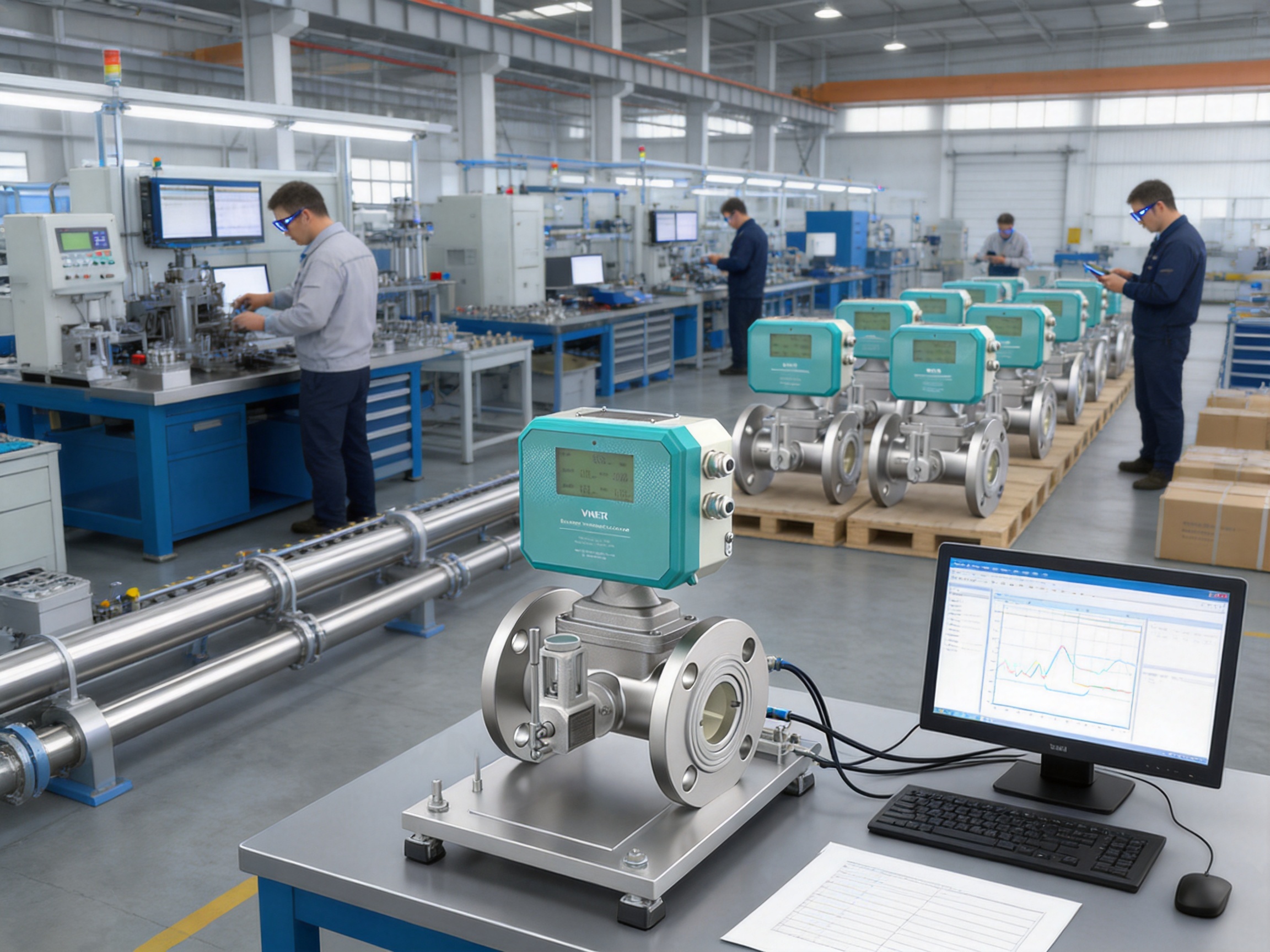
The company operates approximately 23,000 square meters of modern facilities across three plants. This production scale supports dedicated areas for machining, assembly, electronics, testing, calibration, warehousing, and quality control.
Organized production areas help reduce variation between batches. Controlled assembly procedures make it easier to manage sensor installation, wiring, sealing, display integration, and transmitter configuration. A stable process is particularly important for instruments that may be used in multiple pipe sizes and pressure classes.
Technical Team and Engineering Support
A technical team of more than 150 people supports product development, application review, engineering selection, production, commissioning, and after-sales service. Flowmeter selection is not simply a matter of matching pipe diameter. Engineers must consider gas density, viscosity, pressure, temperature, expected flow range, velocity, upstream disturbances, material compatibility, output requirements, and installation environment.
Engineering support helps customers avoid common sizing errors. Selecting a meter solely according to nominal pipe size can result in a poor measurement range if the actual gas flow is too low or too high. An engineering-driven process evaluates the operating envelope before the instrument is manufactured.
In-House Calibration
Calibration is essential for turbine flowmeters because the relationship between rotor frequency and flow must be verified. In-house calibration capability enables the manufacturer to evaluate meter performance, record calibration data, and maintain better control over product traceability.
Calibration activities may include checking the meter at multiple flow points, verifying signal output, confirming display values, and reviewing the relationship between the instrument coefficient and the final configuration. This process supports stable product quality and gives customers greater confidence in measurement results.
Certified Quality Processes
Certified quality processes provide a framework for document control, inspection, nonconformance management, process monitoring, and continual improvement. For industrial instruments, quality management should extend from incoming materials to final testing and shipment.
Important production controls may include inspection of the meter body, verification of rotor and bearing components, checking of electrical connections, pressure testing where applicable, transmitter function testing, output verification, and review of calibration documentation.
Automated and Consistent Manufacturing
Increasing automation can improve repeatability in manufacturing operations. Automated or semi-automated procedures are useful for machining, assembly support, electronic testing, parameter loading, and inspection. Automation does not replace engineering judgment, but it can reduce variation in repetitive operations.
Consistent manufacturing is especially important when customers order multiple meters for a large plant. Matching instruments across a project simplifies spare-parts planning, configuration management, commissioning, and maintenance training.
Engineering Projects in International Markets
The company has delivered more than 2,000 engineering projects in over 30 countries. International project experience exposes the manufacturer to different standards, environmental conditions, communication systems, pipeline practices, and industry expectations.
This experience can be useful for export customers, EPC contractors, system integrators, and OEM partners. It also encourages a practical understanding of documentation, packaging, product labeling, technical communication, and project coordination.
Installation Considerations
Correct installation is necessary to achieve the expected performance of any gas flowmeter. Before installation, the user should verify that the meter size and range match the actual minimum, normal, and maximum gas flow. The gas pressure, temperature, density, composition, moisture level, and cleanliness should also be reviewed.
Pipeline Configuration
The meter should be installed in a pipeline with a stable and representative flow profile. Excessive swirl, strong turbulence, pulsation, or abrupt changes in pipe diameter can influence the rotor signal. Recommended straight pipe lengths should be maintained wherever possible, and valves or elbows should not be positioned in a way that creates severe disturbances immediately upstream of the meter.
The pipeline should be properly supported so that mechanical stress is not transferred to the flowmeter body. Flanges, gaskets, bolts, and seals should be selected according to the pressure and temperature requirements. Internal weld beads, loose materials, scale, and debris should be removed before commissioning.
Gas Cleanliness and Moisture
The LWQ Series is intended for clean and dry gases. Solid particles may damage the rotor or affect its balance. Liquid carryover may increase friction, interfere with rotor movement, or cause unstable readings.
Where necessary, filters, separators, dryers, or condensate-management equipment should be installed upstream. The filtration system should be designed so that it does not create excessive pressure loss or become a new source of flow instability.
Electrical Installation
Power supply, grounding, signal wiring, and communication cables should be installed according to the instrument documentation and relevant electrical practices. Signal cables should be protected from strong electromagnetic interference, high-power cables, and sources of vibration or mechanical damage.
For RS485 Modbus networks, correct polarity, termination, addressing, baud-rate configuration, and network topology are important. A well-organized communication network makes commissioning easier and reduces the risk of intermittent data loss.
Commissioning
During commissioning, technicians should confirm the flow direction, verify the display units, check pressure and temperature values, inspect output signals, and compare local readings with the control-system values. The cumulative totalizer should be initialized or recorded according to the project procedure.
It is also useful to observe the meter during low, normal, and high demand. Unstable readings may indicate air pockets, pulsation, excessive vibration, improper grounding, insufficient flow conditioning, gas contamination, or an incorrect parameter setting.
Maintenance and Long-Term Reliability
A well-selected and correctly installed turbine flowmeter can provide dependable service with routine maintenance. Maintenance requirements depend on gas cleanliness, operating hours, pressure, temperature, vibration, and the importance of the measurement point.
Periodic inspection should include checking the external condition of the meter, verifying display operation, reviewing communication status, inspecting cable glands, and confirming that the pipeline remains properly supported. Operators should compare current readings with historical trends to identify gradual changes.
A gradual increase in pressure loss or a change in the relationship between flow and process demand may indicate contamination, rotor wear, bearing problems, or an upstream filter restriction. Unexpected zero-flow readings or intermittent signals may be associated with wiring, pickup, power supply, or mechanical movement issues.
Calibration intervals should be determined according to the application, required uncertainty, regulatory requirements, operating conditions, and internal quality procedures. Custody-related applications may require more frequent verification and stricter documentation than general utility monitoring.
Spare-parts planning can improve availability. Users may consider maintaining suitable pickup components, seals, electronic modules, and other service parts according to the meter configuration and operating environment. A manufacturer with multiple product lines and engineering support can help coordinate replacement and troubleshooting requirements.
Data Management and Energy Optimization
Flow measurement becomes more valuable when the data is analyzed rather than merely displayed. The LWQ Series can transmit measurements to a supervisory system where operators can create consumption profiles, compare operating shifts, monitor peak demand, and establish performance indicators.
For a boiler, gas consumption can be compared with steam production or heat output. For a compressed-air system, branch consumption can be compared with compressor loading. For a chemical process, nitrogen usage can be assessed against production volume. For a factory, each workshop can be evaluated according to its energy intensity.
Trend analysis can also support predictive maintenance. A slow increase in gas consumption without a corresponding increase in production may indicate leakage, burner deterioration, valve problems, insulation issues, or process inefficiency. Early detection can prevent higher costs and unplanned downtime.
Digital data can be integrated into energy-management programs. Daily and monthly records can be used to establish baselines, calculate savings, verify improvement projects, and allocate utility costs. Standard volume flow data is particularly useful because it provides a consistent basis for comparison when operating pressure and temperature vary.
How to Select the Correct Configuration
Users should provide complete process information before selecting a gas turbine flowmeter. The most important parameters include gas type, minimum flow, normal flow, maximum flow, operating pressure, operating temperature, pipeline size, connection standard, installation orientation, required accuracy, output signals, hazardous-area requirements, and whether compensated standard flow is required.
The gas composition should be considered carefully. Changes in density and viscosity can influence meter performance and calculation. If the gas contains significant moisture, oil mist, dust, corrosive components, or liquid droplets, additional treatment or a different flowmeter technology may be needed.
The flow range should be reviewed at actual operating conditions and, where necessary, at standard conditions. A meter that is correctly sized for normal flow may not perform well if the minimum flow is far below its effective range or if the maximum flow produces excessive velocity.
Pressure and temperature sensors should be selected and configured to cover the complete operating range. The reference conditions used for standard volume calculation must be clearly defined so that the displayed and transmitted values are interpreted correctly.
Communication requirements should be discussed early. The user may need local display only, pulse output for a totalizer, 4–20 mA for a control loop, frequency output for a specialized input, or Modbus communication for a digital plant network. Choosing the appropriate configuration at the beginning avoids later signal-conversion work.
Quality, Traceability, and Project Support
Industrial customers often require more than a functioning instrument. They may need technical drawings, data sheets, inspection records, calibration certificates, material information, wiring diagrams, operating instructions, packing documentation, and spare-parts recommendations.
Traceability helps connect the supplied instrument to its production and calibration records. This is important for EPC projects, regulated industries, maintenance planning, and quality audits. A clear documentation package also helps the end user install, operate, and service the meter correctly.
The manufacturer’s support for EPC contractors, end users, and OEM partners is useful in projects where flowmeters must be integrated into a broader package. The product may be supplied as part of a gas skid, utility-monitoring system, boiler package, process-control project, or plant-wide energy-management program.
Engineering-driven selection is also valuable when the flowmeter is used in an unfamiliar application. A technical review can determine whether a turbine meter is appropriate or whether an electromagnetic, Coriolis, vortex, thermal mass, ultrasonic, swirl, or rotameter solution would be more suitable.
Practical Application Examples
Industrial Boiler Fuel Monitoring
An industrial boiler can use the LWQ Series on its natural gas supply line to measure fuel consumption. Pressure and temperature compensation provide standardized values for energy reporting. The 4–20 mA output can be connected to the boiler-control system, while Modbus communication can transmit flow and totalized data to the energy-management platform.
By comparing gas consumption with steam production, the operator can identify changes in boiler efficiency. A sudden increase in fuel use may trigger inspection of the burner, combustion air, heat-transfer surfaces, or control parameters.
Nitrogen Inerting
A chemical plant may use nitrogen to protect storage tanks and process equipment from oxygen ingress. A flowmeter installed on the nitrogen supply can monitor continuous blanketing demand and detect abnormal usage.
If the flow remains high when production is stopped, the data may indicate an open valve, a damaged regulator, a leaking tank connection, or an incorrect pressure-control setting. Totalized nitrogen consumption can also support supply planning.
Compressed-Air Allocation
A manufacturing plant may install meters on the main compressed-air header and on individual production branches. The resulting data can show which lines consume the most air and when consumption occurs.
Because the LWQ Series offers low pressure loss and digital communication, it can help create a practical monitoring network without imposing significant additional backpressure. The data can be used to prioritize leak detection and equipment upgrades.
Flare Gas Supervision
A refinery may need to monitor flare gas flow for operational review and environmental reporting. The application should be evaluated carefully because flare systems can experience changing composition, intermittent flow, pressure fluctuation, and wide turndown.
Where the gas condition and measurement range are suitable, the meter can provide local and remote flow information. Engineering review is essential to confirm that the selected meter can operate reliably under the expected flare conditions.
Gas Blending
A gas blending or bottling station may use several flowmeters to control the ratio of different gases. Each meter can send instantaneous and cumulative flow data to a controller. The system can then regulate valves and verify the quantity of each component in a batch.
Accurate configuration, stable pressure control, proper calibration, and consistent gas properties are important for achieving the required blend ratio. The transmitter’s digital functions support data recording and batch verification.
Q&A
What gases can the LWQ Series measure?
The flowmeter is intended for clean and dry gases such as natural gas, nitrogen, hydrogen, compressed air, oxygen, argon, carbon dioxide, fuel gas, and suitable process gases. The final selection must consider gas composition, pressure, temperature, moisture, cleanliness, and compatibility with wetted materials.
Does the flowmeter measure mass flow directly?
The turbine sensing principle measures volumetric flow through rotor frequency. When pressure and temperature sensors are integrated, the transmitter can calculate compensated standard volume flow. It is not the same as a direct Coriolis mass measurement, so users should select the technology according to whether volume flow, standardized volume flow, or direct mass flow is required.
What is the purpose of the inlet flow straightener?
The inlet flow straightener reduces swirl and turbulence and helps condition the gas before it reaches the rotor. This improves the stability of the velocity profile and supports more consistent measurement.
Why is pressure compensation important for gas?
Gas volume changes as pressure changes. Pressure compensation allows the transmitter to convert operating-volume measurements into a defined standard or normal volume. This makes consumption values more comparable across changing operating conditions.
Why is temperature compensation needed?
Gas temperature affects density and volume. Temperature compensation improves the calculation of standard volume flow and helps maintain consistent reporting when ambient or process temperature changes.
Can the flowmeter be connected to a SCADA system?
Yes. RS485 Modbus communication is available for connection to SCADA, DCS, PLC, and IIoT systems. Pulse, frequency, and 4–20 mA outputs can also be selected for different control and monitoring architectures.
Can operators read the flow locally?
Yes. The integrated segment LCD can display real-time flow rate, cumulative flow, pressure, and temperature. It is designed for field observation and can remain readable at ambient temperatures down to approximately -30°C.
Is the flowmeter suitable for dirty or wet gas?
The standard application is clean and dry gas. Dirty gas, liquid carryover, oil mist, or heavy moisture may affect the rotor and measurement stability. Filtration, separation, drying, or an alternative measurement principle may be required after an application review.
What installation information should be provided for sizing?
Users should provide the gas type and composition, minimum and maximum flow, normal flow, operating pressure, operating temperature, pipe size, connection requirements, installation orientation, accuracy requirement, output signals, and environmental conditions. Complete information helps prevent incorrect sizing.
How does this product compare with a vortex flowmeter?
Both technologies can be used for industrial gas measurement, but they respond differently to flow conditions and installation factors. A turbine meter provides rotor-frequency measurement and can offer low starting flow and fast response in suitable clean-gas applications. A vortex meter has no rotating rotor but requires adequate velocity and careful consideration of vibration and flow disturbances. The better choice depends on the application.
How does it compare with a Coriolis meter?
A Coriolis meter directly measures mass flow and can provide very high accuracy, but it is often heavier and more expensive, especially in larger sizes. A turbine meter can be a more compact and economical option when standardized volume flow is acceptable and the gas is clean and suitable for rotor measurement.
How often should the meter be calibrated?
The interval depends on the required measurement uncertainty, operating conditions, gas cleanliness, regulatory requirements, and the importance of the measurement point. Custody-related systems usually require stricter verification than general utility monitoring. The user should establish a calibration plan based on process risk and applicable standards.
What manufacturing support is available?
The manufacturer supports product selection, engineering sizing, calibration, documentation, project coordination, and application-related communication. Its portfolio of multiple flowmeter technologies allows customers to obtain technical guidance for different liquid, gas, and slurry measurement duties.
Conclusion
The LWQ Series Gas Turbine Flowmeter is a practical solution for accurate measurement of clean and dry industrial gases. Its operating principle is straightforward, yet its integrated functions address many of the requirements found in modern gas systems. The inlet flow straightener supports stable rotor operation, while the pickup converts rotor movement into a precise frequency signal.
Low starting flow, low pressure loss, high repeatability, and fast response make the instrument suitable for utility and process applications. Integrated pressure and temperature compensation allows the transmitter to calculate standard volume flow under changing operating conditions. A local LCD provides convenient field access, while Modbus, pulse, frequency, and analog outputs support connection to a wide range of control and energy-management systems.
The product’s value is further strengthened by the manufacturer’s engineering and production capabilities. Experience since 2011, facilities covering approximately 23,000 square meters across three plants, a technical team of more than 150 people, in-house calibration, certified quality processes, international project experience, and knowledge of multiple flowmeter technologies provide a strong foundation for consistent supply and application support.
For customers evaluating gas measurement options, the most important step is to match the instrument to the actual process. Gas composition, flow range, pressure, temperature, cleanliness, installation layout, accuracy, and communication requirements should all be reviewed before ordering. When these conditions are suitable, the LWQ Series can provide reliable measurement, useful digital data, and an efficient path toward better gas control and energy performance.
References
International vocabulary and general principles for measurement, instrumentation, and metrological terminology.
Industrial guidance for flow measurement of gases in closed pipelines.
General engineering practices for turbine flowmeter installation, flow conditioning, calibration, and maintenance.
Industrial recommendations for pressure and temperature compensation of compressible fluids.
Modbus application guidelines for serial communication in industrial automation systems.
Energy-management principles for monitoring natural gas, compressed air, boiler fuel, and industrial utilities.
Quality-control practices for industrial instrumentation manufacturing, calibration, inspection, and traceability.
Product: LWQ Series Gas Turbine Flowmeter-副本


We offer all our products and services at international standards.
Products
Contact Information
-

+86-18652789521
+86-18052582295
+86-0514-83633600 / 83633900 -

+86-0514-83633600 / 83633900
-

shawn@vnerflow.com
info@vnerflow.com -

No. 11 Xingye Road, Chenji Town Industrial Park, Yizheng, Yangzhou, China
