
 0
0
 EN
EN  English
 عربى
عربى Español
 русский
If you need any help, please feel free to contact us
Home / Author / Guo Lanyue — Industrial Flow Meter Sales Manager / Temperature and Pressure Compensated Vortex Flowmeters for Accurate Steam and Gas Measurement
Temperature and Pressure Compensated Vortex Flowmeters for Accurate Steam and Gas Measurement
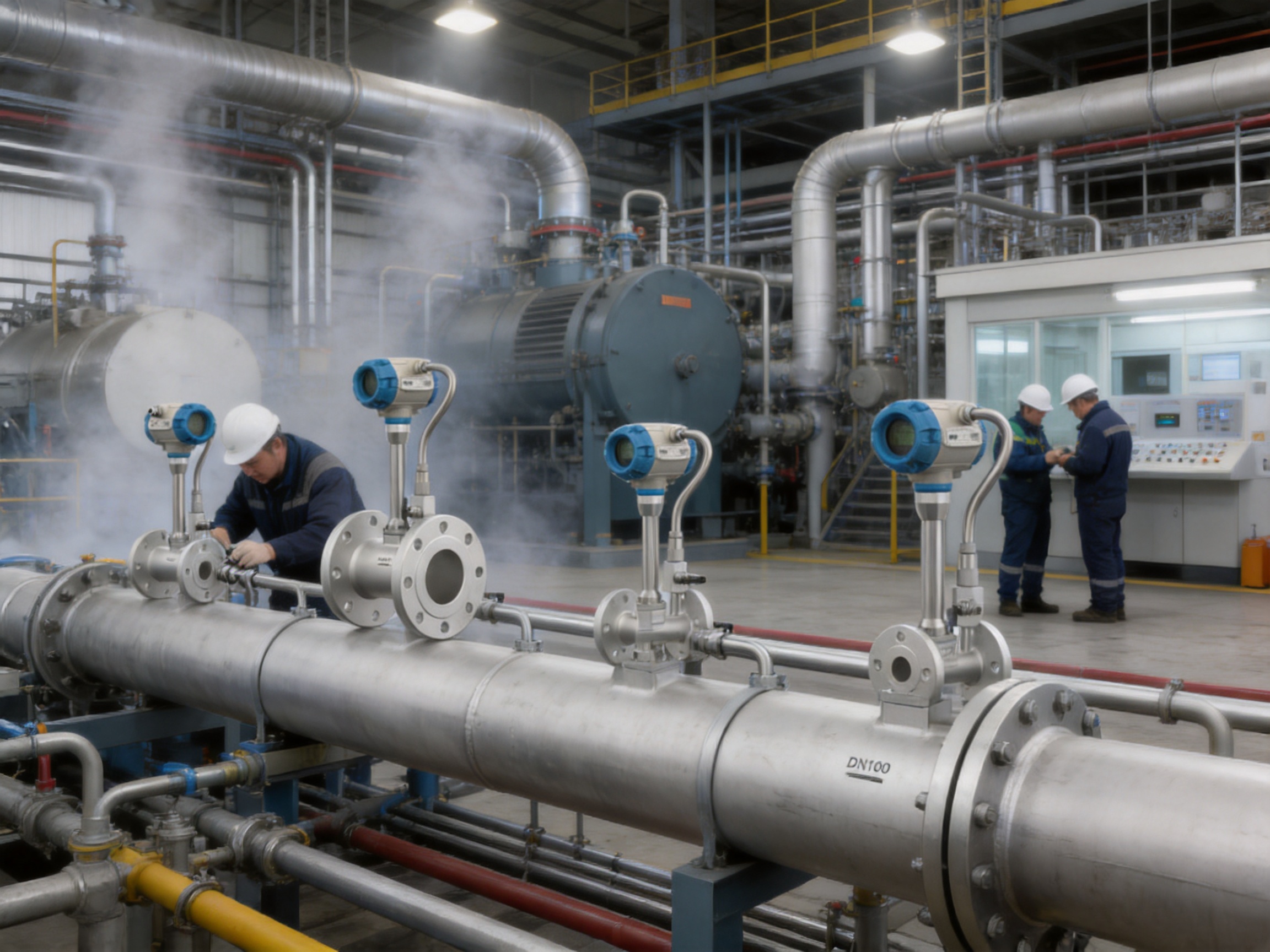
Reliable flow measurement is essential wherever steam, compressed air, nitrogen, fuel gas, or other industrial gases are produced, distributed, consumed, or billed. In these applications, measuring only the operating volume of a fluid is often insufficient. Gas and steam density changes significantly with temperature and pressure, so a flow value obtained under changing operating conditions may not accurately represent the actual mass transferred or the standard volume used for energy management and cost allocation.
The MA80T-TP Series Temperature/Pressure Compensation Vortex Flowmeter addresses this challenge by combining vortex flow measurement with integrated temperature and pressure compensation. It is designed for industrial users that require operating volumetric flow, compensated standard volume flow, and mass flow from a single measurement solution. Typical applications include boiler outlets, main steam headers, process steam lines, compressed air networks, nitrogen distribution, fuel gas systems, plant utility monitoring, and energy management projects.
Developed as an enhanced version of the MA80T vortex flowmeter, the MA80T-TP Series uses a piezoelectric sensor to detect vortex shedding while receiving temperature and pressure signals through dedicated measurement channels. Its converter processes these signals in real time to calculate corrected flow values according to the configured medium and reference conditions. The result is a practical instrument for installations where process control, energy balance, utility cost allocation, and equipment performance depend on dependable compensated flow data.
The product is manufactured by Jiangsu Vner Electronic Technology Co., Ltd., an industrial instrumentation company based in Yangzhou, China. Since 2011, the company has developed and manufactured electromagnetic, Coriolis, vortex, swirl, turbine, thermal mass, ultrasonic, and rotameter products for liquid, gas, steam, and slurry measurement. Its manufacturing capabilities, calibration resources, technical team, engineering experience, and international project history support the production of customized instruments for demanding industrial environments.
Why Temperature and Pressure Compensation Matters
Steam and gases are compressible media. Unlike many liquids, their density can change considerably when pressure or temperature changes. A compressed air flowmeter installed in a plant header may indicate one operating volume at a low-pressure condition and a different operating volume at a higher-pressure condition, even though the actual amount of air supplied to the process is comparable. Similarly, steam volume varies with pressure, temperature, and phase condition.
Operating volumetric flow describes the volume occupied by the medium at the actual measuring pressure and temperature. This value can be useful for process monitoring, but it may not be suitable for comparing consumption between different operating periods or different parts of a plant. A standard volumetric flow value converts the measured volume to specified reference conditions. Mass flow expresses the quantity of material directly and is often preferred for energy calculations, production accounting, and material balance analysis.
A conventional vortex flowmeter can measure operating volume effectively when properly sized and installed. However, without compensation, the converter cannot determine the corrected flow value accurately when density changes. An external flow computer may be added, but this creates additional wiring, configuration, panel space, commissioning work, and potential points of failure. The MA80T-TP Series integrates the required measurement inputs and calculation functions into the flowmeter system, reducing the complexity of a compensated measurement loop.
For saturated steam, pressure and temperature information helps verify the expected thermodynamic condition and calculate density. For superheated steam, both temperature and pressure are particularly important because the density relationship changes with operating conditions. For compressed air, nitrogen, and other gases, pressure and temperature compensation supports the conversion from actual volume to standard volume. The converter can also provide mass flow where the medium configuration and application conditions support that calculation.
Vortex Measurement Principle
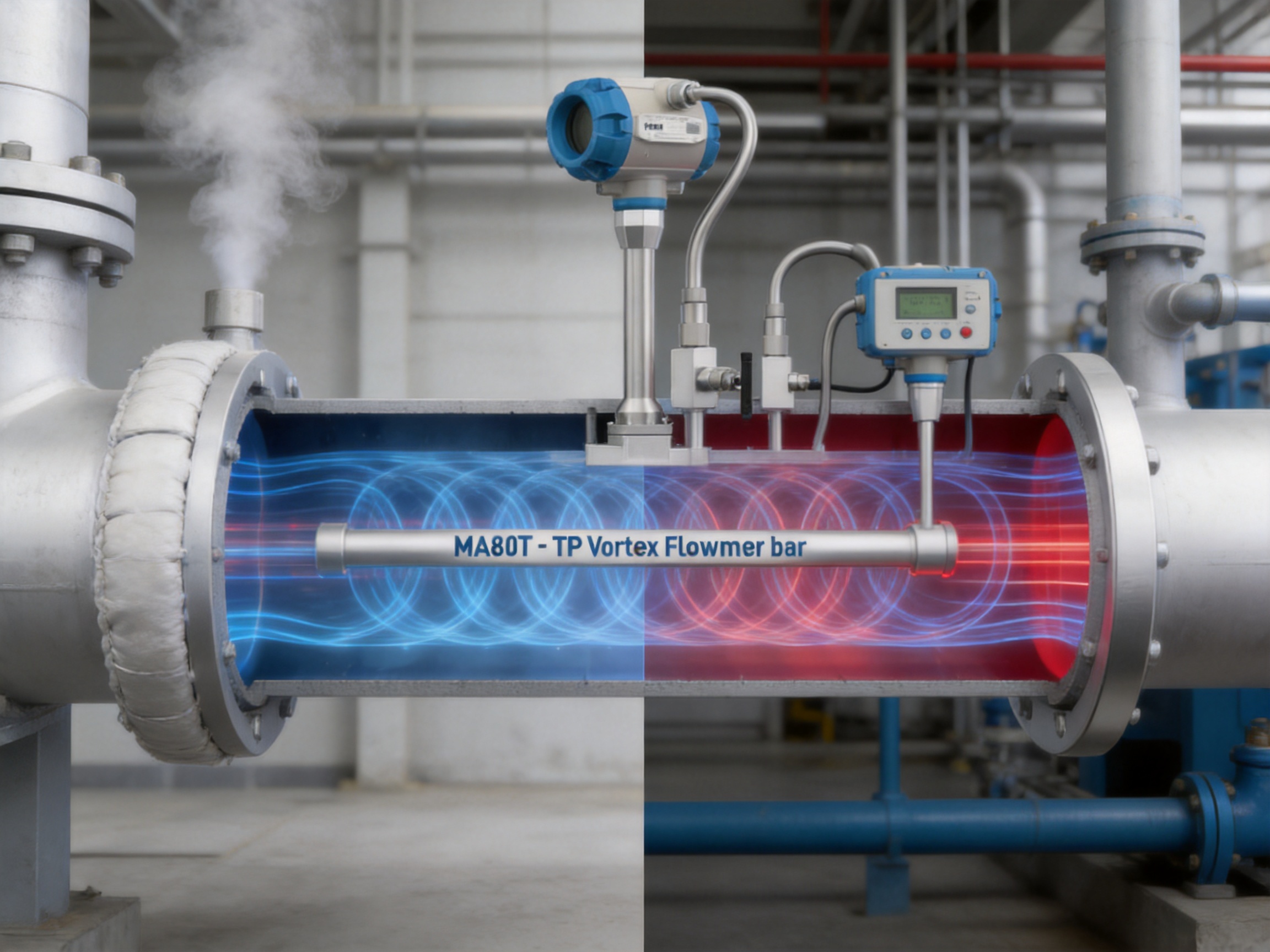
The MA80T-TP Series operates according to the Kármán vortex street principle. When a flowing medium passes a bluff body, also called a shedder bar, alternating vortices are formed downstream. These vortices are shed from opposite sides of the bluff body in a repeating pattern. Within the appropriate operating range, the frequency of vortex shedding is proportional to the average flow velocity.
A piezoelectric sensor detects the pressure fluctuations or mechanical effects associated with the vortex street. The electronic converter filters and evaluates the sensor signal, determines the vortex frequency, and converts that frequency into a flow rate based on the meter size, calibrated characteristics, and configured process data. Because the measurement is based on frequency rather than a moving mechanical element, the instrument has no rotating impeller or bearing assembly in the flow path.
The absence of moving parts is a major advantage in industrial utility service. Mechanical wear can cause drift, increased maintenance, and eventual measurement failure in traditional moving-element instruments. The welded vortex shedder design is intended for continuous operation and provides a robust primary measurement structure. With suitable installation and process conditions, the meter can operate for long periods with limited routine maintenance.
The vortex principle is suitable for steam, compressed gases, and many clean, low-viscosity liquids. The MA80T-TP Series is primarily intended for single-phase media. Correct application selection remains important because excessive vibration, pulsation, entrained liquid, solid particles, or severe flow disturbance can affect vortex signal quality. Proper sizing and installation are therefore essential to achieving the specified performance.
Integrated Temperature and Pressure Compensation
The defining feature of the MA80T-TP Series is the integration of flow frequency, temperature, and pressure information within one compensated measurement solution. The flow sensor provides the vortex frequency. An RTD channel provides temperature information, while a pressure sensor input accepts a suitable pressure transmitter signal. The converter combines these signals with the configured fluid type, reference conditions, and engineering parameters.
This integrated structure allows the instrument to calculate several process variables, including operating volumetric flow, standard volumetric flow, mass flow, and accumulated totals. The actual set of available values depends on the medium, configuration, sensor inputs, and application requirements. For steam and gas service, the converter applies the relevant density or correction relationship to generate a compensated result.
In a steam distribution network, for example, the user may monitor the actual operating flow at the line, the compensated mass flow, and the accumulated steam total. In a compressed air system, the user may display standard volume flow to compare production and consumption across different pressure zones. These values can be sent to a control system through analog, pulse, or optional digital communication outputs.
Integrated compensation also improves system organization. Instead of installing a separate vortex meter, temperature transmitter, pressure transmitter, flow computer, and multiple signal interfaces, the user can apply a coordinated instrument package. This can simplify the control cabinet, reduce interconnection requirements, and make commissioning more straightforward. It also provides operators with a unified interface for reviewing measured inputs, calculated outputs, alarms, and diagnostic information.
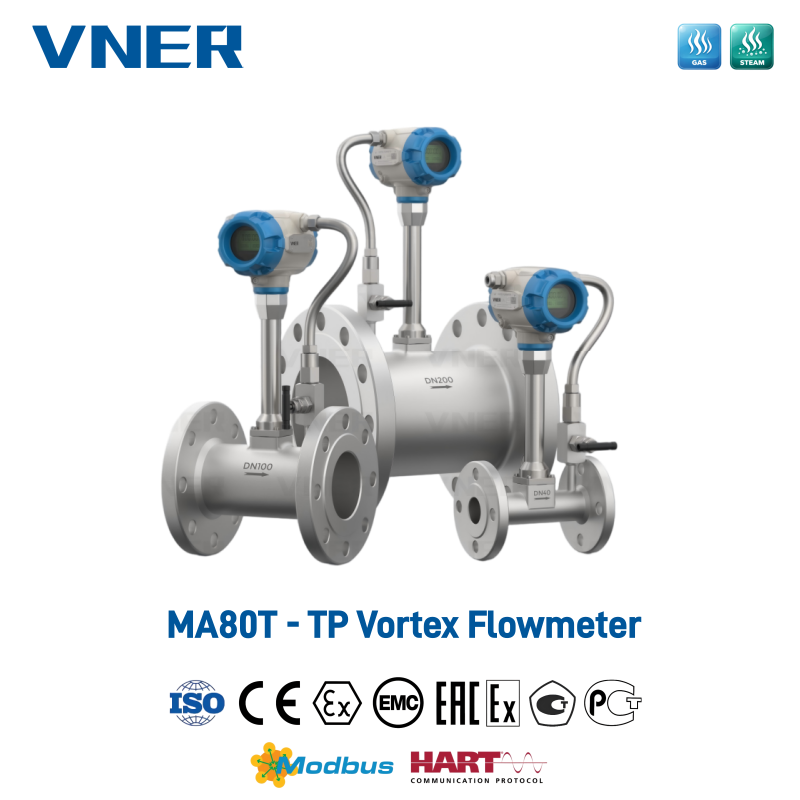
MA80T-TP Series Temperature/Pressure Compensation Vortex Flowmeter
Advantages in Steam Measurement
Steam measurement is one of the strongest application areas for a temperature and pressure compensated vortex flowmeter. Steam may be saturated or superheated, and the measurement objective may vary from process control to energy accounting. A boiler operator may need to know the mass of steam generated, while a production department may need to allocate steam consumption among several users. A utility manager may require standard reporting data for energy efficiency analysis.
For saturated steam, the pressure and temperature relationship is closely related to the thermodynamic state. Monitoring both values gives the converter the information needed to support compensated calculations and signal plausibility checks. For superheated steam, temperature provides additional information that is essential for determining density under changing conditions. The MA80T-TP Series is therefore suitable for main steam headers, boiler outlets, turbine inlets, reboilers, heat exchangers, sterilization systems, and process steam branches.
Compared with an uncompensated volumetric vortex meter, the compensated version provides more meaningful information when line pressure or temperature varies. This is especially important in plants where steam demand changes throughout the day, where multiple consumers operate at different loads, or where pressure reduction stations are installed between the boiler and end users.
The flowmeter can support energy management by providing stable and traceable consumption information. When steam totals are combined with pressure, temperature, and configured process data, engineering teams can compare production output with utility consumption, identify abnormal losses, and assess the effect of insulation, leakage control, or equipment upgrades.
Advantages in Compressed Air and Gas Networks
Compressed air is often one of the least visible but most expensive utilities in an industrial plant. Compressors consume substantial electrical energy, and air losses from leaks, open drains, damaged hoses, and improperly regulated equipment can create continuous operating costs. Measuring compressed air at the compressor outlet, distribution header, production area, or major consumer can help establish a clearer utility balance.
Because compressed air density changes with pressure and temperature, actual volumetric flow alone may give a misleading impression when comparing different measurement points. The MA80T-TP Series uses pressure and temperature signals to calculate standard volume flow, allowing users to compare consumption on a common reference basis. This supports leak surveys, compressor performance reviews, production-line utility accounting, and plant-wide energy management.
The same principle applies to nitrogen, instrument air, inert gases, and certain fuel gases. In chemical and petrochemical plants, compensated gas measurement can support distribution monitoring and process control. In oil and gas facilities, fuel gas and instrument air lines may require reliable flow data under variable operating conditions. The flowmeter can deliver analog and pulse outputs for conventional control systems, while HART or Modbus RTU options can provide access to additional measured and calculated variables.
Compared with a basic gas flowmeter that reports only actual volume, a compensated instrument provides a more useful basis for comparing consumption across different pressures and temperatures. Compared with a separate flow computer arrangement, the integrated design can reduce system complexity and make the measurement package easier to manage.
Product Construction and Materials
The MA80T-TP Series is available with SS304 or SS316L body and flange materials, with customized materials available upon request. Sensor wetted materials may include SS304, SS316L, Hastelloy C, Hastelloy B, or titanium, depending on the model and application. Material selection should be based on the medium, temperature, pressure, corrosion environment, cleaning procedure, and required service life.
SS304 is suitable for many general industrial utility services. SS316L may be preferred where improved corrosion resistance is required or where plant hygiene and chemical compatibility are important. Hastelloy alloys and titanium can be considered for more demanding corrosive conditions, subject to a detailed application review. Offering multiple material options enables the manufacturer to adapt the meter to a wider range of process environments instead of relying on a single standard construction.
The product is offered in flanged and wafer versions. Flanged meters can be selected for installations that require a more substantial connection or a specific piping standard. Wafer versions can reduce face-to-face length and may be advantageous where installation space is limited. Process connection standards include GB, DIN, and ANSI, with other standards available on request.
The measuring assembly is designed without moving parts. This reduces the number of wear components exposed to the process and supports low-maintenance operation. The sensor and shedder structure are selected according to the meter model, temperature class, and material requirements. Standard temperature capability is up to 250 degrees Celsius, while high-temperature versions can reach up to 350 degrees Celsius, depending on configuration.
Performance Characteristics
Under calibrated conditions, typical volumetric flow accuracy is up to plus or minus 1.0 percent of rate for liquids and approximately plus or minus 1.0 percent or plus or minus 1.5 percent of rate for gases and steam, depending on the model and application. The overall uncertainty of compensated mass or standard volume flow depends not only on the vortex flowmeter but also on the accuracy class of the temperature and pressure sensors, the quality of installation, the correctness of fluid configuration, and the operating range.
The typical turndown ratio is up to 1:10 to 1:20, depending on the medium and installation conditions. Turndown describes the relationship between the upper and lower flow limits within which the meter can provide acceptable measurement performance. Actual turndown must be confirmed during sizing because gas density, Reynolds number, pipe size, vibration, pressure, temperature, and required accuracy all influence the practical measuring range.
A typical straight pipe recommendation is 15 nominal pipe diameters upstream and 5 nominal pipe diameters downstream. The exact requirement should be confirmed for each installation. Elbows, reducers, valves, pumps, regulators, partially open control valves, and other disturbances can create velocity profile distortion or swirl. Where straight-run space is limited, a flow conditioner or revised piping arrangement may be considered after engineering review.
Pressure ratings can reach up to 4.0 MPa for selected models. The applicable rating depends on the body design, connection standard, temperature, flange class, sensor construction, and model selection. Users should always confirm the final pressure-temperature rating from the project datasheet before ordering or installing the instrument.
Converter Functions and Outputs
The converter is designed to present both measured and calculated values in a practical industrial format. Primary outputs include 4–20 mA and pulse signals. Depending on configuration, the analog output can be assigned to operating flow, compensated flow, mass flow, or another selected process variable. Pulse outputs can be used for totalization or connection to external monitoring equipment.
Optional HART and Modbus RTU communication provide access to remote configuration and a broader set of process data. Digital communication can reduce the need for multiple analog channels and allow control systems to retrieve temperature, pressure, operating flow, standard volume flow, mass flow, totalizers, and diagnostic information. It can also support commissioning by allowing engineers to review configuration parameters without opening the instrument enclosure.
Integrated totalizers are useful for utility accounting. A steam user may track a daily, monthly, or batch total, while a compressed air manager may compare consumption between production shifts. Totalizer functions should be configured carefully, including engineering units, reference conditions, medium settings, and reset or access permissions.
Diagnostic functions include sensor fault indication, temperature and pressure signal plausibility checks, and signal quality monitoring. These functions help distinguish a real process change from an instrumentation problem. For example, an abnormal pressure signal, disconnected RTD, unstable vortex frequency, or implausible temperature-pressure relationship can be identified during commissioning or routine operation.
Comparison with Other Flow Measurement Technologies
Compared with Basic Vortex Flowmeters
A standard vortex flowmeter can provide dependable operating volumetric flow, but it normally requires separate density compensation if the application needs mass or standard volume results. The MA80T-TP Series includes temperature and pressure measurement channels and performs compensation within the converter. This makes it more suitable for steam and gas networks where operating conditions vary.
The compensated product may reduce the need for separate instruments and an external flow computer. It also provides a coordinated display and output structure, which can simplify operator training and maintenance. The basic vortex principle remains familiar, but the measurement package delivers more useful information.
Compared with Turbine Flowmeters
Turbine flowmeters use a rotating element that can be sensitive to wear, contamination, lubrication requirements, and changes in mechanical condition. The MA80T-TP Series has no moving parts in the measurement structure and is therefore advantageous for continuous steam and utility gas service. Turbine meters may be suitable for clean liquids and gases in particular applications, but vortex technology is often preferred when low maintenance and robust industrial construction are priorities.
Compared with Differential Pressure Flowmeters
Differential pressure systems use a primary element such as an orifice plate, nozzle, or venturi together with pressure measurement and often temperature compensation. These systems can be highly established, but they introduce permanent pressure loss, impulse lines, manifolds, and additional installation considerations. A vortex meter generally has a compact direct-flow design and does not require impulse tubing for the primary flow measurement.
For a new steam or gas installation, the MA80T-TP Series can offer a simpler alternative to a complete differential pressure flow loop. The final choice should still consider pipe size, flow range, pressure loss, accuracy, maintenance access, and plant standards.
Compared with Electromagnetic Flowmeters
Electromagnetic flowmeters are highly effective for conductive liquids, slurries, and water-based applications, but they cannot measure dry gases or steam. The MA80T-TP Series extends compensated measurement capability to steam and gas services where electromagnetic technology is unsuitable.
Compared with Coriolis Flowmeters
Coriolis flowmeters directly measure mass flow and can provide excellent accuracy, but they may involve higher purchase cost, greater weight, larger installation requirements, and increased pressure drop in some sizes. A compensated vortex meter can be a practical and economical choice for steam and gas utility networks where the required accuracy, pipe size, and operating conditions are compatible with vortex technology.
Manufacturing Strength and Engineering Capability
Product performance depends not only on the measurement principle but also on manufacturing discipline. Jiangsu Vner Electronic Technology Co., Ltd. operates modern facilities covering approximately 23,000 square meters across three plants. A production structure of this scale supports the separation and coordination of machining, assembly, testing, calibration, quality control, warehousing, and engineering activities.
The company has a technical team of more than 150 people and has delivered over 2,000 engineering projects in more than 30 countries. This experience exposes the organization to different process media, piping standards, environmental conditions, communication requirements, and project documentation practices. Such experience is valuable when selecting a vortex meter for an international EPC project or a customized industrial retrofit.
In-house calibration is an important manufacturing advantage. Calibration allows the manufacturer to compare instrument output with reference equipment, identify deviations, record performance data, and support product traceability. For a compensated flowmeter, calibration is only one part of the complete accuracy chain, but it provides a controlled foundation for verifying the vortex measurement signal and converter response.
Certified quality processes support repeatable production. Consistent material control, dimensional inspection, electrical testing, sensor verification, enclosure checks, assembly procedures, and final inspection help reduce variation between instruments. Automated and increasingly standardized manufacturing processes can improve product consistency while maintaining flexibility for customized orders.
Engineering-driven sizing and selection are particularly important for vortex applications. An instrument should not be selected by line size alone. The engineer must consider minimum and maximum flow, density, pressure, temperature, viscosity, Reynolds number, pressure loss, straight-run availability, fluid phase, vibration, and required output variables. A manufacturer that supports this evaluation can help users avoid undersizing, oversizing, unstable signals, and inaccurate compensation.
The company’s product range includes several complementary technologies. This allows project engineers to select the most suitable instrument according to the medium rather than forcing every application into one product category. Electromagnetic meters can address conductive liquids and slurry, Coriolis meters can address direct mass measurement, turbine meters can serve clean liquid or gas applications, thermal mass meters can measure certain gases, ultrasonic meters can support specific non-invasive or large-pipe applications, and vortex meters can address steam and general gas service.
Advanced Production Processes for Reliable Instruments
Manufacturing a vortex flowmeter requires control of both mechanical and electronic elements. The shedder bar must maintain the designed geometry and position within the flow passage. The sensor assembly must be installed securely and protected from process conditions. The converter must process low-level frequency signals while rejecting interference and maintaining stable output behavior.
Machining and forming processes must maintain dimensional consistency in the flow body and internal components. Welding quality is important for a welded vortex shedder design because structural integrity and dimensional stability affect long-term reliability. Surface treatment, cleaning, and inspection should be appropriate for the selected material and intended process environment.
Electronic assembly requires controlled soldering, wiring, connector installation, insulation verification, and functional testing. Temperature and pressure input channels must be checked for correct signal response and configuration. Communication interfaces require testing to ensure that measured and calculated variables can be accessed correctly by external systems.
Calibration and final testing provide an opportunity to verify the complete assembled instrument. Tests may include flow signal response, output scaling, pulse behavior, display functions, alarm behavior, temperature input response, pressure input response, communication, enclosure integrity, and configuration retention. The exact test scope depends on the model, order specification, and project requirements.
Traceability is another important strength for industrial projects. Recording model information, material details, calibration results, electrical test results, and final inspection data helps users maintain documentation throughout the instrument life cycle. This is especially valuable in power, petrochemical, pharmaceutical, food, and other industries where maintenance and quality records are closely controlled.
Installation Guidance
Correct installation is necessary for achieving reliable vortex measurement. The pipe should be clean and free from welding slag, scale, loose particles, and foreign objects before the meter is installed. The meter body should be aligned with the pipeline, and the gasket should not protrude into the flow passage. Flanges, bolts, and sealing materials must be suitable for the operating pressure and temperature.
Upstream and downstream straight pipe lengths should follow the project datasheet. A typical recommendation is 15 DN upstream and 5 DN downstream, but the actual requirement can change according to the disturbance source and piping configuration. A control valve should generally not be installed immediately upstream of the flowmeter because valve turbulence and pressure fluctuations can affect signal quality.
The meter should be installed in a location that remains filled with the intended medium and avoids two-phase flow wherever possible. For steam service, drainage, condensate management, insulation, and orientation should be considered carefully. For gas service, the installation should minimize the possibility of liquid accumulation. The instrument should not be exposed to excessive external vibration or unsupported pipe movement.
The temperature sensor should measure a representative process temperature, and the pressure transmitter should be installed at a suitable pressure tapping point. The distance between the flowmeter and pressure measurement point should be considered during engineering because pressure loss and local disturbances can affect the calculated density. The converter configuration must match the actual process connection, medium, engineering units, reference conditions, sensor range, and output assignments.
Electrical wiring should comply with local regulations and plant standards. Signal cables should be routed away from high-power cables, variable-frequency drives, and sources of electromagnetic interference. Grounding, shielding, power supply stability, and cable gland selection all contribute to reliable signal transmission. Before commissioning, the user should verify the zero or no-flow condition, input signal plausibility, output scaling, totalizer settings, alarm limits, and communication parameters.
Application Selection and Sizing Considerations
Before ordering a MA80T-TP Series flowmeter, the user should collect the complete process data. Important information includes medium type, minimum flow, normal flow, maximum flow, operating pressure, operating temperature, pipe size, pipe material, required connection standard, fluid phase, expected density, viscosity where applicable, and the desired output variables.
For steam, it is important to identify whether the service is saturated or superheated. The pressure and temperature range should be supplied rather than a single nominal value. If the line can operate close to saturation, the application engineer should review the possibility of condensation, wet steam, or unstable phase conditions. For compressed gases, the pressure range, temperature range, gas composition, and required standard reference conditions should be specified.
Meter sizing should ensure that the normal flow is comfortably within the recommended range. An oversized meter may operate below the minimum vortex detection threshold, while an undersized meter may create unnecessary pressure loss or exceed the permitted velocity. The practical turndown ratio of approximately 1:10 to 1:20 should be treated as an application-dependent guideline rather than a universal guarantee.
Pressure rating and temperature capability must be reviewed together. A meter rated for a particular pressure at ambient temperature may have a lower permissible pressure at elevated temperature. Flange rating, body material, sensor material, gasket material, and transmitter rating should all be checked as one system.
For compensated outputs, the accuracy of the temperature and pressure transmitters contributes to the total result. High-accuracy vortex measurement cannot fully compensate for inaccurate auxiliary inputs. The required sensor class should therefore be selected according to the uncertainty target of the overall measurement system.
Industry Applications
Power Generation and Energy Utilities
Power plants and industrial energy centers use steam meters at boiler outlets, main headers, turbine inlets, auxiliary systems, and branch lines. Compensated measurements help operators compare steam generation with consumption and assess energy balance. A reliable totalizer can support operational reporting and maintenance planning.
Chemical and Petrochemical Processing
Chemical facilities commonly distribute steam, compressed air, nitrogen, and other utility gases throughout complex pipe networks. The MA80T-TP Series can support utility sub-metering, process heating control, reactor services, reboiler supply, heat exchanger monitoring, and gas distribution analysis. Material selection should be reviewed carefully where corrosive gases or aggressive cleaning environments are present.
Oil and Gas Facilities
Fuel gas, instrument air, nitrogen, and process steam are frequently used in refineries, gas processing plants, terminals, and petrochemical facilities. Compensated flow values can support burner management, utility allocation, equipment monitoring, and operational troubleshooting. Connection standards, hazardous-area requirements, pressure ratings, and communication protocols should be confirmed during project engineering.
Pharmaceutical Manufacturing
Clean steam and utility gases are used in sterilization, clean-in-place systems, drying, and production support. In these applications, reliable monitoring and documented measurement performance may be important for qualification and reporting. Material compatibility, hygienic installation, cleanability, and project documentation should be considered in addition to basic flow accuracy.
Food and Beverage Production
Food and beverage plants consume steam, compressed air, nitrogen, and other utilities for cooking, heating, packaging, cleaning, and refrigeration support. Compensated flow measurement helps identify energy consumption by production area and supports cost control. The selected body and sensor materials should match the plant’s sanitation practices and environmental conditions.
HVAC and District Energy
Industrial heating systems and district energy networks may use steam or hot water for space heating and process services. Vortex technology is suitable for certain hot-water applications within its operating limits, as well as steam distribution and sub-metering. Temperature and pressure data can support more consistent energy reporting where operating conditions vary across the network.
Operational Benefits for Plant Owners
The first operational benefit is improved information quality. Users can access operating flow as well as compensated mass or standard volume values, allowing the measurement to serve both process and management purposes. This reduces the need to estimate density or apply manual correction factors after data collection.
The second benefit is reduced instrumentation complexity. Integrated temperature and pressure channels, converter calculations, totalizers, analog outputs, pulse outputs, and optional digital communication can be combined into a single coordinated solution. Fewer separate devices may reduce installation cost, panel space, wiring, and maintenance workload.
The third benefit is improved troubleshooting. Diagnostic functions help operators identify sensor faults, implausible temperature-pressure combinations, and signal-quality problems. When a flow value changes unexpectedly, maintenance personnel can review the measured inputs and calculated variables rather than relying only on one unexplained output.
The fourth benefit is suitability for energy management. Steam and compressed gas are often major contributors to plant operating cost. Accurate compensated measurement can support leak detection, production comparison, utility budgeting, equipment efficiency analysis, and internal billing. It can also help identify opportunities for insulation improvements, pressure optimization, and demand control.
The fifth benefit is long-term maintainability. A no-moving-parts design minimizes mechanical wear, while standardized manufacturing and in-house calibration support consistent replacement and service practices. With proper application selection, the instrument can provide stable measurement for continuous industrial operation.
Quality, Customization, and Project Support
Industrial projects rarely use identical conditions in every installation. Pipe standards may differ between countries, materials may need to match a corrosive medium, and the control system may require a particular communication protocol. The product supports GB, DIN, and ANSI process connection standards, with other connection requirements available upon request.
Material customization is also available according to model and application. SS304, SS316L, Hastelloy alloys, and titanium provide different levels of chemical resistance and mechanical suitability. The correct choice should be made through a documented compatibility review rather than by selecting the most expensive material automatically.
Output configuration can be adapted to the plant control architecture. A conventional 4–20 mA signal may be used for distributed control, pulse output may be used for totalization, and HART or Modbus RTU may be selected where digital access to multiple variables is needed. Assignable outputs allow the measurement system to focus on operating flow, compensated flow, mass flow, or another configured value.
Engineering support is especially valuable during the sizing stage. A project team can provide process conditions, piping drawings, connection requirements, hazardous-area expectations, output specifications, and documentation needs. The manufacturer can then help confirm the model, meter size, material, sensor configuration, temperature and pressure input ranges, and appropriate compensation parameters.
Maintenance Recommendations
Although the MA80T-TP Series is designed for low maintenance, periodic inspection remains advisable. Operators should check for external corrosion, damaged cables, loose connections, abnormal vibration, leakage at flanges, and unexpected changes in pressure drop or signal stability. The display and control system should be reviewed for diagnostic alarms and implausible process values.
The temperature sensor and pressure transmitter should be verified according to the plant calibration schedule. Since compensated flow accuracy depends on these inputs, a drifted RTD or pressure transmitter can produce an incorrect result even when the vortex sensor itself is operating normally. Calibration intervals should be established according to process criticality, regulatory requirements, historical stability, and plant quality procedures.
If the process contains deposits or contaminants, the internal flow passage should be inspected during planned shutdowns. Deposits near the shedder bar can affect the flow pattern and signal response. Cleaning methods must be compatible with the body and sensor materials and should not damage the measurement structure.
Maintenance personnel should retain configuration records, calibration certificates, material documentation, and communication settings. Keeping these records improves replacement planning and helps ensure that a new or repaired instrument is configured consistently with the original application.
Q&A
What is the main purpose of the MA80T-TP Series?
The main purpose is to measure steam and gas flow while compensating for changes in temperature and pressure. It can provide operating volumetric flow, standard volumetric flow, mass flow, and accumulated totals depending on the configured medium and application.
What measurement principle does it use?
It uses the Kármán vortex street principle. A bluff body creates alternating vortices in the flowing medium, and a piezoelectric sensor detects the vortex shedding frequency. The frequency is proportional to flow velocity within the applicable measuring range.
Why are temperature and pressure inputs required for gas measurement?
Gas density changes with pressure and temperature. The additional inputs allow the converter to calculate a corrected standard volume or mass value instead of reporting only the actual volume at the measuring conditions.
Can it measure both saturated and superheated steam?
Yes, it is designed for compensated saturated and superheated steam applications. The final suitability depends on pressure, temperature, flow range, installation, phase condition, and the selected model.
Does the flowmeter have moving parts?
No. The vortex measurement structure uses a fixed shedder design and piezoelectric sensing rather than a rotating impeller. This supports low maintenance and reduces mechanical wear.
What outputs are available?
Primary outputs include 4–20 mA and pulse. HART and Modbus RTU are available as optional digital communication functions. Outputs can be assigned to selected operating or compensated flow variables according to the configuration.
What materials are available?
Body and flange materials include SS304 and SS316L, with customization available upon request. Depending on the model, sensor wetted materials may include SS304, SS316L, Hastelloy C, Hastelloy B, and titanium.
What is the typical accuracy?
Typical volumetric flow accuracy can reach up to plus or minus 1.0 percent of rate for liquids and approximately plus or minus 1.0 percent or plus or minus 1.5 percent of rate for gases and steam under calibrated conditions. The total uncertainty of compensated flow also includes the temperature and pressure sensor accuracies and application conditions.
What straight pipe length is normally recommended?
A typical recommendation is 15 nominal pipe diameters upstream and 5 nominal pipe diameters downstream. The exact requirement must be confirmed based on the piping layout, disturbance sources, meter size, and project specification.
What pressure and temperature ranges are available?
Selected models can support pressure ratings up to 4.0 MPa. Standard temperature capability is up to 250 degrees Celsius, while high-temperature versions can reach up to 350 degrees Celsius. Final limits depend on the model, material, connection, and process conditions.
Is the product suitable for liquids?
It can measure clean, low-viscosity, single-phase liquids within the applicable flow and temperature range. For liquid applications, users should confirm viscosity, density, Reynolds number, pressure loss, and minimum flow before selection.
How does it compare with a Coriolis flowmeter?
A Coriolis meter directly measures mass flow and may offer excellent accuracy, but it can be more expensive and heavier, especially in large sizes. A compensated vortex meter can provide an economical and compact solution for many steam and gas utility applications where its performance is suitable.
How does the manufacturer support customized projects?
The manufacturer supports multiple process connection standards, material options, communication choices, output assignments, and application-specific engineering. Its technical team, calibration capability, manufacturing facilities, and international project experience support EPC, end-user, and OEM requirements.
Conclusion
The MA80T-TP Series Temperature/Pressure Compensation Vortex Flowmeter is designed for industrial users that need more than an uncompensated operating volume measurement. By combining vortex frequency detection with temperature and pressure inputs, it provides a practical route to standard volume flow and mass flow for steam and gas applications.
Its principal advantages include a no-moving-parts design, integrated compensation, multiple calculated variables, flexible outputs, optional digital communication, diagnostic functions, broad material choices, and flanged or wafer installation. These features make it suitable for steam distribution, compressed air management, nitrogen networks, fuel gas measurement, process utility monitoring, and energy accounting.
The product is supported by the manufacturing and engineering capabilities of Jiangsu Vner Electronic Technology Co., Ltd., including modern multi-plant facilities, a large technical team, in-house calibration, quality processes, application-focused sizing, and experience across more than 30 countries. This combination of product design and manufacturing strength helps users obtain a measurement solution that is not only technically capable but also adaptable to real industrial project conditions.
For the best result, the meter should be selected using complete process data and installed according to the applicable piping, temperature, pressure, grounding, and communication requirements. When correctly sized, configured, calibrated, and maintained, the MA80T-TP Series can provide reliable compensated flow information for process control, energy balance, utility management, and long-term industrial operation.
References
1. Industrial Flow Measurement Principles: Vortex, Differential Pressure, Turbine, Electromagnetic, Ultrasonic, Thermal Mass, and Coriolis Technologies.
2. General Engineering Practice for Steam Flow Measurement and Energy Management.
3. Gas Flow Measurement Under Variable Pressure and Temperature Conditions.
4. Kármán Vortex Street Theory and Frequency-Based Flow Measurement.
5. Industrial Instrumentation Calibration, Traceability, and Quality Control Practices.
6. Process Piping Installation Guidance for Vortex Flowmeters.
7. Steam and Compressed Gas Utility Metering in Power, Chemical, Pharmaceutical, Food, and Manufacturing Facilities.
8. MA80T-TP Series Temperature/Pressure Compensation Vortex Flowmeter Product Information.
Product: MA80T-TP Series Temperature/Pressure Compensation Vortex Flowmeter

We offer all our products and services at international standards.
Products
Contact Information
-

+86-18652789521
+86-18052582295
+86-0514-83633600 / 83633900 -

+86-0514-83633600 / 83633900
-

shawn@vnerflow.com
info@vnerflow.com -

No. 11 Xingye Road, Chenji Town Industrial Park, Yizheng, Yangzhou, China
