
 0
0
 EN
EN  English
 عربى
عربى Español
 русский
If you need any help, please feel free to contact us
Home / Author / Ren Xiaotong — Technical Sales Engineer for Gas Flow Meters / Industrial Swirl Flowmeters for Reliable Liquid, Gas, and Steam Measurement
Industrial Swirl Flowmeters for Reliable Liquid, Gas, and Steam Measurement
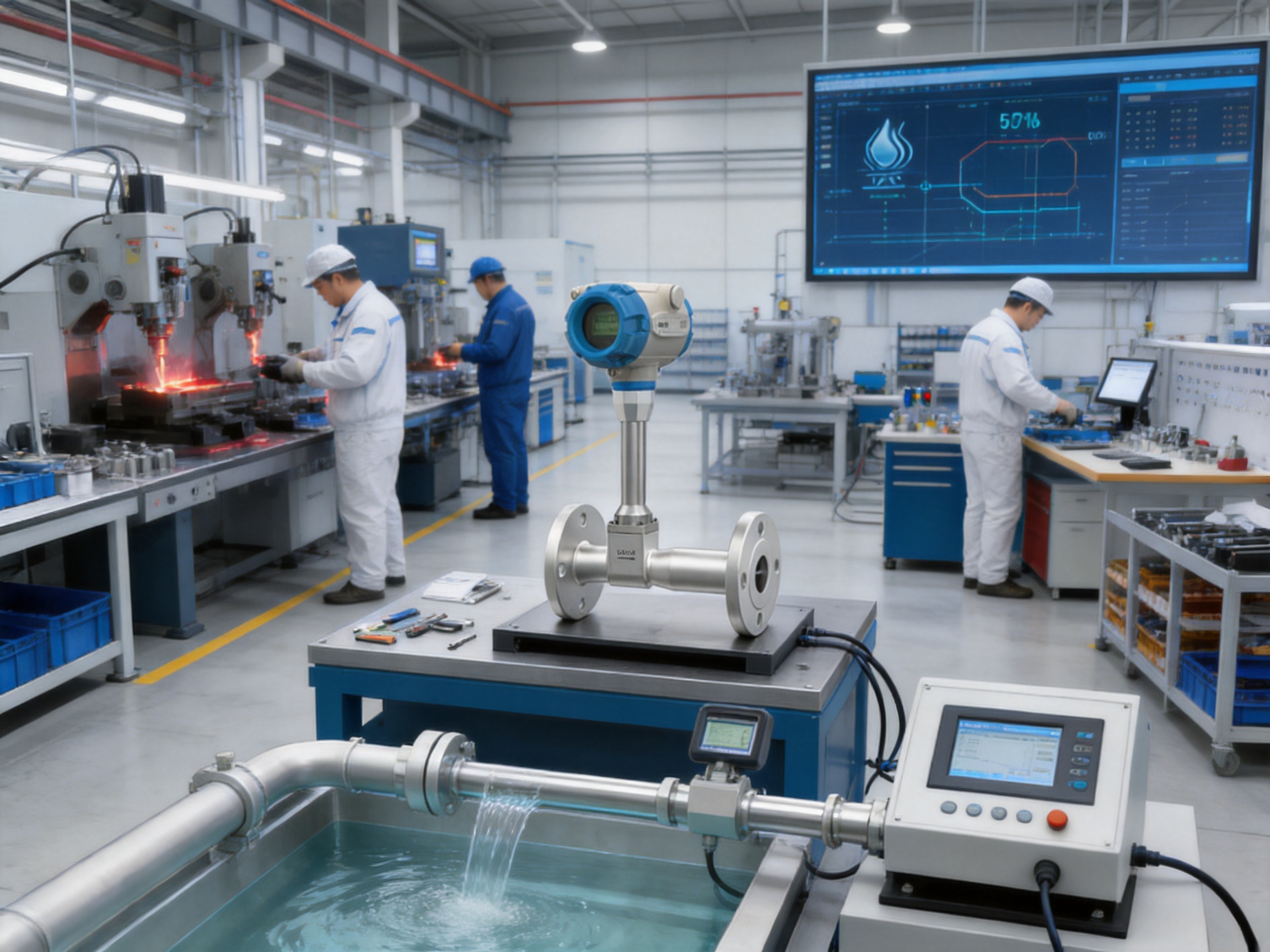
Industrial Swirl Flowmeters for Reliable Liquid, Gas, and Steam Measurement
Accurate flow measurement is essential to the safe, efficient, and economical operation of modern industrial facilities. Energy plants, chemical factories, oil and gas installations, water systems, pharmaceutical facilities, food processing plants, and metal production lines all depend on dependable information about the movement of liquids, gases, and steam. When flow data is unstable or inaccurate, the consequences can include poor energy management, incorrect process control, excessive material consumption, production losses, and unnecessary maintenance.
The SA80T Series Swirl Flowmeter is designed for demanding industrial measurement applications where stable performance, broad media compatibility, and long-term reliability are required. It measures liquids, gases, saturated steam, and superheated steam by detecting the frequency of swirl or vortex precession generated inside the flow path. Because the sensing system has no moving mechanical parts, the instrument can deliver dependable operation with limited wear and reduced maintenance requirements.
Developed for industrial process environments, the SA80T combines robust construction, flexible material options, multiple communication functions, optional temperature and pressure compensation, and engineering-oriented manufacturing. It is suitable for applications such as steam energy metering, natural gas monitoring, compressed air measurement, cooling water supervision, process gas control, and utility management.
Jiangsu Vner Electronic Technology Co., Ltd. manufactures the SA80T Series as part of a wider range of industrial flow measurement solutions. The company’s experience in electromagnetic, Coriolis, vortex, swirl, turbine, thermal mass, ultrasonic, and rotameter technologies enables it to select and produce instruments according to the actual characteristics of a customer’s process rather than relying on a single measurement principle for every application.
Why Swirl Flow Measurement Matters in Industrial Processes
Industrial processes rarely use only one type of medium. A single production site may need to measure cooling water, compressed air, nitrogen, natural gas, process vapors, chemical liquids, saturated steam, and superheated steam. Each medium has different physical properties, including density, viscosity, pressure, temperature, compressibility, and flow behavior.
A suitable flowmeter must therefore do more than generate a basic flow signal. It must maintain reliable performance as operating conditions change. It should also withstand industrial vibration, pressure fluctuations, temperature variation, contamination, and long operating cycles. Installation requirements, communication compatibility, material selection, calibration, and maintenance access are equally important.
The SA80T Series addresses these requirements through a swirl-based measurement principle and a fully welded, non-moving flow path. The design is intended to provide stable measurement without the mechanical wear associated with traditional moving-element meters. For industrial users, this can simplify maintenance planning and help reduce the risk of measurement drift caused by mechanical damage or component friction.
Swirl flowmeters are particularly valuable when one instrument must handle several forms of industrial utility measurement. The SA80T can be configured for liquid, gas, and steam service, allowing users to apply a consistent product platform across different areas of a plant. This can simplify engineering, procurement, operator training, spare-parts planning, and instrument management.
Operating Principle of the SA80T Series
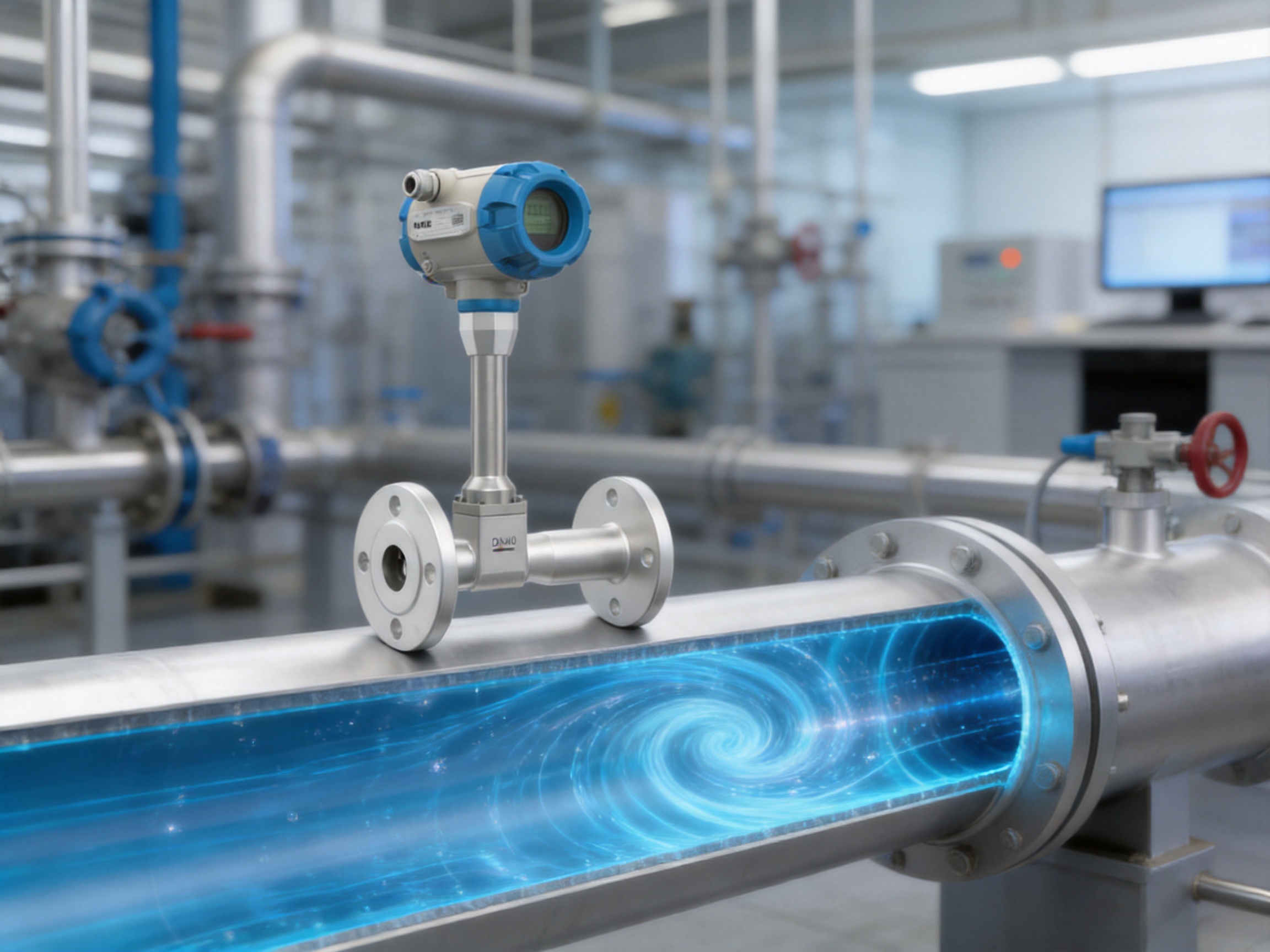
The SA80T measures flow using swirl or vortex precession. As the process medium passes through the specially designed internal flow structure, the fluid is forced into a controlled swirling motion. The resulting vortex precesses at a frequency that is related to the volumetric flow rate.
A piezoelectric sensor detects the pressure fluctuations or dynamic signals associated with this precessing flow. The electronics process the detected frequency and convert it into a flow signal. Under stable operating conditions, the frequency is proportional to volumetric flow, allowing the instrument to determine the flow rate without mechanical rotors, gears, bearings, or other moving sensing elements.
The principle offers several practical advantages. First, the absence of moving parts minimizes mechanical wear. Second, the signal is based on frequency, which can provide good resistance to gradual amplitude changes caused by normal process variation. Third, the flowmeter can be integrated with digital electronics for pulse output, analog transmission, communication, diagnostics, and optional compensation functions.
The actual performance of any flowmeter depends on correct sizing, suitable installation, process conditions, and calibration. The SA80T should be selected according to the expected minimum, normal, and maximum flow rates, process pressure, process temperature, medium composition, pipe size, and required output signal. Engineering review is especially important for gases and steam because density changes significantly with pressure and temperature.
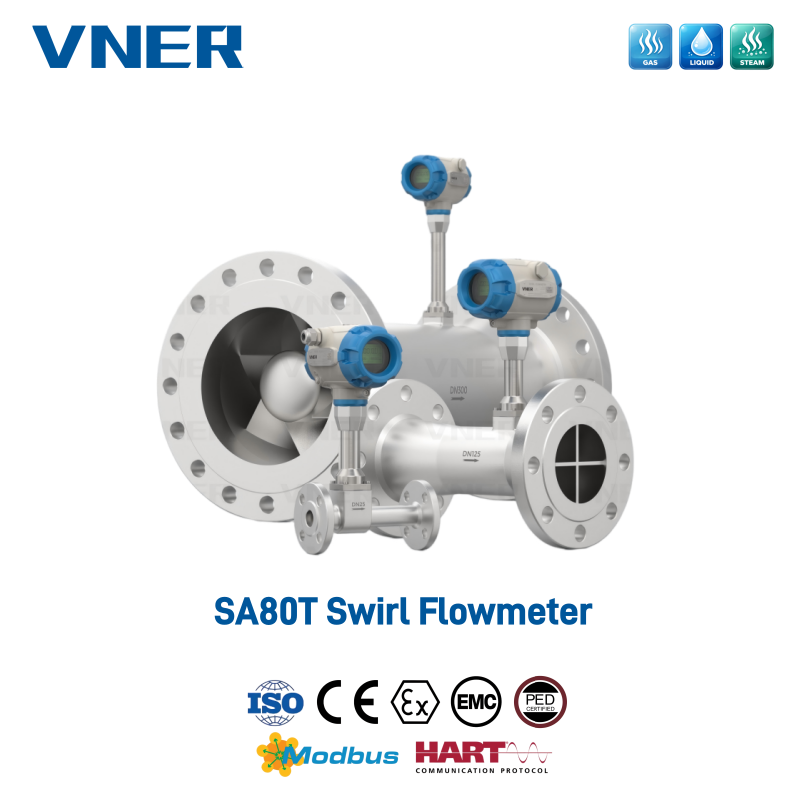
SA80T Series Swirl Flowmeter
Measurement of Liquids, Gases, and Steam
One of the most important benefits of the SA80T Series is its ability to measure a wide range of industrial media. It is designed for liquids, gases, saturated steam, and superheated steam, including clean or slightly contaminated media when the application is properly evaluated.
Liquid Measurement
In liquid applications, the SA80T can be used for process liquids, cooling water, utility water, selected chemical liquids, and other compatible media. The typical liquid accuracy is up to ±0.5 percent of rate under calibrated conditions. Actual accuracy depends on flow velocity, fluid properties, installation, pipe configuration, and the selected model.
Liquid applications may include cooling circuits, heat exchanger systems, process water distribution, liquid reactant control, water and wastewater utility monitoring, and thermal fluid measurement. Material selection is important when the liquid is corrosive or contains chemical components. The flow body can be manufactured from carbon steel, SS304, or SS316L, while sensor wetted materials may include SS304, SS316L, Hastelloy C, Hastelloy B, or titanium.
Gas Measurement
The SA80T is also suitable for a range of industrial gases, including compressed air, nitrogen, natural gas, fuel gas, and process vapors. Gas flow measurement is commonly used for utility allocation, production control, combustion management, equipment efficiency analysis, and emissions-related monitoring.
The product is relevant to low-flow gas and high-pressure gas applications when the selected size, pressure rating, and operating range are appropriate. Gas accuracy is typically up to ±1.0 percent of rate under calibrated conditions. Because gas density varies with pressure and temperature, users may choose optional temperature and pressure inputs for compensated flow calculations, standard-volume output, or direct mass-related process information.
For natural gas and fuel gas systems, reliable flow data supports furnace operation, process heater management, energy accounting, and distribution monitoring. The flowmeter should be selected with attention to gas composition, pressure, temperature, expected flow range, hazardous-area requirements where applicable, and the required output or communication protocol.
Steam Measurement
Steam measurement is one of the principal application areas for the SA80T Series. The instrument can be applied to saturated steam and superheated steam for boiler outlet metering, steam distribution, energy balance, process heating, sterilization, drying, and enhanced oil recovery.
The standard temperature capability is up to 250 degrees Celsius, while extended steam versions can reach up to 400 degrees Celsius as an optional configuration. Pressure ratings may include 1.6 MPa, 2.5 MPa, or 4.0 MPa depending on the model and specification.
Steam users require more than a simple instantaneous flow indication. They often need reliable energy accounting, allocation of steam consumption, identification of abnormal demand, and evaluation of boiler or process efficiency. Optional temperature and pressure compensation can improve the usefulness of the measurement by allowing the system to calculate compensated steam flow or standard process values.
For steam service, correct installation is essential. The piping must be designed to avoid excessive vibration, liquid accumulation, and unfavorable flow disturbances. The meter should be selected for the actual pressure and temperature conditions, and the application should be reviewed if the steam contains significant moisture, solids, or condensate.
Core Technical Specifications
The following table summarizes the principal technical features and available configurations of the SA80T Series. Final specifications depend on the selected model, process conditions, calibration requirements, and customer configuration.
| Item | Specification |
|---|---|
| Measurement principle | Swirl or vortex precession with frequency proportional to volumetric flow |
| Measured media | Liquids, gases, saturated steam, and superheated steam |
| Body materials | Carbon steel, SS304, or SS316L |
| Sensor wetted materials | SS304, SS316L, Hastelloy C, Hastelloy B, or titanium |
| Standard sensor | Piezoelectric sensor |
| Typical liquid accuracy | Up to ±0.5 percent of rate under calibrated conditions |
| Typical gas and steam accuracy | Up to ±1.0 percent of rate under calibrated conditions |
| Turndown ratio | Up to 1:20, depending on medium and installation |
| Typical straight pipe requirement | Approximately 3 DN upstream and 1 DN downstream, subject to installation review |
| Standard temperature capability | Up to 250 degrees Celsius |
| Extended steam temperature | Up to 400 degrees Celsius as an option |
| Pressure ratings | 1.6 MPa, 2.5 MPa, or 4.0 MPa, depending on model |
| Process connections | GB, DIN, ANSI, and other standards upon request |
| Outputs | 4–20 mA and pulse |
| Digital communication | HART and Modbus RTU as optional functions |
| Compensation | Optional temperature and pressure inputs |
| Flow path design | Fully welded with no moving parts |
Advantages Compared with Conventional Flow Measurement Options
Every flow measurement technology has an appropriate application range. Electromagnetic flowmeters are highly effective for conductive liquids, turbine flowmeters can be useful for clean fluids, Coriolis meters provide direct mass measurement, thermal mass meters are valuable for selected gas applications, and ultrasonic meters can support non-invasive or large-pipe measurement. The strongest choice depends on the medium and process requirements.
The SA80T offers a distinct combination of capabilities for users who need one robust instrument platform for liquids, gases, and steam. Its advantages are particularly relevant when the process includes changing utility services, elevated pressure, high temperature, or a requirement for low maintenance.
No Moving Mechanical Components
Mechanical flowmeters with rotating or moving elements can experience wear, bearing degradation, friction, and sensitivity to contamination. The SA80T uses a piezoelectric sensing system and a non-moving flow path. This design reduces the number of wear-prone components and can support longer service intervals when the meter is correctly sized and installed.
Broad Medium Compatibility
Many specialized flowmeters are optimized for one medium or one physical property. The SA80T is designed for liquids, gases, and steam, giving plant engineers greater flexibility. A common product family can be used for water, air, natural gas, process vapor, saturated steam, and superheated steam, subject to application verification.
Wide Industrial Temperature and Pressure Options
The availability of standard and extended temperature configurations allows the SA80T to serve normal utility applications as well as demanding steam systems. Multiple pressure ratings support different levels of industrial service. Users can therefore select a configuration according to the process rather than applying an unsuitable general-purpose meter.
Useful Turndown Capability
A turndown ratio of up to 1:20, depending on the medium and installation conditions, allows the meter to cover a relatively broad flow range. This is useful in plants where consumption changes between operating shifts, production loads, seasons, or process stages. Proper sizing remains essential because no flowmeter can maintain its best performance outside the conditions for which it was designed.
Integration with Control and Management Systems
The 4–20 mA and pulse outputs support common DCS, PLC, energy management, and totalization systems. Optional HART and Modbus RTU communication can support remote configuration, process data access, and diagnostics. This makes the instrument suitable for both traditional control architectures and modern digital plant environments.
Optional Temperature and Pressure Compensation
For gases and steam, the relationship between volume, mass, pressure, and temperature is important. Optional temperature and pressure inputs allow the flowmeter system to provide compensated values, including standard-volume or mass-related outputs where the application requires them. This can improve energy accounting and reduce the need for separate manual calculations.
Reduced Maintenance Requirements
The fully welded flow path and absence of moving parts help simplify maintenance. The instrument does not require routine lubrication or replacement of rotating sensing elements. Maintenance teams can focus on verifying wiring, process connections, signal quality, calibration status, and installation conditions.
Construction and Materials for Demanding Service
Industrial flowmeters must maintain mechanical integrity while exposed to pressure, temperature, chemical contact, vibration, and continuous flow. Material selection is therefore a major part of product engineering. The SA80T body can be supplied in carbon steel, SS304, or SS316L, with customization available for specific requirements.
Carbon steel can provide a practical solution for many general industrial services where corrosion resistance is not the primary concern. SS304 and SS316L offer improved corrosion resistance and are widely used in water, chemical, food, pharmaceutical, and process applications. SS316L is often preferred where chloride exposure, chemical compatibility, or hygienic considerations require a more resistant stainless-steel grade.
The sensor wetted components can be produced using SS304, SS316L, Hastelloy C, Hastelloy B, or titanium. These options allow the instrument to be matched more closely to the chemical and thermal characteristics of the measured medium. Material compatibility should always be confirmed using the actual fluid composition, concentration, temperature, pressure, and operating duration.
The fully welded flow path supports structural stability and reduces the number of internal joints or removable parts exposed to the process. This is beneficial in applications where minimizing leakage risk, mechanical complexity, and maintenance access requirements is important.
Manufacturing Process and Quality Approach
Reliable measurement begins with manufacturing consistency. A flowmeter’s performance depends not only on its stated measurement principle but also on the geometry of the flow body, sensor installation, electronic assembly, sealing, material traceability, calibration, and final inspection.
Jiangsu Vner Electronic Technology Co., Ltd. uses modern production processes and German-inspired manufacturing technologies in the development and production of the SA80T Series. The objective is to produce instruments with stable performance, repeatable quality, and dependable operation in demanding industrial environments.
Engineering-Based Product Development
The company’s product portfolio covers electromagnetic, Coriolis, vortex, swirl, turbine, thermal mass, ultrasonic, and metal tube rotameter technologies. This broad technical base supports application-oriented product development. Engineers can evaluate whether a swirl flowmeter, Coriolis meter, electromagnetic meter, turbine meter, or another technology is most suitable for a given medium and process.
For the SA80T, engineering work includes the design of the internal flow structure, sensor arrangement, electronics, process connection, material selection, pressure rating, temperature capability, and output configuration. Such design coordination is important because measurement performance is affected by the relationship between mechanical construction and electronic signal processing.
Modern Production Facilities
The company operates approximately 23,000 square meters of modern facilities across three plants. The production environment supports instrument assembly, machining, welding, electronics integration, testing, calibration, quality control, and order customization.
Manufacturing capacity across multiple facilities can help separate production activities according to process requirements while maintaining coordinated quality management. It also supports the production of standard instruments and customized configurations for different industries, pipe standards, pressure levels, materials, and communication requirements.
Technical Personnel and Process Support
With a technical team of more than 150 people, the company combines product development, manufacturing, application engineering, calibration, quality control, and customer support. This is particularly valuable for flow measurement because correct meter selection often requires more than simply matching a nominal pipe diameter.
Engineering review may involve calculating the expected velocity, checking minimum and maximum flow rates, evaluating pressure loss, confirming temperature limits, reviewing gas or steam density, assessing material compatibility, and determining whether temperature and pressure compensation is needed. Application support before production helps reduce the risk of receiving an instrument that is technically correct in general but unsuitable for the actual process.
In-House Calibration
Calibration is a critical part of flowmeter production. A meter must be evaluated against a known reference to verify the relationship between the generated signal and the actual flow. In-house calibration allows the manufacturer to control important steps in the quality process and maintain better traceability between production, testing, and documentation.
Calibration under controlled conditions can support the stated typical accuracy of up to ±0.5 percent of rate for liquids and up to ±1.0 percent of rate for gases and steam. These figures should be understood as typical performance under calibrated conditions, not a substitute for application-specific verification. Field installation, fluid properties, pipe configuration, process stability, and operating range all influence the final result.
Quality Traceability and Repeatability
Industrial users often require more than a single measurement result. They need confidence that every instrument in a project will perform consistently, that materials and components can be traced, and that documentation will be available for commissioning and future maintenance.
VNER emphasizes certified quality processes, product consistency, traceability, and repeatable measurement. These principles are important for EPC contractors, plant owners, OEM partners, and system integrators managing multiple instruments across a large project.
Increasingly Automated Manufacturing
Automation can improve manufacturing repeatability by reducing variation in assembly, inspection, and production control. Automated or semi-automated processes can also improve efficiency and help standardize the handling of recurring product configurations. For a flowmeter, repeatability in sensor assembly, electronic testing, sealing, and final inspection is directly related to product reliability.
Automation does not replace engineering judgment. Instead, it provides a more consistent production foundation while technical personnel address product design, application suitability, calibration, non-standard requirements, and customer-specific documentation.
Signal Outputs, Communication, and Diagnostics
The SA80T Series is designed to connect with common industrial monitoring and control systems. Its standard 4–20 mA output can transmit a continuous flow signal over a conventional analog loop. This format remains widely used in DCS, PLC, SCADA, process control, and energy management systems.
Pulse output can be used for flow totalization, batch measurement, local counters, or digital input modules. It is useful when the application requires accumulated volume rather than only an instantaneous flow rate.
Optional HART communication supports remote configuration and access to additional instrument information through compatible systems. Modbus RTU provides a digital communication option for systems that use serial industrial networks. These communication functions can reduce the need for repeated local access, particularly when instruments are installed in difficult or widely distributed locations.
Basic diagnostics may include signal quality monitoring, zero drift indication, and self-check functions. Diagnostic information can help maintenance personnel identify abnormal conditions such as unstable signals, wiring issues, process disturbances, or changes that require further investigation.
Diagnostics should be treated as an aid to maintenance rather than a replacement for engineering assessment. If a signal becomes unstable, the operator should consider process conditions, grounding, vibration, upstream disturbances, condensation, gas composition, sensor condition, and communication wiring before making a final conclusion.
Installation Guidelines for Stable Performance
Correct installation is essential for any flowmeter. A well-manufactured instrument may not deliver expected performance if the pipe is incorrectly sized, the flow profile is disturbed, the meter is installed near a valve, or the process contains excessive vibration or unstable multiphase conditions.
Pipe Configuration
The typical straight pipe requirement for the SA80T is approximately 3 DN upstream and 1 DN downstream, although the final requirement should be confirmed for the actual installation. The upstream and downstream sections should be properly aligned, and the internal pipe diameter should be compatible with the meter and the process line.
Valves, reducers, expanders, elbows, pumps, compressors, tees, and other disturbances can affect the flow profile. Where such components are located near the meter, additional straight pipe or a different installation arrangement may be required. The meter should not be forced into a misaligned pipe because mechanical stress can affect sealing and long-term reliability.
Flow Direction and Orientation
The instrument should be installed according to the marked flow direction. The preferred orientation depends on the medium and process conditions. Liquid lines should be arranged to remain full during measurement. Steam and gas lines should be evaluated for condensate, drainage, vibration, and temperature effects.
For high-temperature applications, the transmitter and electronics should be protected from excessive heat. Extended steam versions should be selected when the process temperature exceeds standard limits. Installation teams should also consider access to the display, terminal compartment, grounding points, and maintenance areas.
Flow Range and Sizing
Correct sizing is necessary to achieve the desired accuracy, turndown, pressure loss, and signal stability. Oversizing can cause the normal flow to fall near the lower measurement limit, while undersizing can increase velocity and pressure loss beyond acceptable levels.
Users should provide the minimum, normal, and maximum flow rates, line size, pressure, temperature, medium name, density or operating conditions, viscosity for liquids, and required output. For gas and steam applications, pressure and temperature data are particularly important because they affect density and compensated flow calculations.
Process Cleanliness
The SA80T is suitable for clean or slightly contaminated media when the application is appropriate. Excessive solids, heavy deposits, large particles, or unstable multiphase flow can influence measurement and should be evaluated before selection. Filters, strainers, separators, or other conditioning equipment may be required in some systems.
Electrical Installation
Signal wiring should be installed according to the applicable electrical and control-system requirements. Cable routing should minimize exposure to strong electromagnetic interference, high-power switching equipment, and unnecessary vibration. Correct grounding and shielding practices are important for stable signal transmission.
When HART or Modbus RTU is selected, communication wiring, addressing, termination, and configuration should be checked during commissioning. A structured commissioning record can help maintenance teams troubleshoot the instrument more efficiently in the future.
Applications Across Major Industries
Power and Energy
Power plants use flowmeters to monitor steam, cooling water, compressed air, fuel gas, boiler feed systems, and auxiliary utilities. The SA80T can measure saturated or superheated steam at boiler outlets, in distribution headers, and at process users. This information supports energy balance calculations, efficiency monitoring, steam allocation, and detection of abnormal consumption.
Cooling water measurement is also important for turbines, condensers, heat exchangers, and auxiliary equipment. Stable data helps operators confirm that cooling circuits are functioning correctly and that heat-transfer equipment is receiving the required flow.
Chemical and Petrochemical Processing
Chemical and petrochemical plants often handle a combination of compressed air, nitrogen, natural gas, process vapors, water, and liquid reactants. The SA80T can support utility monitoring and process control where its materials and performance range are suitable.
Material selection is especially important in chemical service. The availability of stainless-steel, Hastelloy, and titanium sensor materials gives engineers more options when dealing with corrosive or chemically active media. The process composition, concentration, temperature, and pressure should be reviewed before final selection.
Oil and Gas
Oil and gas facilities use flow measurement for fuel gas, natural gas, utility gas, steam, cooling systems, and process support services. The SA80T can be used for furnace and process-heater fuel gas monitoring, natural gas utility measurement, and steam injection measurement in enhanced oil recovery systems.
Steam measurement in enhanced oil recovery requires attention to temperature, pressure, moisture condition, installation, and energy accounting. A suitable extended-temperature and pressure-rated configuration may be required. Application engineering should confirm whether the operating conditions are compatible with the selected meter.
Pharmaceutical and Biotechnology
Pharmaceutical and biotechnology facilities require dependable measurement of clean steam, purified water, water for injection, process water, and cleaning utilities. The SA80T can support clean steam sterilization systems and water distribution monitoring where the construction, material selection, hygienic requirements, and validation documentation are appropriate.
In regulated facilities, the instrument may need to be integrated into qualification, calibration, maintenance, and documentation procedures. The specific cleanability, surface finish, connection, and compliance requirements should be confirmed before ordering.
Food and Beverage
Food and beverage facilities use flowmeters for carbon dioxide, cleaning solutions, steam, thermal fluids, process water, and utility distribution. The SA80T can support carbon dioxide monitoring for beverage carbonation or dosing and can measure selected CIP or SIP services.
Hygiene, material compatibility, temperature, cleaning chemicals, and connection standards must be reviewed. The correct configuration helps ensure that the instrument can withstand cleaning cycles and operate reliably within the production environment.
Pulp and Paper
Pulp and paper plants use large quantities of steam and process water. The SA80T can be applied to drying-section steam supply, utility monitoring, and process-water measurement. Stable flow information can support drying control, energy balance, and production consistency.
Steel, Metallurgy, Textile, and Dyeing
Steel and metallurgical facilities require cooling water and process-water measurement for casting, rolling, furnaces, heat exchangers, and auxiliary systems. Textile and dyeing facilities may measure cooling water, process water, dye liquors, steam, and thermal fluids.
Where dye liquors or process liquids contain suspended material, filtration and application review may be necessary. Correct material selection and regular inspection help preserve performance in chemically active or contaminated environments.
Project Support and Customization Strengths
Industrial measurement projects often include requirements that are not covered by a standard catalog selection. Pipe standards may differ between regions, pressure classes may vary, materials may need to match an existing system, and control systems may require a particular communication protocol. The SA80T supports GB, DIN, ANSI, and other process connection standards upon request.
Customization may include body material, sensor wetted material, temperature capability, pressure rating, output configuration, communication functions, display arrangement, compensation inputs, and documentation. These options allow the meter to be integrated into new installations, replacement projects, OEM equipment, and plant modernization programs.
VNER has supplied instruments for more than 2,000 engineering projects in over 30 countries. This experience exposes the company to different industrial standards, climate conditions, process designs, procurement practices, and commissioning requirements. Such project experience can support more practical product selection and documentation preparation.
The company works with EPC contractors, end users, and OEM partners in oil and gas, petrochemical, polysilicon, power, water and wastewater, and other industrial sectors. For EPC projects, consistency across multiple instruments and clear technical documentation are important. For OEM partners, repeatable production and configuration control are equally valuable. For end users, long-term serviceability and dependable support are central concerns.
Selection Checklist for Buyers and Engineers
Before selecting an SA80T flowmeter, users should prepare complete process information. The following checklist can help engineers and procurement teams reduce selection errors.
| Selection Item | Information to Confirm | Why It Matters |
|---|---|---|
| Measured medium | Liquid, gas, saturated steam, superheated steam, or vapor | Determines measurement suitability and configuration |
| Minimum, normal, and maximum flow | Operating range and expected fluctuations | Supports correct sizing and turndown evaluation |
| Pipe size | Nominal diameter and internal pipe condition | Confirms connection and installation compatibility |
| Pressure | Normal, minimum, maximum, and design pressure | Determines pressure rating and compensation needs |
| Temperature | Normal and maximum process temperature | Confirms standard or extended-temperature configuration |
| Fluid properties | Density, viscosity, composition, conductivity, and solids content | Supports accuracy and material-compatibility review |
| Pipe arrangement | Upstream fittings, downstream fittings, valves, pumps, and available straight run | Helps evaluate flow-profile effects |
| Material requirement | Carbon steel, SS304, SS316L, Hastelloy, titanium, or other option | Improves corrosion resistance and service life |
| Output signal | 4–20 mA, pulse, HART, Modbus RTU, or combinations | Ensures compatibility with plant control systems |
| Compensation | Temperature and pressure inputs, standard volume, or mass-related output | Improves gas and steam data usability |
| Installation environment | Indoor, outdoor, vibration, temperature, moisture, and access conditions | Supports mechanical and electrical reliability |
| Documentation | Calibration certificate, drawings, manuals, inspection records, and project forms | Supports commissioning, quality control, and maintenance |
Commissioning and Long-Term Maintenance
Commissioning should begin with a visual inspection of the meter, process connections, body, cable entries, display, and identification information. The flow direction should be verified against the pipe direction. The pipe should be checked for alignment, cleanliness, full-pipe conditions for liquids, and appropriate support.
Electrical connections should be checked before energizing the instrument. The output range, pulse scaling, totalizer settings, communication address, engineering units, and compensation parameters should be configured according to the project requirements.
During initial operation, the flow signal should be compared with expected process conditions. Operators should confirm that the reading responds correctly to changes in demand and that the output received by the control system matches the local display or digital value. Any abnormal fluctuation should be investigated rather than ignored.
Routine maintenance is generally focused on external inspection, wiring condition, process leakage, signal quality, display condition, grounding, and calibration status. Because the SA80T has no moving sensing parts, users do not need to plan regular lubrication or replacement of mechanical rotors. However, the flow path should still be considered if the process can produce deposits, blockage, or excessive contamination.
Periodic verification intervals should be established according to the criticality of the application, regulatory requirements, process stability, operating environment, and plant quality system. Energy-accounting meters and custody-related instruments may require more frequent verification than meters used only for general indication.
How the SA80T Supports Energy Efficiency
Energy management depends on trustworthy measurement. Steam, compressed air, natural gas, cooling water, and thermal fluids all represent significant operating costs in industrial plants. Without accurate flow data, managers may not know where energy is being consumed, lost, or used inefficiently.
Steam meters can help identify excessive consumption in heating systems, compare boiler output with user demand, and support energy balance calculations. Gas meters can provide information about furnace efficiency, heater operation, and utility allocation. Compressed-air measurement can reveal abnormal demand caused by leaks or poorly controlled equipment.
Cooling-water measurement helps verify heat-transfer performance and detect underflow conditions that may increase equipment temperature or reduce production efficiency. Process-water measurement can support optimized pumping, treatment, and distribution.
By combining flow measurement with optional temperature and pressure compensation, the SA80T can provide more meaningful process information than an uncompensated volumetric reading in applications where operating conditions vary significantly. Digital communication can also make this information available to plant-wide monitoring and energy management systems.
Why Manufacturing Strength Matters to Product Performance
Flowmeter performance is often discussed in terms of accuracy, but accuracy is only one part of a successful installation. A meter must also be mechanically strong, electrically stable, properly calibrated, correctly documented, and suitable for the environment in which it will operate.
A manufacturer with capabilities across design, machining, welding, electronics, calibration, testing, and application support can manage more of the product lifecycle internally. This can improve communication between departments and reduce uncertainty when a project requires a customized configuration.
Jiangsu Vner Electronic Technology Co., Ltd. has developed its manufacturing and engineering capabilities around industrial flow measurement since 2011. Its facilities, technical team, in-house calibration, quality processes, and international project experience support the production of instruments intended for real industrial process environments.
The company’s approach emphasizes stable and repeatable measurement rather than one-off instrument production. This is important for customers purchasing multiple meters for a plant expansion, replacement program, OEM package, or international EPC project. Consistent product configuration and traceability help simplify installation, commissioning, and future maintenance.
Q&A: Common Questions About the SA80T Series
What type of flowmeter is the SA80T?
The SA80T is a swirl flowmeter that detects the frequency of vortex precession generated in the flow path. The frequency is related to volumetric flow, and the electronic system converts the detected signal into a usable flow output.
Can the SA80T measure both gas and liquid?
Yes. The series is designed for liquids, gases, saturated steam, and superheated steam. The final model should be selected according to the medium, flow range, temperature, pressure, material compatibility, and installation conditions.
Is the SA80T suitable for natural gas measurement?
It can be suitable for natural gas and fuel gas monitoring when the pressure, temperature, flow range, materials, installation environment, and applicable safety requirements are properly evaluated. Optional temperature and pressure compensation may be useful when standard-volume or compensated flow information is required.
Can it measure low-flow gas?
The SA80T can be considered for low-flow gas applications when the meter is correctly sized and the operating flow remains within the specified measurement range. Minimum flow, gas density, pressure, temperature, and pipe size should be provided for engineering review.
What is the typical accuracy?
Typical accuracy is up to ±0.5 percent of rate for liquids and up to ±1.0 percent of rate for gases and steam under calibrated conditions. Actual field performance depends on installation, process stability, fluid characteristics, sizing, and calibration requirements.
Does the flowmeter have moving parts?
No. The SA80T uses a piezoelectric sensor and a fully welded flow path without moving mechanical sensing components. This reduces wear and can help lower maintenance requirements.
What temperature range can the meter handle?
The standard temperature capability is up to 250 degrees Celsius. Extended steam versions can reach up to 400 degrees Celsius as an optional configuration. The actual limit must be confirmed for the selected model and process connection.
What pressure ratings are available?
Available pressure ratings may include 1.6 MPa, 2.5 MPa, and 4.0 MPa, depending on the model. The selected rating should be higher than the actual operating and design requirements of the process.
What materials are available?
Body materials include carbon steel, SS304, and SS316L. Sensor wetted materials may include SS304, SS316L, Hastelloy C, Hastelloy B, and titanium. Material selection should be based on fluid compatibility and operating conditions.
What outputs are provided?
The standard output options include 4–20 mA and pulse. HART and Modbus RTU communication are available as optional functions for remote configuration, diagnostics, and integration with industrial control systems.
Can the meter calculate compensated gas or steam flow?
Optional temperature and pressure inputs can support compensated flow calculations, including direct mass-related or standard-volume output where the configuration and application require it. The required compensation method should be confirmed during selection.
How much straight pipe is needed?
The typical requirement is approximately 3 DN upstream and 1 DN downstream. The final requirement depends on the installation arrangement and should be confirmed when valves, elbows, reducers, pumps, compressors, or other disturbances are nearby.
Is the SA80T suitable for steam energy metering?
Yes. It can be applied to saturated and superheated steam for boiler outlet metering, energy balance, efficiency monitoring, process heating, steam distribution, clean steam systems, and enhanced oil recovery. Temperature, pressure, installation, and compensation requirements should be reviewed.
How does the product reduce maintenance?
The non-moving sensing design eliminates routine maintenance associated with rotating components, bearings, and mechanical friction. Regular inspection, signal verification, calibration, wiring checks, and process-condition review are still recommended.
What information should be supplied for a quotation?
Important information includes the medium, minimum and maximum flow, normal flow, pipe size, pressure, temperature, density or gas operating conditions, viscosity for liquids, material requirements, process connection standard, output signals, communication needs, installation conditions, and documentation requirements.
What industries commonly use this type of flowmeter?
Typical industries include power and energy, chemical and petrochemical processing, oil and gas, pharmaceutical and biotechnology, food and beverage, pulp and paper, steel, metallurgy, textile, dyeing, water, and wastewater treatment.
Conclusion
The SA80T Series Swirl Flowmeter provides a practical solution for industrial users who need reliable measurement of liquids, gases, and steam across a broad range of process applications. Its swirl or vortex-precession principle, piezoelectric sensing, non-moving flow path, flexible materials, broad temperature and pressure options, and digital integration capabilities make it suitable for demanding plant environments.
Compared with flowmeters designed for narrower service conditions, the SA80T offers a useful combination of medium flexibility, reduced mechanical wear, optional compensation, industrial communication, and application adaptability. Its performance is strengthened by correct sizing, proper installation, controlled calibration, and attention to process-specific requirements.
Jiangsu Vner Electronic Technology Co., Ltd. supports the product through modern manufacturing facilities, a substantial technical team, in-house calibration, certified quality processes, engineering-based selection, and experience from more than 2,000 projects in over 30 countries. These capabilities help the SA80T serve not merely as a standalone instrument but as part of a dependable industrial measurement system.
For users evaluating a flowmeter for low-flow gas, high-pressure gas, natural gas, steam measurement, cooling water, process liquids, or utility monitoring, the SA80T should be assessed against the actual operating conditions and project objectives. With suitable configuration and installation, it can provide stable flow information for process control, energy management, equipment protection, and long-term industrial operation.
References
1. Industrial Flow Measurement Principles: Frequency-Based and Vortex-Type Flowmeter Applications.
2. Process Instrumentation Engineering: Flowmeter Selection, Sizing, Installation, and Calibration Practices.
3. Industrial Steam Measurement and Energy Accounting Guidelines.
4. Gas Flow Measurement: Pressure, Temperature, Density, and Standard-Volume Compensation.
5. Industrial Piping Installation Practices for Flow Measurement Devices.
6. Materials Selection for Corrosive Chemical and High-Temperature Process Service.
7. Jiangsu Vner Electronic Technology Co., Ltd. SA80T Series technical information and product specifications.
8. Industrial Calibration, Traceability, and Quality-Control Practices for Flow Instrumentation.
Product: SA80T Series Swirl Flowmeter


We offer all our products and services at international standards.
Products
Contact Information
-

+86-18652789521
+86-18052582295
+86-0514-83633600 / 83633900 -

+86-0514-83633600 / 83633900
-

shawn@vnerflow.com
info@vnerflow.com -

No. 11 Xingye Road, Chenji Town Industrial Park, Yizheng, Yangzhou, China
