
 0
0
 EN
EN  English
 عربى
عربى Español
 русский
If you need any help, please feel free to contact us
Home / Author / Ren Xiaotong — Technical Sales Engineer for Gas Flow Meters / Temperature and Pressure Compensated Swirl Flowmeters for Steam and Gas Measurement
Temperature and Pressure Compensated Swirl Flowmeters for Steam and Gas Measurement
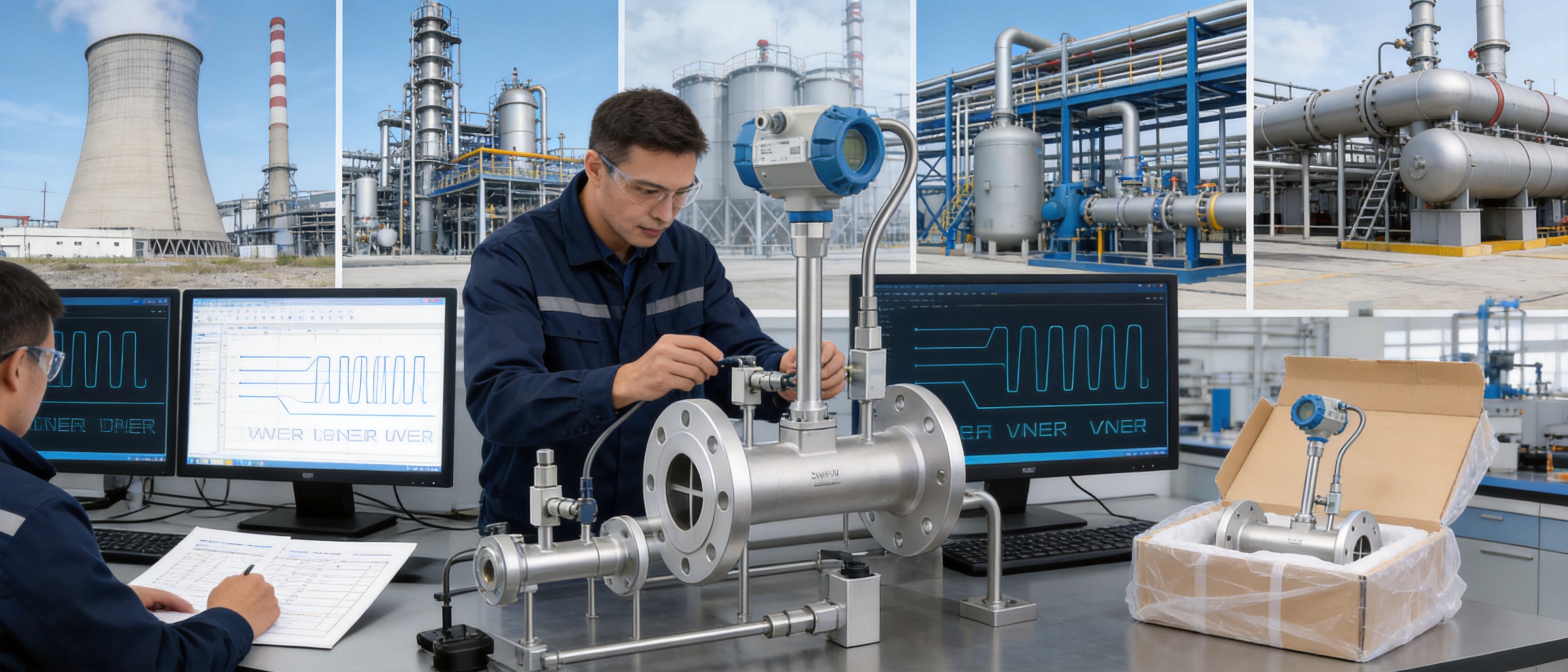
Reliable flow measurement is essential wherever steam, compressed air, natural gas, process gases, or other utility media are used to control production, allocate energy, or determine operating costs. In many industrial systems, measuring volumetric flow alone is not sufficient. Gas density changes with pressure and temperature, while steam properties vary significantly between saturated and superheated conditions. A flowmeter that reports only the volume passing through the pipe can therefore produce a misleading result when process conditions fluctuate.
The SA80T-TP Series Temperature/Pressure Compensation Swirl Flowmeter is designed to address this challenge. It combines the operating principles of a swirl flowmeter with integrated temperature and pressure measurement, allowing the converter to calculate compensated flow values in real time. Depending on the configured application, the instrument can provide operating volumetric flow, mass flow, or standardized volume flow.
This capability makes the SA80T-TP suitable for industrial steam networks, compressed-air systems, process-gas distribution, energy management, boiler monitoring, chemical production, and other applications in which changing operating conditions must be reflected accurately in the measurement result.
Manufactured by Jiangsu Vner Electronic Technology Co., Ltd., the instrument forms part of a broader portfolio of industrial flow measurement technologies. The company develops electromagnetic, Coriolis, vortex, swirl, turbine, thermal mass, ultrasonic, and metal-tube rotameter solutions for liquid, gas, steam, and slurry applications. Its engineering-oriented approach combines product selection, manufacturing, calibration, and application support to provide measurement equipment for demanding industrial environments.
Why Compensation Matters in Industrial Flow Measurement
Industrial flow is often discussed in terms of volume per unit of time. For liquids with relatively stable density, operating volumetric flow can be an adequate process variable. However, gases and steam are compressible media. Their density is strongly affected by pressure and temperature. When either condition changes, the relationship between actual volume and mass changes as well.
For example, a compressed-air line may supply the same mass of air while the operating pressure varies. The air volume measured at the pipe conditions will not remain constant. Similarly, steam flowing from a boiler may change from saturated to superheated conditions, or its pressure may fluctuate as downstream demand changes. A volumetric reading that does not account for these variables may not accurately represent the amount of steam being consumed.
Temperature and pressure compensation helps convert the measured operating flow into a more useful engineering value. The converter receives the flow signal together with temperature and pressure inputs. It then calculates density according to configured media parameters and thermodynamic relationships. The result can be expressed as mass flow, such as kilograms per hour or tonnes per hour, or as standardized volume flow, such as normal cubic metres per hour.
This is important in applications involving:
• Steam consumption measurement and boiler efficiency analysis.
• Compressed-air cost allocation between production departments.
• Natural-gas and process-gas monitoring.
• Fuel-gas control for furnaces and heaters.
• Gas mixing and reactor feed control.
• Energy balance calculations across plants and production lines.
• Commercial or internal billing based on compensated flow.
Without compensation, an operator may interpret a change in density as a change in consumption, or fail to detect a real change in mass flow because the operating volume appears stable. The SA80T-TP is intended to reduce this type of error by continuously incorporating temperature and pressure into the flow calculation.
Operating Principle of the SA80T-TP Series
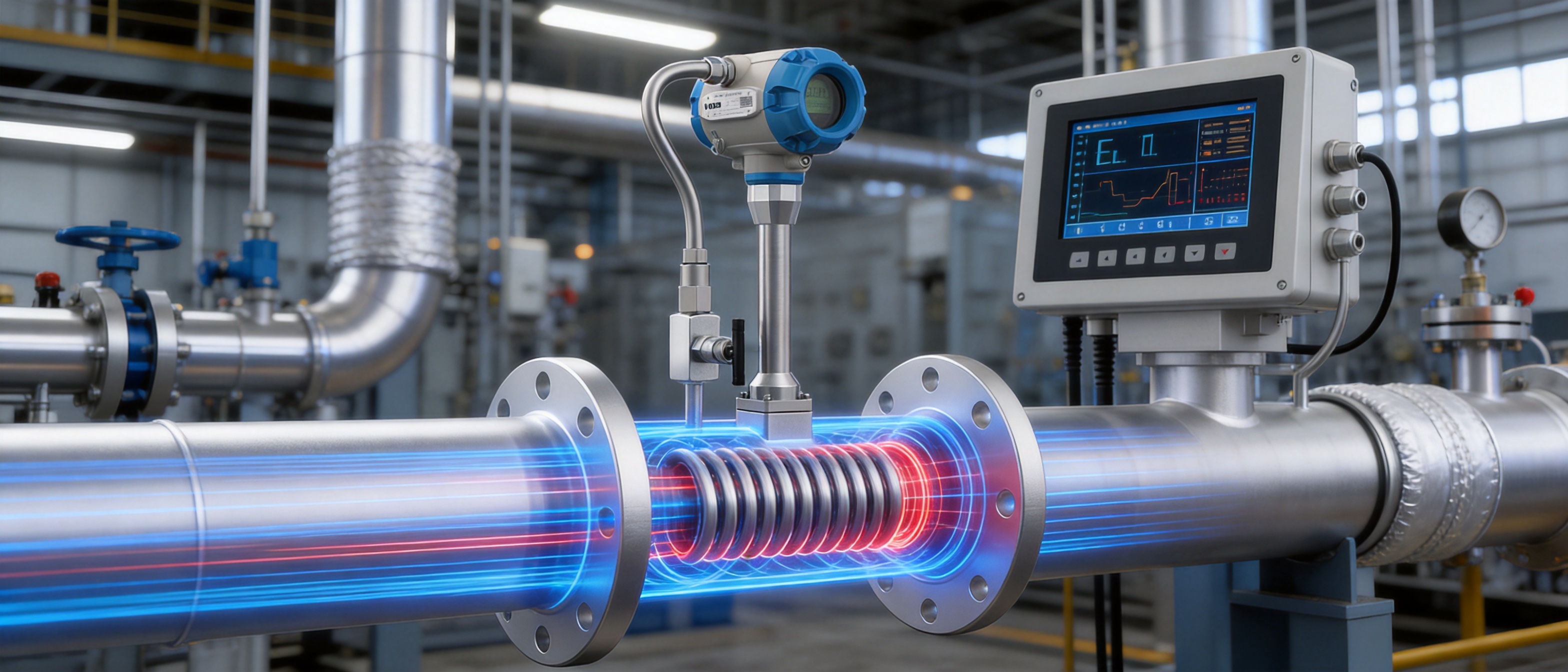
The SA80T-TP is based on the swirl flowmeter principle, also known as vortex precession measurement. A specially designed swirl generator introduces rotational motion into the flowing medium. Downstream of the generator, the fluid forms a stable swirling pattern. As the swirl moves through the measuring tube, pressure fluctuations or flow disturbances associated with the precession are detected by the sensor.
The frequency of the generated signal is related to the flow velocity. Once the internal geometry of the meter and the measured signal are known, the converter can determine the operating volumetric flow. The primary flow measurement is therefore obtained from the relationship between swirl frequency and flow velocity rather than from a moving mechanical element.
The TP version adds temperature and pressure measurement to this basic flow signal. These measurements are used to determine the current density of the medium. For steam, the calculation can be configured according to the relevant pressure and temperature relationship. For gases, the converter can apply the configured gas parameters and operating conditions to calculate mass or standard volume flow.
The measurement sequence can be summarized as follows:
1. The process medium enters the flowmeter and passes through the swirl generator.
2. The generated swirl produces a measurable periodic signal.
3. The sensor detects the signal frequency and the converter calculates operating volumetric flow.
4. Integrated or connected temperature and pressure sensors measure current process conditions.
5. The converter determines density using configured media data and thermodynamic correlations.
6. The instrument outputs compensated mass flow, standardized volume flow, and, where required, the original operating volumetric flow.
This arrangement provides more information than a basic flowmeter that reports only flow velocity or operating volume. It also avoids relying entirely on a separate external compensation system, which can require additional signal wiring, a separate calculation unit, and more complicated integration into the control architecture.
Principal Measurement Outputs
Operating Volumetric Flow
Operating volumetric flow describes the volume passing through the meter at the actual process pressure and temperature. This value can be useful for local process control, equipment loading analysis, and applications where the operating conditions remain relatively stable.
Mass Flow
Mass flow expresses the actual quantity of material moving through the pipeline. It is especially valuable for steam, fuel gas, compressed gases, chemical process gases, and energy calculations. A mass-based result is less affected by changes in operating volume caused by pressure or temperature fluctuations.
For steam systems, mass flow may be used to analyze boiler output, compare production areas, estimate thermal energy consumption, or manage steam distribution. In gas systems, mass flow can support accurate dosing, combustion control, and material balance calculations.
Standardized Volume Flow
Standardized volume flow converts the measured gas flow to a defined reference condition. This is commonly used for compressed air, nitrogen, oxygen, natural gas, and other industrial gases. Since the reference condition is fixed, standardized volume flow allows different measurement points or operating periods to be compared more consistently.
Configuration of the reference condition and media parameters is important. Normalized or standard volume terminology can differ between industries and regions, so the required reference temperature, reference pressure, gas composition, and unit should be confirmed during specification and commissioning.
Advantages of the Temperature and Pressure Compensated Design
More Meaningful Flow Values Under Changing Conditions
The central advantage of the SA80T-TP is its ability to adjust flow calculations as process temperature and pressure change. A standard flowmeter may continue to measure the operating volume correctly, but the operating volume itself may not represent the actual material consumption. The compensated design provides a result that is more useful for production management and energy accounting.
Integrated Measurement Functions
Because the TP version integrates flow, temperature, and pressure measurement in one instrument, system design can be simplified. A separate pressure transmitter, temperature transmitter, and external flow computer may not be necessary for applications within the instrument’s configured measurement scope.
Integration can reduce the number of components installed on the pipeline. It may also reduce cabinet space, signal-conditioning requirements, wiring complexity, and the number of devices that operators must inspect during routine maintenance. The exact installation arrangement still depends on the process, the required accuracy, hazardous-area requirements, and the project instrumentation standard.
Improved Process Control
In steam and gas control loops, density variation can introduce a difference between the indicated flow and the actual material flow. When the control system receives a compensated value, it can respond to the process based on a more relevant variable. This can improve control of steam valves, gas mixers, burners, and reactor feed systems.
For example, a gas mixer may require a stable mass ratio between two gases. If one gas supply pressure changes while the controller uses only operating volume, the mixture ratio may shift. A compensated measurement can help the control system maintain the intended relationship more effectively.
Support for Energy Management
Steam and compressed air are frequently among the largest hidden energy costs in a factory. A compensated flowmeter can support a clearer understanding of how much steam or gas is consumed by each process area. This information can be used to identify leaks, compare equipment efficiency, establish production-based energy indicators, and allocate costs.
For boiler systems, the meter can monitor steam output continuously. When combined with fuel consumption, feedwater data, and other boiler measurements, the resulting information can support efficiency optimization and maintenance planning.
Reduced Dependence on Mechanical Moving Parts
The swirl measurement principle does not depend on a traditional mechanical impeller or turbine rotor in the flow path. This can reduce concerns associated with mechanical wear, bearing degradation, and rotor damage caused by certain operating conditions. It also makes the technology attractive for utility gases and steam where a robust, relatively low-maintenance flow sensor is preferred.
As with all flowmeter technologies, the instrument must be correctly selected and installed. Solid particles, liquid carryover, severe pulsation, excessive vibration, and operation outside the recommended velocity range can affect any flow measurement system. Proper process design remains essential.
One Platform for Several Industrial Media
The SA80T-TP is intended for steam and gases, while the broader swirl flowmeter design can be applied to suitable industrial media. Its compensation functions are particularly useful where media density varies with operating conditions. This versatility allows engineering teams to use a familiar measurement platform across boiler rooms, utility systems, process plants, and energy networks.
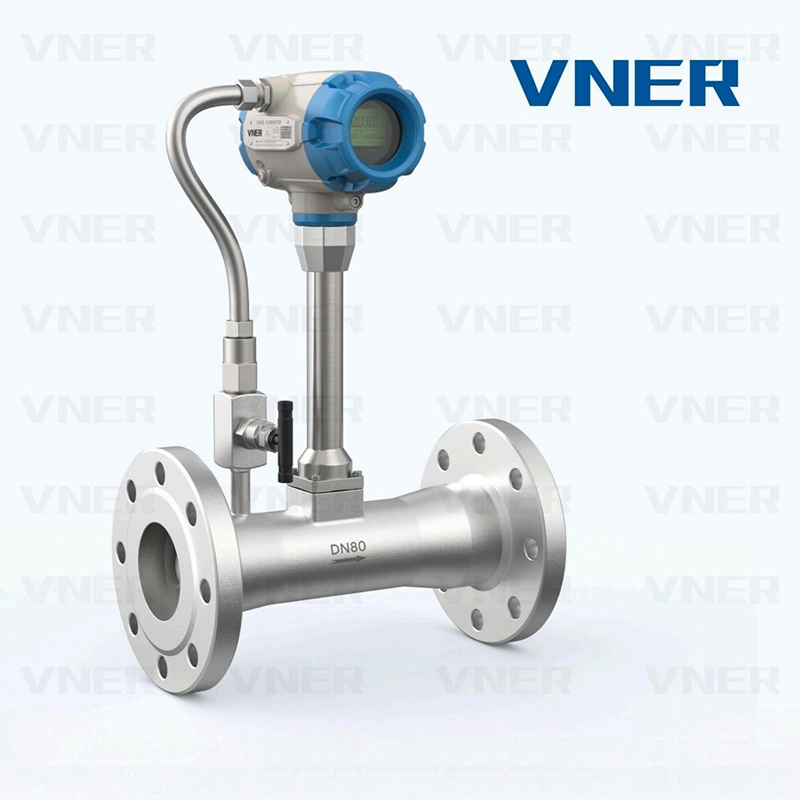
SA80T-TP Series Temperature/Pressure Compensation Swirl Flowmeter-副本
Comparison with Common Competing Flowmeter Technologies
Every flowmeter technology has a suitable operating range. The best choice depends on media properties, pipe size, pressure, temperature, cleanliness, required accuracy, installation conditions, and the desired output. The SA80T-TP should not be viewed as a universal replacement for all technologies. Its advantages are most apparent in steam and gas applications where compensation, robust operation, and integrated calculation are important.
| Technology | Typical Strength | Potential Limitation in Steam or Gas Compensation Applications | Position of the SA80T-TP |
|---|---|---|---|
| Basic swirl or vortex flowmeter | Measures operating volumetric flow with a simple and robust structure | May require external temperature and pressure signals for compensated outputs | Integrates temperature and pressure inputs and performs real-time compensation |
| Mechanical turbine flowmeter | Can provide useful measurement for clean, stable-flow liquids and gases | Moving parts may be affected by wear, contamination, or changing flow conditions | Uses a non-mechanical swirl sensing principle suitable for many utility and process applications |
| Thermal mass flowmeter | Directly measures gas mass-related thermal behavior | Performance can depend on gas composition, contamination, and thermal properties | Uses flow frequency with pressure and temperature compensation based on configured media data |
| Coriolis mass flowmeter | Provides direct mass flow measurement with high capability for many liquids and gases | May involve higher cost, greater weight, and installation constraints in large steam or gas lines | Offers a practical alternative for suitable larger-line steam and gas measurement applications |
| Electromagnetic flowmeter | Excellent for conductive liquids and slurry applications | Not suitable for dry gases, steam, or non-conductive media | Targets gas and steam applications outside the normal electromagnetic operating range |
| Ultrasonic flowmeter | Can provide non-invasive or low-pressure-loss measurement in suitable applications | Performance can be influenced by installation, acoustic conditions, gas composition, or flow profile | Provides an inline swirl-based solution with integrated compensation functions |
Compared with a standard un-compensated swirl flowmeter, the main difference is not simply the sensor structure. It is the value of the output. A standard meter may be entirely adequate when pressure and temperature are stable or when the process only needs actual volumetric flow. The TP model becomes more valuable when the customer needs a mass-based or standardized result during variable operation.
Compared with a turbine meter, the SA80T-TP avoids a rotating impeller in the measurement principle. This can be advantageous where maintenance access is limited or where long-term operation with steam and utility gases is required. Compared with thermal mass technology, the TP design uses measured pressure and temperature together with flow frequency and configured media data rather than depending only on heat transfer behavior. This can be useful when the process engineer requires a broader thermodynamic calculation framework.
Compared with a large Coriolis meter, the swirl solution can offer a more practical installation concept for certain large-diameter steam and gas pipelines. Coriolis technology remains highly capable, particularly when direct mass flow measurement is required for liquids or specialized applications. However, its cost, line size, structural weight, and pressure-drop considerations may make another technology more appropriate for utility distribution networks.
The real competitive advantage of the SA80T-TP is therefore application-based: it combines a robust swirl flow measurement method with real-time temperature and pressure compensation in a platform intended for industrial steam and gas systems.
Steam Measurement Applications
Saturated Steam
Saturated steam systems are common in process heating, sterilization, food production, textile operations, chemical plants, and district utility networks. In these systems, pressure and temperature are closely related when the steam is in a saturated state. Measuring both values helps the converter determine the steam condition and calculate a meaningful flow output.
Accurate saturated steam measurement can support boiler output monitoring, distribution balancing, production cost allocation, and equipment performance analysis. It can also help identify abnormal conditions, such as unexpected pressure loss, excessive condensation, or inconsistent steam supply.
Superheated Steam
Superheated steam is used in power generation, turbine systems, chemical processing, drying, and high-temperature industrial operations. Unlike saturated steam, superheated steam has a temperature above the saturation temperature at the corresponding pressure. Both pressure and temperature are therefore important to the density calculation.
The SA80T-TP can be configured for applications requiring compensated measurement of superheated steam, subject to the operating range of the installed sensors and the specified process conditions. The engineering team should confirm pressure, temperature, pipe size, velocity, steam quality, installation arrangement, and required output units before selection.
Boiler Efficiency Optimization
Continuous steam flow monitoring can be combined with fuel, feedwater, and combustion data to evaluate boiler performance. If steam output decreases while fuel input remains high, the plant may need to investigate burner performance, heat-transfer fouling, insulation, blowdown, or steam leakage. A reliable compensated flow signal provides a valuable part of this analysis.
In multi-boiler systems, individual flowmeters can help compare units and manage load distribution. In production plants, branch-line meters can show which departments consume the most steam and whether improvements in insulation, condensate recovery, or process scheduling are producing measurable benefits.
Steam Injection
Steam injection is used in enhanced oil recovery, chemical processing, humidification, and selected thermal treatment processes. The quantity of injected steam can influence reservoir performance, reaction conditions, or product quality. A compensated flow result helps operators control injection rates more consistently when supply pressure and temperature vary.
Compressed Air and Gas Applications
Compressed-Air Networks
Compressed air is often generated centrally and distributed through a large plant network. The air may be consumed by pneumatic tools, actuators, packaging equipment, instrumentation, and production machinery. Since the pressure can vary across the system, measuring only actual volume may make comparison between areas difficult.
Standardized volume flow provides a common basis for monitoring consumption. By installing meters at the compressor outlet, major branches, and production areas, the plant can compare generated air with end-use consumption. Large differences may indicate leakage, unmetered use, or measurement problems.
The SA80T-TP can support compressed-air management by combining flow measurement with pressure and temperature data. This is particularly useful when the network operates under changing demand or when different departments need transparent energy allocation.
Natural Gas and Fuel Gas
Natural gas and fuel gas systems require dependable measurement for combustion control, production accounting, and cost management. The mass or standardized volume of gas entering a furnace, boiler, heater, or engine can affect operating efficiency and emissions.
When supply pressure changes, the actual gas volume in the line does not provide a complete indication of the energy input. A compensated flow output can provide a better process variable for fuel management, provided that the gas composition and calculation parameters are properly defined.
Process Gases
Nitrogen, oxygen, hydrogen, carbon dioxide, and other gases are used in chemical reactors, inerting systems, semiconductor manufacturing, metal processing, food and beverage production, and pharmaceutical facilities. Their flow may need to be measured by mass or standardized volume, especially when a precise ratio between gases is required.
In a reactor, inaccurate gas dosing can affect stoichiometric balance, yield, reaction stability, and safety. In an inerting system, insufficient nitrogen flow may fail to maintain the required atmosphere. In a beverage line, carbon dioxide dosing can influence carbonation and product consistency. A compensated flow signal can support these processes more effectively than an uncorrected operating-volume value.
Industry-Specific Benefits
Power Generation
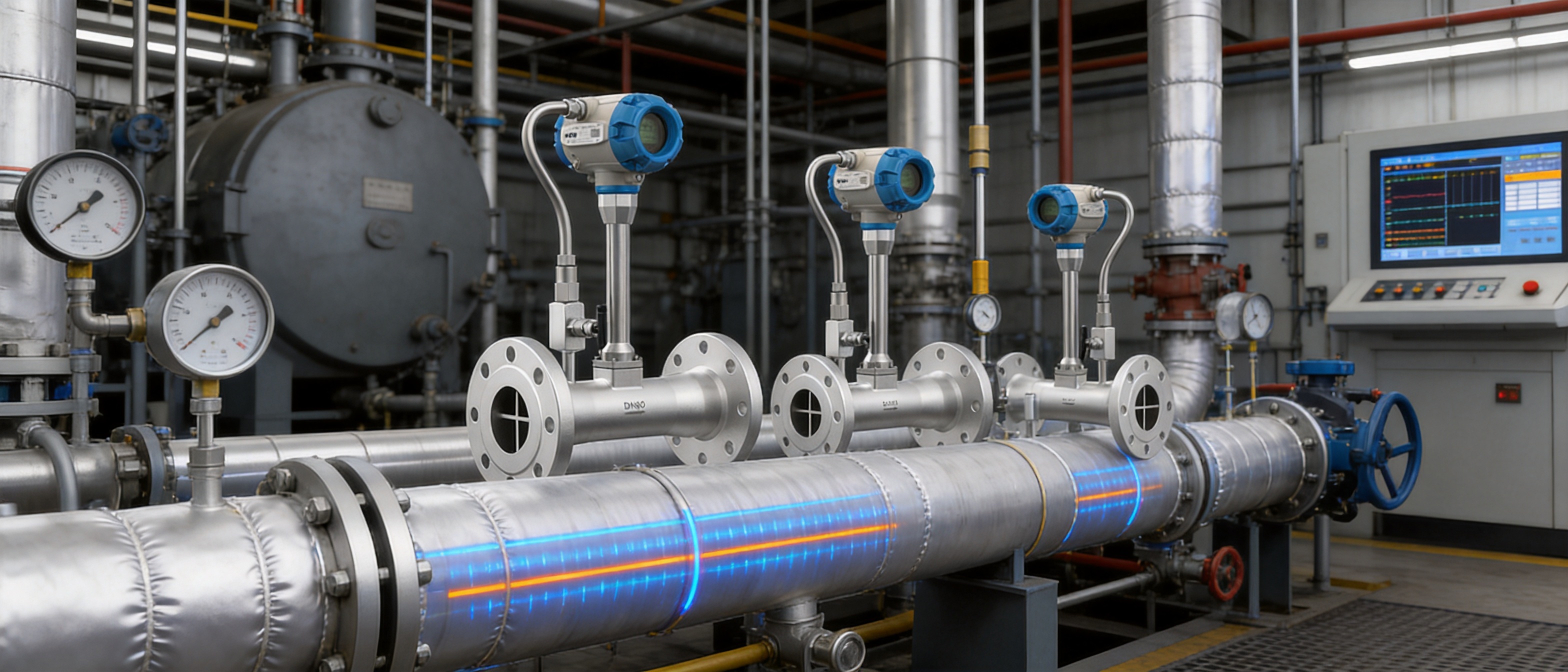
Power plants and industrial energy centers use flowmeters to monitor boiler steam, auxiliary steam, compressed air, fuel gas, cooling water, and other utilities. The SA80T-TP is particularly relevant to steam and gas measurement points where pressure and temperature are variable.
In boiler output lines, compensated steam flow can be used for load monitoring and energy balance. In turbine-related systems, reliable utility measurement supports performance analysis and maintenance decisions. In fuel systems, compensated gas flow can assist combustion control and consumption reporting.
Chemical and Petrochemical Processing
Chemical plants often operate with multiple gases, vapors, and utility streams. Process conditions may change quickly during batch transitions, production-rate adjustments, or start-up and shutdown. A temperature- and pressure-compensated flowmeter can provide a more stable basis for process control and material balance calculations.
Applications may include compressed air, nitrogen blanketing, natural gas, hydrogen, oxygen, process vapor, and steam. The instrument can also contribute to accurate utility allocation between production units and help engineers identify abnormal consumption.
Oil and Gas
Steam injection, fuel gas monitoring, process heating, and utility distribution are common measurement requirements in oil and gas facilities. Steam injection rates can affect enhanced oil recovery performance, while fuel gas measurement is important for heaters, furnaces, and power-generation equipment.
Because oil and gas facilities often operate under demanding pressure and temperature conditions, careful instrument selection is necessary. Materials, pressure rating, hazardous-area certification, process connection, sensor range, and communication requirements should be reviewed before purchase.
Pharmaceutical Manufacturing
Pharmaceutical facilities use clean steam for sterilization, cleaning, and SIP operations. They also use compressed gases, nitrogen, purified water, and other utilities. Measurement equipment may need to support strict documentation, traceability, hygienic design, and repeatable performance.
The SA80T-TP can be considered for suitable utility-side steam or gas applications. The final design should distinguish between general plant utilities and validated hygienic process lines. Surface finish, materials, cleaning requirements, installation standards, and validation documentation must be confirmed for each project.
Food and Beverage
Food and beverage plants use steam for cooking, heating, pasteurization, cleaning, and sterilization. Carbon dioxide and compressed air may be used in packaging and beverage production. Monitoring these streams can improve production consistency and energy management.
Compensated measurement is useful when gas pressure changes during peak demand or when steam consumption is compared across different production shifts. For food-contact or hygienic applications, the meter configuration and installation materials should be selected according to the relevant plant requirements.
Pulp and Paper
Pulp and paper facilities use large quantities of steam for drying and process heating. They may also measure black liquor, white liquor, condensate, compressed air, and process gases. Steam flow measurement is important for dryer performance, production scheduling, and energy efficiency.
The broader VNER product range includes technologies for liquid and slurry measurement, while the SA80T-TP is focused on suitable steam and gas services. This portfolio approach can help a plant standardize its instrument supply while selecting the appropriate principle for each medium.
Textile, Steel, and Metallurgy
Textile plants may measure process steam, compressed air, process water, and dye liquors. Steel and metallurgical plants may require cooling-water measurement, furnace-gas monitoring, shielding-gas measurement, and high-temperature steam measurement.
These facilities often contain pulsating loads, large utility networks, elevated temperatures, and difficult access. A robust industrial flowmeter with integrated compensation can simplify the measurement architecture at selected points and provide operators with more useful data for production control.
Engineering and Installation Considerations
Process Conditions
Correct sizing begins with complete process information. The engineering team should obtain the medium name, minimum and maximum flow, normal flow, operating pressure, operating temperature, pipe size, required accuracy, expected density, viscosity where relevant, and the desired output unit.
For gases, gas composition or relative density may be required. For steam, the engineer should identify whether the application involves saturated or superheated steam and whether wet steam or condensate carryover is possible. The sensor range must cover the complete expected pressure and temperature envelope without sacrificing resolution during normal operation.
Pipeline Installation
As with other inline flowmeters, the pipeline should be designed to provide a suitable flow profile. Straight pipe requirements, upstream disturbances, valves, reducers, elbows, tees, pumps, compressors, and partially closed control valves can influence the flow pattern. The exact straight-run requirement depends on the meter design and the installation conditions.
The flowmeter should be installed in a location where the pipe remains full and where maintenance personnel can access the converter and sensor. Sudden condensation, liquid accumulation, excessive vibration, and strong mechanical stress from unsupported piping should be avoided.
Steam Installation
Steam applications require special attention to condensate. The piping arrangement should prevent water pockets from collecting around the meter. Drainage, insulation, orientation, and upstream steam quality all affect performance. A steam meter should not be installed simply by replacing an existing liquid or gas meter without reviewing the complete piping system.
For superheated steam, heat loss and temperature sensor placement should be considered. For saturated steam, the relationship between pressure and temperature should be checked during commissioning. Unexpected disagreement between pressure and temperature may indicate wet steam, sensor problems, heat loss, or an incorrect configuration.
Gas Installation
Gas measurement systems should be protected from liquid carryover, excessive dust, and contamination when these conditions are present. Filters, separators, drains, or other upstream equipment may be required. The effect of gas composition on density calculation should also be reviewed, particularly for mixed gases, natural gas, biogas, or process gases whose composition changes over time.
Configuration and Commissioning
The converter must be configured with the correct medium parameters, engineering units, reference conditions, sensor ranges, and output requirements. Commissioning should include verification of the pressure and temperature signals, confirmation of the flow direction, inspection for zero or abnormal readings, and comparison with an independent process value where possible.
For energy or billing applications, configuration records and calibration documentation should be retained. Changes to gas properties, reference conditions, or calculation parameters should be controlled and documented.
Manufacturing Strengths of Jiangsu Vner Electronic Technology Co., Ltd.
The performance of an industrial flowmeter depends on more than the sensing principle. Mechanical accuracy, electronics quality, calibration, assembly consistency, software configuration, material traceability, and application engineering all influence the final result. Jiangsu Vner Electronic Technology Co., Ltd. has developed its manufacturing and engineering capabilities around these requirements.
The company was established in 2011 and is based in Yangzhou, China. It operates modern facilities covering approximately 23,000 square metres across three plants and has a technical team of more than 150 people. Its product portfolio covers multiple flow measurement principles, including electromagnetic, Coriolis, vortex, swirl, turbine, thermal mass, ultrasonic, and metal-tube rotameter technologies.
Multi-Technology Engineering Capability
Many industrial projects include different media and operating conditions within the same plant. A wastewater line may require electromagnetic measurement, a compressed-air header may require gas flow measurement, a chemical dosing line may require Coriolis measurement, and a boiler outlet may require compensated steam measurement.
Because VNER develops several flowmeter families, its engineers can compare technologies according to the application instead of forcing every service into one product category. This helps customers select the most appropriate measurement principle for liquids, gases, steam, or slurry.
In-House Calibration
Calibration is a key part of flowmeter manufacturing. A meter must be tested against a known reference to confirm that the sensor, signal processing, and converter produce a consistent result. In-house calibration allows the manufacturer to control testing procedures, record results, and identify deviations before shipment.
For the SA80T-TP, calibration and verification should cover the flow signal and the associated temperature and pressure measurement functions within the specified product configuration. The final certificate and test records support traceability and provide useful documentation for customers’ quality systems.
Engineering-Driven Sizing and Selection
An incorrectly sized flowmeter can create avoidable problems. If the operating velocity is too low, signal stability may be affected. If the velocity is too high, pressure loss, noise, erosion, or sensor stress may become concerns. A meter that is selected without considering the full flow range may perform poorly during low-load or peak-load operation.
VNER’s engineering approach emphasizes sizing and selection based on actual process conditions. Customers and EPC contractors can provide application data for review before the instrument is specified. This is particularly important for compensated steam and gas applications, where density, pressure, temperature, and standardization parameters must be considered together.
Quality Process and Traceability
Industrial users require repeatable products, not only individual instruments that perform well during a factory test. Consistent component sourcing, controlled assembly, inspection procedures, configuration records, and traceability help reduce variation between production batches.
VNER states that its manufacturing system focuses on certified quality processes, product consistency, traceability, and long-term reliability. These priorities are relevant to engineering projects in which multiple meters must be installed across a plant or delivered as part of a standardized equipment package.
Automated and Organized Manufacturing
Increasing automation can improve repeatability in production, reduce manual variation, and support higher manufacturing efficiency. Automation does not replace engineering judgment, but it can make routine assembly and inspection steps more consistent. Combined with technical supervision and testing, organized manufacturing supports stable product quality as production volume increases.
International Project Experience
VNER has supplied flow measurement solutions for more than 2,000 engineering projects in over 30 countries. Its customers and project partners include EPC contractors, industrial end users, and OEM organizations. Experience across oil and gas, petrochemical, polysilicon, power, water and wastewater, and other industries exposes the engineering team to diverse process conditions and project standards.
International project experience is valuable because flowmeter requirements vary by region and industry. Customers may require different flange standards, electrical interfaces, communication protocols, certificates, documentation packages, units, and inspection procedures. A manufacturer accustomed to project-based supply is better positioned to manage these requirements than a supplier focused only on catalogue sales.
Product Value for EPC Contractors and OEMs
EPC contractors need instruments that can be selected, documented, purchased, inspected, and commissioned within a larger project schedule. The SA80T-TP can be integrated into steam and gas measurement packages where compensated flow is required. Early technical review helps clarify process data, instrumentation interfaces, installation constraints, and documentation requirements.
OEMs may use compensated swirl flowmeters in boiler skids, steam distribution modules, gas supply packages, thermal systems, or process equipment. The ability to provide mass flow and standardized volume flow from one converter can make the instrument easier to integrate into an equipment control panel or supervisory system.
For end users, the main benefit is operational information. The meter can provide a measurement related to actual material movement rather than only the volume at a changing process condition. This supports production management, maintenance planning, energy analysis, and cost control.
Maintenance and Long-Term Operation
A good maintenance program begins with correct installation and configuration. Operators should periodically inspect process connections, wiring, grounding where applicable, sensor condition, pressure taps, temperature sensing points, and the display or control-system signal. Steam systems should be checked for condensate-related problems, insulation damage, and abnormal vibration.
Trend monitoring is also valuable. A sudden change in indicated flow, pressure, or temperature may be caused by a process event, sensor drift, line blockage, valve movement, gas-composition change, or an instrument issue. Reviewing all related variables together is more effective than examining the flow value alone.
Calibration intervals should be established according to the importance of the measurement, process conditions, regulatory requirements, and the customer’s quality management system. Critical energy or custody-related measurements may require more frequent verification than general utility monitoring.
Since the SA80T-TP includes multiple measurement inputs, maintenance personnel should verify each function independently. A correct flow signal with an incorrect pressure range can still produce an incorrect compensated result. Similarly, an incorrectly configured reference condition can make a standardized gas-flow value appear inconsistent even when the primary flow measurement is operating properly.
How to Select the Right Configuration
When selecting the SA80T-TP, customers should prepare a complete technical data sheet. The following information is especially important:
• Process medium and composition.
• Minimum, normal, and maximum flow.
• Operating pressure and pressure variation.
• Operating temperature and temperature variation.
• Saturated or superheated steam condition, if applicable.
• Nominal pipe size and process connection standard.
• Required mass-flow or standard-volume units.
• Gas reference temperature and pressure, if standardized output is required.
• Required signal outputs and communication interface.
• Environmental conditions and enclosure requirements.
• Hazardous-area or special certification requirements.
• Required material, inspection, calibration, and documentation standards.
Providing complete data at the beginning reduces the risk of an unsuitable size, incorrect density calculation, insufficient sensor range, or incompatible installation. VNER’s engineering team can use this information to evaluate the application and recommend an appropriate configuration.
Frequently Asked Questions
What is the main difference between the SA80T-TP and a standard swirl flowmeter?
The SA80T-TP includes temperature and pressure measurement for real-time compensation. A standard swirl flowmeter primarily measures operating volumetric flow. The TP version can additionally calculate mass flow and standardized volume flow when the appropriate process parameters are configured.
Can the instrument measure both saturated and superheated steam?
It is designed for suitable saturated and superheated steam applications. The final suitability depends on the pressure, temperature, flow range, sensor limits, installation arrangement, steam quality, and required calculation method. These details should be reviewed during technical selection.
Why is pressure compensation important for compressed air?
Compressed-air density changes when pressure changes. A fixed volume at one pressure does not contain the same mass of air as the same volume at another pressure. Pressure compensation helps convert the operating measurement into a standardized volume or mass-related value that can be compared more consistently.
Can it output normal or standard cubic metres per hour?
Yes, the TP model is intended to provide standardized volumetric flow such as Nm³/h when the reference conditions and gas parameters are correctly configured. The customer should specify the required reference temperature, reference pressure, gas composition, and unit convention.
Does the product provide operating volumetric flow as well?
Yes. In addition to compensated outputs, the converter can provide conventional operating volumetric flow. This allows users to review both the actual process volume and the calculated mass or standardized volume value.
Is the SA80T-TP suitable for liquid measurement?
The product is primarily described for steam, compressed gases, and energy metering applications. The broader product range includes flowmeters for liquids, but the correct technology depends on conductivity, viscosity, density, solids content, pressure, temperature, and flow range. A liquid application should be evaluated separately rather than assumed to be suitable for the TP configuration.
How does it compare with a Coriolis mass flowmeter?
A Coriolis meter directly measures mass flow and is highly capable in many applications. However, it can be more expensive, heavier, and less practical in some large-diameter steam or gas lines. The SA80T-TP offers a swirl-based alternative with temperature and pressure compensation for suitable industrial services. The final choice should be based on accuracy, line size, pressure drop, budget, installation, and process requirements.
How does it compare with a thermal mass flowmeter?
A thermal mass meter determines gas flow from heat-transfer behavior and may be sensitive to gas composition or contamination. The SA80T-TP calculates compensated flow using swirl frequency together with measured pressure, measured temperature, and configured media parameters. Each principle has advantages, so the choice should reflect gas composition, operating range, maintenance conditions, and the required output.
What information is needed for quotation and sizing?
The supplier should receive the medium, flow range, pressure, temperature, pipe size, process connection, density or gas composition, required output, and installation conditions. For steam, the supplier should know whether the service is saturated or superheated. For gas, reference conditions and standardization requirements should be stated.
Can the instrument be used in an energy management system?
Yes. Compensated steam, gas, or compressed-air values can be transmitted to a control system, data logger, or energy management platform, subject to the available output and communication configuration. The instrument can support energy balance, consumption monitoring, cost allocation, and efficiency analysis.
What role does the manufacturer play after delivery?
Application review, correct configuration, calibration documentation, installation guidance, and technical support are all important after delivery. Jiangsu Vner Electronic Technology Co., Ltd. supports EPC contractors, end users, and OEM partners with engineering-driven selection and industrial flow measurement experience.
What are the main causes of inaccurate compensated results?
Common causes include incorrect medium parameters, wrong reference conditions, pressure or temperature sensor range errors, poor installation, condensate in steam lines, gas-composition changes, flow outside the specified range, and unaccounted process disturbances. Checking the primary flow, pressure, temperature, and configuration together is essential.
Conclusion
The SA80T-TP Series Temperature/Pressure Compensation Swirl Flowmeter is designed for industrial users who need more than a basic operating-volume indication. By combining swirl flow measurement with temperature and pressure inputs, it provides a practical way to calculate mass flow and standardized volume flow for steam and gas applications.
Its advantages are especially relevant in systems with changing pressure and temperature, including boiler networks, compressed-air systems, fuel-gas lines, chemical reactors, energy distribution systems, and process utilities. The instrument can help improve control accuracy, strengthen energy accounting, simplify instrumentation architecture, and provide more meaningful flow information for plant operators.
Its competitive position comes from the combination of a robust non-mechanical swirl sensing principle, integrated compensation, flexible output values, and suitability for industrial steam and gas measurement. It is not intended to replace every flowmeter technology; rather, it provides a strong alternative where compensated volumetric measurement is required without the cost or installation complexity that may accompany some direct mass-flow technologies.
The product is supported by Jiangsu Vner Electronic Technology Co., Ltd., a specialized industrial flowmeter manufacturer with a multi-technology portfolio, in-house calibration capability, modern manufacturing facilities, an experienced technical team, international project experience, and a focus on repeatable quality and traceability. Through appropriate sizing, configuration, installation, and maintenance, the SA80T-TP can become an important measurement point in an industrial control and energy management strategy.
References
1. International Organization for Standardization. Measurement of fluid flow in closed conduits: General principles and flow measurement practice.
2. International Organization for Standardization. Measurement of fluid flow by means of pressure differential devices and industrial flowmeter installation guidance.
3. International Association for the Properties of Water and Steam. Industrial formulations and thermodynamic property references for water and steam.
4. American Society of Mechanical Engineers. Industrial steam and gas measurement practices for process instrumentation.
5. International Society of Automation. Process measurement and control principles for industrial flow applications.
6. Engineering documentation and product information for temperature- and pressure-compensated swirl flow measurement.
7. Jiangsu Vner Electronic Technology Co., Ltd. Product portfolio and manufacturing information for industrial flow measurement instruments.
Product: SA80T-TP Series Temperature/Pressure Compensation Swirl Flowmeter-副本


We offer all our products and services at international standards.
Products
Contact Information
-

+86-18652789521
+86-18052582295
+86-0514-83633600 / 83633900 -

+86-0514-83633600 / 83633900
-

shawn@vnerflow.com
info@vnerflow.com -

No. 11 Xingye Road, Chenji Town Industrial Park, Yizheng, Yangzhou, China
